Bank accounts make everyday money management easier, but fees can quietly reduce your balance if you don’t know what you’re being charged for. A monthly maintenance fee, overdraft charge, ATM fee, or insufficient-funds fee may seem small individually, but repeated charges can add up to hundreds of dollars over time.
The good news is that many common bank account fees can be avoided by choosing the right account, understanding the account’s fee schedule, maintaining the required balance, and paying attention to how you use your account.
This guide explains how to avoid common bank account fees, what the most common charges mean, and what you should check before opening or keeping a bank account.
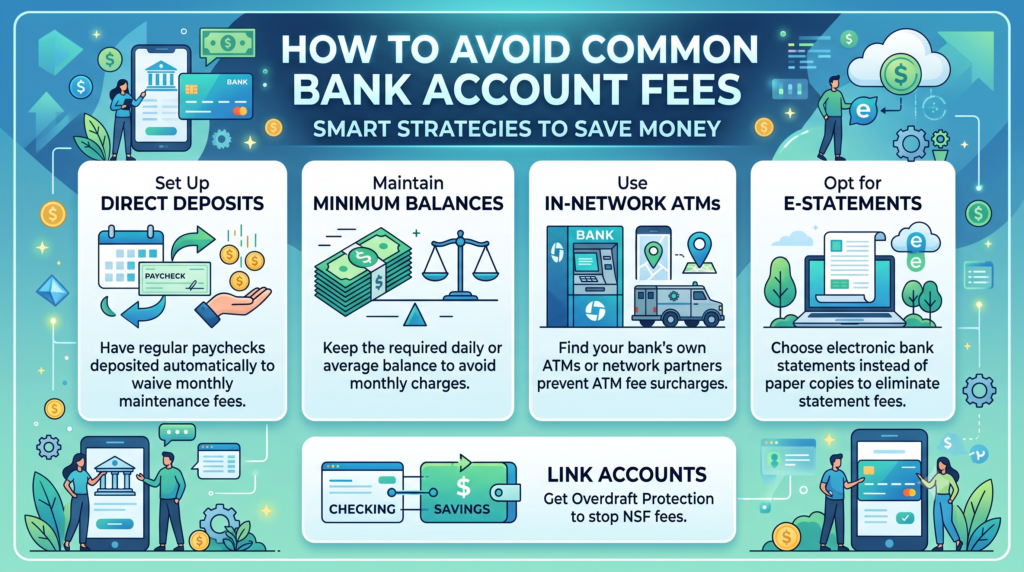
What Are Bank Account Fees?
Bank account fees are charges a bank or credit union may impose for providing certain services or when specific account conditions occur.
Some fees are predictable, such as a monthly maintenance fee. Others happen because of a particular transaction or situation, such as using an out-of-network ATM or overdrawing an account.
Common fees include:
- Monthly maintenance fees
- Overdraft fees
- Insufficient-funds fees
- Out-of-network ATM fees
- Excessive transaction fees on certain account types
- Wire transfer fees
- Foreign transaction fees
- Paper statement fees
- Stop-payment fees
- Account closure or early-closure fees
Not every financial institution charges all of these fees, and some accounts have few or no routine fees.
The important lesson is that the cheapest-looking account isn’t necessarily the best account. You need to compare the complete fee structure and determine whether the account fits your normal banking habits.
1. Avoid Monthly Maintenance Fees
A monthly maintenance fee is one of the most common charges associated with checking and savings accounts.
For example, a bank might charge $10, $12, or $15 per month unless you meet certain requirements.
A $12 monthly fee may not sound significant, but over one year it equals:
$12 × 12 = $144
If you can avoid that fee simply by meeting an account requirement, doing so can make a meaningful difference.
How to avoid monthly fees
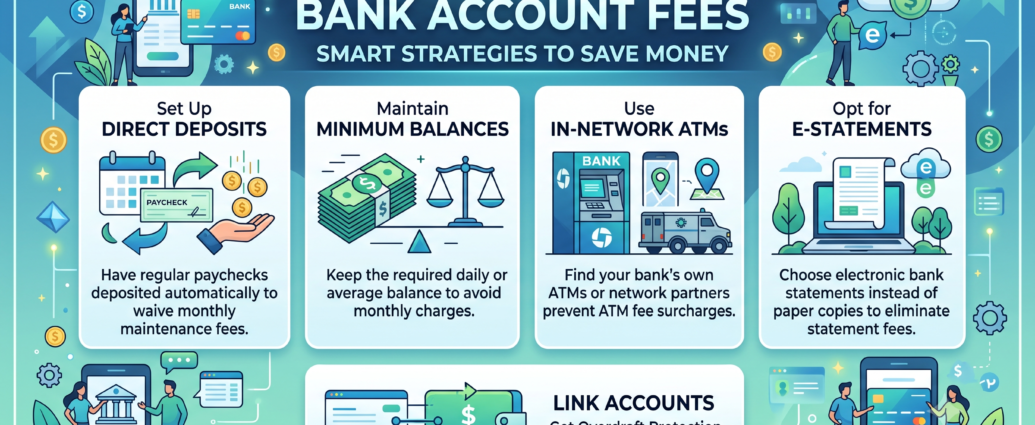
Banks commonly waive monthly maintenance fees when customers meet conditions such as:
- Maintaining a minimum balance
- Receiving qualifying direct deposits
- Meeting age requirements
- Maintaining multiple accounts with the same institution
- Enrolling in specific banking programs
Before opening an account, read the fee schedule carefully and determine exactly how the waiver works.
Don’t assume that having money in the account automatically eliminates the fee. Some institutions use an average daily balance, while others may require a specific minimum balance on certain days.
Choose an account with no monthly fee
If you don’t want to monitor balance requirements every month, a no-monthly-fee account may be simpler.
This can be particularly useful if your income varies or your account balance regularly fluctuates.
The CFPB provides consumer guidance on comparing bank account fees and understanding how fees can affect your finances. (consumerfinance.gov)
2. Avoid Overdraft Fees
An overdraft can occur when you attempt to make a payment or withdrawal that exceeds the available funds in your account, depending on the account’s terms and the transaction involved.
For example, suppose your available balance is $80 and a $120 payment is processed.
Depending on the bank’s policies and the type of transaction, the payment could be declined or another outcome could occur, potentially resulting in a fee.
How to reduce your overdraft risk
Keep track of:
- Current account balance
- Pending transactions
- Automatic payments
- Checks that haven’t cleared
- Debit-card purchases
- Scheduled transfers
Your available balance may not always tell the entire story if transactions are still pending.
Consider overdraft protection carefully
Some banks offer overdraft protection services that transfer money from another account or line of credit when your checking account doesn’t have enough funds.
These services can help in some situations, but they may also involve fees or interest.
Don’t automatically enroll in a protection product without understanding its cost and terms.
3. Avoid Insufficient-Funds Fees
An insufficient-funds situation occurs when there isn’t enough money available to cover a transaction and the bank returns or declines it, depending on the circumstances.
This can happen with:
- Automatic bill payments
- Checks
- Electronic transfers
- Recurring subscriptions
- Other transactions
The simplest way to reduce this risk is to maintain a buffer in your checking account.
Create a checking-account buffer
Instead of budgeting your account balance down to the last dollar, you might keep an additional amount that you don’t normally spend.
For example, if your normal monthly expenses are $2,500, you might decide to maintain an extra $300–$500 buffer if your finances allow it.
The appropriate buffer depends on your income and expenses.
The goal isn’t to keep unnecessary cash idle. It’s to reduce the chance that a forgotten transaction pushes your account below zero.
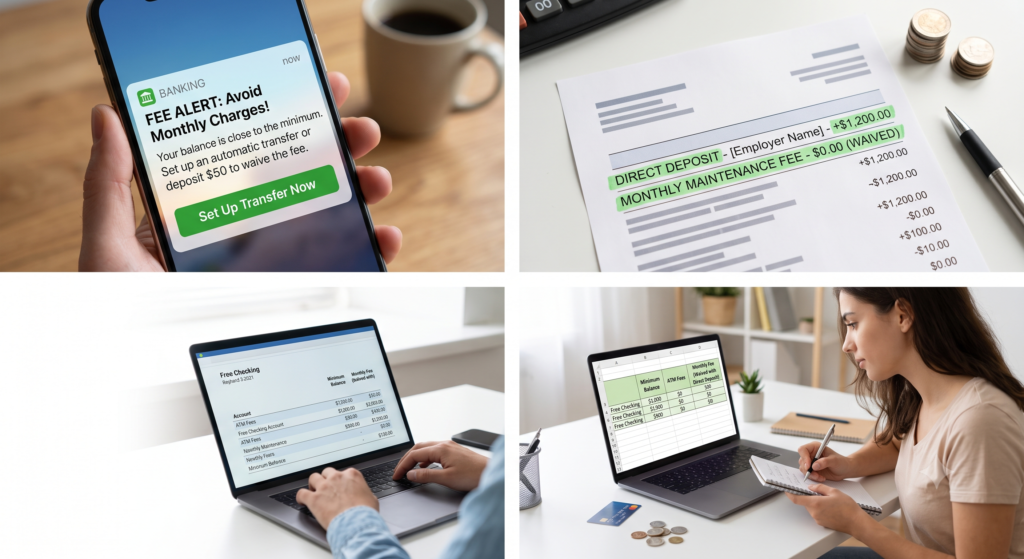
4. Avoid Out-of-Network ATM Fees
ATM fees can come from more than one source.
You may encounter:
- A fee from the ATM operator
- A fee from your own bank for using an out-of-network ATM
For example, you might withdraw $40 but pay several dollars in combined fees.
That means you’re paying a significant percentage of the withdrawal amount simply to access your own money.
How to avoid ATM fees
Use:
- Your bank’s ATM network
- Your credit union’s shared network, when applicable
- ATMs identified as fee-free by your financial institution
- Cash-back options at participating retailers when appropriate
Some banks also reimburse certain ATM fees.
Before relying on reimbursement, check:
- Monthly reimbursement limits
- Eligible ATM fees
- Geographic restrictions
- Account requirements
5. Avoid Wire Transfer Fees
Wire transfers can be useful for sending larger amounts of money quickly, but they can involve fees.
Banks may charge different amounts for:
- Domestic incoming wires
- Domestic outgoing wires
- International incoming wires
- International outgoing wires
If you regularly transfer money, compare the cost before choosing the method.
Consider whether a wire is necessary
Depending on the situation, alternatives such as ACH transfers may be less expensive.
However, ACH transfers and wires aren’t interchangeable in every situation. They can differ in speed, availability, limits, and how transactions are processed.
Don’t choose a transfer method solely because it has the lowest fee. Consider the urgency and requirements of the payment.
6. Watch Out for Paper Statement Fees
Some financial institutions charge customers for receiving paper statements.
If you don’t need physical statements, switching to electronic statements may eliminate the fee.
However, digital statements should not mean ignoring your account.
Review your electronic statements regularly for:
- Unexpected charges
- Subscription payments
- Bank fees
- Unauthorized transactions
- Changes to interest rates or account terms
Going paperless can save money while also making it easier to organize financial records.
7. Understand Foreign Transaction Fees
If you travel internationally or make purchases from merchants outside your country, foreign transaction fees can become an unexpected expense.
Some bank cards and financial products charge a percentage of the transaction amount.
For example, a 3% fee on $2,000 of purchases would equal:
$2,000 × 3% = $60
If you travel frequently, look for an account or card that doesn’t charge foreign transaction fees, assuming its other terms meet your needs.
Also remember that foreign transaction fees and ATM fees are different. A card may have no foreign transaction fee but still charge an ATM withdrawal fee.
8. Read the Fee Schedule Before Opening an Account
One of the most effective ways to avoid bank fees is to research the account before opening it.
Don’t rely solely on an advertisement saying:
“Free checking.”
Find the actual account disclosures and fee schedule.
Look for:
- Monthly maintenance fee
- Minimum opening deposit
- Minimum balance requirement
- Overdraft fees
- ATM fees
- Wire transfer fees
- Foreign transaction fees
- Stop-payment fees
- Paper statement fees
- Early account closure fees
Ask one simple question
Before opening an account, ask:
“Under what circumstances will I actually pay a fee?”
Then identify whether those circumstances are likely to happen based on your normal banking behavior.
9. Don’t Choose an Account Based Only on the APY
A high interest rate can be attractive, especially for savings accounts.
But APY isn’t the only factor.
Suppose Account A offers a slightly higher APY but charges a monthly fee unless you maintain a large minimum balance.
Account B offers a slightly lower APY with no monthly fee.
For a smaller balance, Account B could potentially be the better choice.
Compare the net benefit
Think about:
Interest earned − account fees = net benefit
For example, suppose you earn $100 in interest but pay $60 in annual account fees.
Your net benefit is only:
$100 − $60 = $40
This is why comparing the entire fee structure is more useful than looking at the advertised APY alone.
10. Keep Track of Automatic Payments
Automatic payments are convenient, but they can also create avoidable fees.
Imagine you have:
- Rent
- Utilities
- Streaming subscriptions
- Insurance
- Loan payments
- Credit-card payments
All scheduled during the same week.
If your account balance is usually low, several automatic payments arriving together can create a cash-flow problem.
Create an automatic-payment calendar
Record:
- Payment name
- Amount
- Due date
- Account used
- Frequency
Then compare the calendar with your expected income dates.
If your income is irregular, maintaining a larger checking-account buffer may be especially useful.
11. Monitor Your Account Regularly
You don’t need to check your bank account every hour.
But reviewing it regularly can help you catch problems before they become expensive.
Look for:
- Unexpected fees
- Duplicate transactions
- Unrecognized purchases
- Subscription renewals
- Pending payments
- Changes in account terms
- Unusual withdrawals
If you notice an unfamiliar transaction, contact your financial institution promptly and follow its fraud-reporting process.
12. Ask the Bank to Waive a Fee
If you’ve been charged a fee, don’t automatically assume it is final.
If the charge resulted from an unusual mistake or a one-time situation, contact the bank and ask whether the fee can be waived.
For example:
“This is the first time I’ve incurred this fee. Would you be able to waive it as a courtesy?”
There is no guarantee the bank will agree, but asking costs nothing.
Don’t build your financial plan around fee waivers, though. A bank may waive one fee and refuse the next.
The better strategy is to prevent the fee from occurring repeatedly.
13. Choose a Bank Based on Your Actual Habits
The best bank account isn’t necessarily the one with the highest advertised APY or the biggest promotional offer.
Think about how you actually use banking services.
If you use ATMs frequently
Prioritize a broad ATM network or ATM-fee reimbursement.
If you maintain a low balance
Look for an account without a minimum-balance requirement or monthly fee.
If you travel internationally
Pay attention to foreign transaction and international ATM fees.
If you frequently send money
Compare transfer costs and available transfer methods.
If you prefer branch banking
A local branch network may be more valuable to you than a slightly higher online savings rate.
Your banking habits should drive your account choice.
14. Don’t Ignore Small Fees
A $3 fee may not seem important.
But consider what happens if small charges repeatedly occur.
Suppose you pay:
- $5 ATM fee every month
- $10 monthly maintenance fee
- $4 paper statement fee
That’s:
$19 × 12 = $228 per year
The individual charges aren’t huge, but together they represent a meaningful annual expense.
The best way to reduce banking costs isn’t necessarily to eliminate every possible fee. It’s to identify the fees that repeatedly affect your financial behavior.
A Simple Bank Fee-Avoidance Checklist
Before opening or keeping a bank account, ask:
- Does the account have a monthly maintenance fee?
- What conditions waive the fee?
- Is there a minimum balance requirement?
- Are there out-of-network ATM fees?
- Does the bank reimburse ATM fees?
- How are overdrafts handled?
- Are there wire-transfer charges?
- Are there foreign transaction fees?
- Are paper statements free?
- Is there an early account closure fee?
- Does the account fit how I actually manage money?
If you can answer these questions, you’ll have a much clearer idea of the account’s real cost.
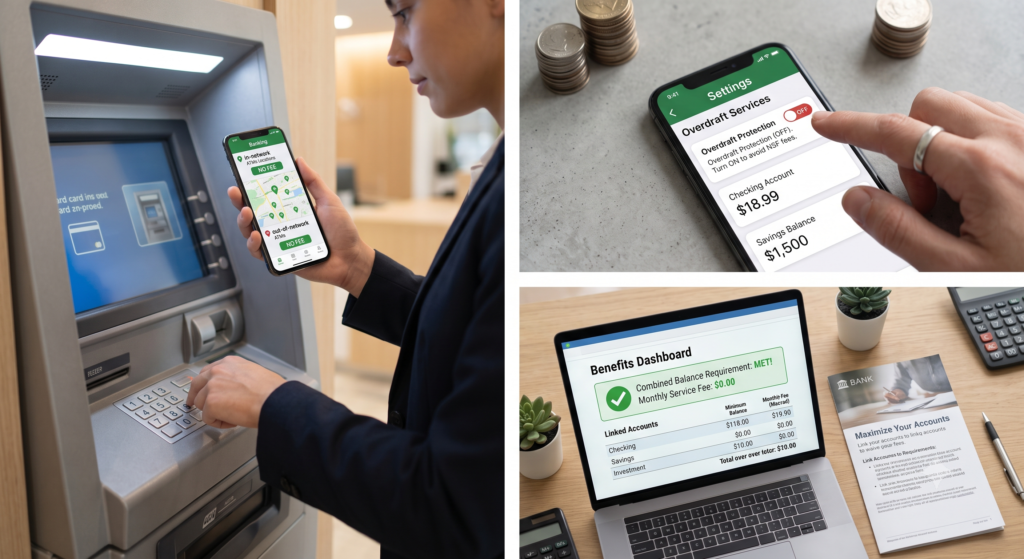
Common Mistakes That Lead to Bank Fees
Keeping too little money in the account
A low balance can make automatic payments risky.
Better approach: Maintain an appropriate cash buffer.
Choosing an account without reading its terms
Promotional advertising doesn’t tell you every possible fee.
Better approach: Review the fee schedule and account disclosures.
Using any convenient ATM
Convenience can become expensive.
Better approach: Use your bank’s network whenever possible.
Ignoring small recurring fees
Several small fees can become a significant annual cost.
Better approach: Review your statements and identify recurring charges.
Assuming “free checking” means everything is free
A checking account may have no monthly maintenance fee but still charge for certain services.
Better approach: Look at the complete fee schedule.
Frequently Asked Questions
What is the easiest bank fee to avoid?
Monthly maintenance fees are often among the easiest to avoid because many accounts waive them when you meet specific requirements or offer accounts without monthly fees.
How can I avoid monthly bank fees?
Choose an account with no monthly maintenance fee or meet the bank’s waiver requirements, such as maintaining a qualifying balance or receiving direct deposits.
How can I avoid ATM fees?
Use your bank’s ATM network or an ATM covered by its fee-reimbursement program. Check the account terms before assuming a fee will be refunded.
How can I avoid overdraft fees?
Monitor your available balance, track pending transactions, and maintain a cash buffer. You can also review your bank’s overdraft settings and available protections.
Are online banks cheaper than traditional banks?
They can be, but not always. Many online banks offer fewer branch-related costs and competitive fee structures, but you should compare the complete account terms.
Can a bank waive a fee?
Sometimes. A bank may waive a fee as a courtesy, particularly for an occasional issue, but policies vary by institution.
Are bank fees tax deductible?
Generally, ordinary personal bank account fees aren’t automatically deductible. Tax treatment can depend on how the account and expenses are used, so consult current tax guidance for your specific circumstances.
Should I close a bank account that charges too many fees?
It may make sense if the account no longer fits your needs, but review automatic payments, direct deposits, outstanding transactions, and any closure requirements before switching.
Is a no-fee bank account always the best choice?
No. Consider the account’s ATM access, customer service, interest rate, features, transfer options, and other terms in addition to fees.
How often should I review my bank account fees?
Review your statements regularly and conduct a broader account review at least once a year. This can help you notice new charges or changes in account terms.
Final Thoughts
Learning how to avoid common bank account fees doesn’t require complicated financial strategies.
Start by understanding the account you already have. Identify the fees you’re actually paying, determine why they occur, and decide whether you can eliminate them through different account settings or better banking habits.
When choosing a new account, don’t be distracted by a promotional offer or attractive interest rate without examining the full fee schedule. A slightly lower APY with fewer fees can sometimes provide more value than an account with a higher advertised rate but expensive requirements.
The best account is one that matches your financial habits.
If you rarely use ATMs, ATM access may matter less. If you travel frequently, foreign transaction costs may matter more. If your balance fluctuates, avoiding minimum-balance requirements may be more important than a promotional rate.
Ultimately, avoiding bank fees is about understanding the rules, choosing an account that fits your behavior, and monitoring your money consistently. A few minutes spent reviewing your account can prevent recurring charges from quietly eating into your savings over time.
For authoritative consumer guidance on bank accounts and fees, the Consumer Financial Protection Bureau (CFPB) provides resources explaining how consumers can compare accounts, understand fees, and make informed banking decisions. (consumerfinance.gov)