

Choosing a rewards credit card can look deceptively simple. One card may advertise cashback, another may offer travel points, and another may promise a large welcome bonus. But the card with the biggest advertised reward is not necessarily the card that gives you the most value.
The right choice depends on how you actually spend, how you repay your balance, which rewards you can realistically redeem, and what the card costs you each year. A card that looks excellent on paper can become expensive if its annual fee is high, its rewards are difficult to use, or you carry a balance and pay substantial interest.
Learning how to choose a rewards credit card therefore requires looking beyond the headline reward rate. You need to evaluate the complete economics of the card.
This guide explains the most important factors to compare, common mistakes to avoid, and a practical method for deciding whether a rewards credit card is genuinely worthwhile.

What Is a Rewards Credit Card?
A rewards credit card gives you benefits for eligible spending. Depending on the card, those benefits may include:
- Cashback
- Reward points
- Travel miles
- Hotel points
- Airline benefits
- Shopping discounts
- Dining rewards
- Fuel-related benefits
- Welcome or sign-up bonuses
- Additional travel or purchase protections
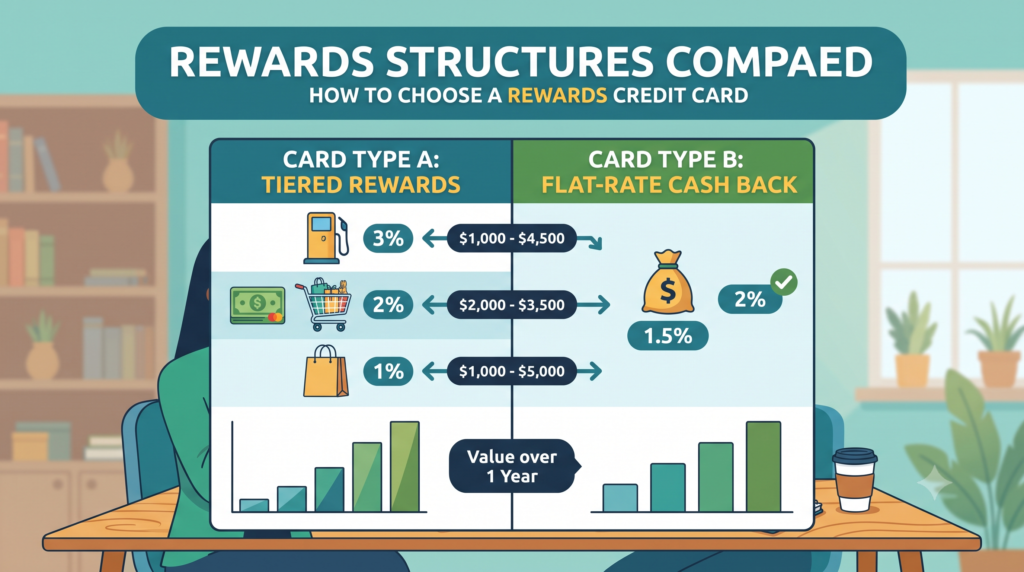
The way rewards are earned varies between cards. Some offer a flat rate on most purchases, while others provide higher rewards in specific spending categories.
For example, a card might provide a standard reward rate on everyday purchases but a higher rate for travel, dining, groceries, or online shopping.
The important question is not simply “How many points do I earn?” It is “What are those points actually worth when I use them?”
How to Choose a Rewards Credit Card
The best approach is to work through the card’s costs, rewards, redemption rules, and your own spending pattern before applying.
1. Start With Your Spending Habits
Your existing spending should drive your card choice.
Look at your spending over the last three to six months and estimate how much you typically spend on:
- Groceries
- Dining
- Fuel
- Online shopping
- Travel
- Utilities
- Entertainment
- Insurance premiums
- Education
- Other regular purchases
You may discover that a card marketed as a premium travel card does not fit your lifestyle if you rarely travel.
Likewise, a cashback card may be more useful than a complicated points card if most of your spending consists of everyday household purchases.
The best rewards card is usually the one that rewards spending you were already going to do—not one that encourages you to spend more.
2. Decide Between Cashback, Points and Travel Rewards
Rewards generally fall into a few broad categories.
Cashback Cards
Cashback cards return a portion of eligible spending as a monetary benefit.
They are usually easier to understand because the value is relatively straightforward.
For someone who wants simplicity, cashback can be attractive because there is less need to calculate the value of airline miles, hotel points, transfer partners, or redemption tiers.
Points-Based Cards
Points can offer greater flexibility, depending on the program.
They may be redeemed for:
- Statement credits
- Travel
- Merchandise
- Gift cards
- Partner programs
- Other benefits
However, the value of a point can vary depending on how it is redeemed.
Travel Rewards Cards
Travel cards may offer miles or points that can be used for flights, hotels, upgrades, or transfers to travel partners.
These cards can be valuable for frequent travelers, particularly when the rewards program offers useful transfer partners or travel benefits.
But travel rewards can also be more complicated. A reward that looks valuable in an advertisement may be less useful if redemption restrictions make it difficult for you to use.
3. Compare the Annual Fee With the Rewards You Expect
An annual fee is one of the most important numbers to consider.
A card offering ₹5,000 or $100 worth of rewards does not necessarily provide ₹5,000 or $100 of net value if you pay a ₹3,000 or $75 annual fee.
A simple calculation is:
Net annual value = rewards used + benefits used − annual fee − other relevant costs
For example, suppose a card provides:
- ₹8,000 estimated annual rewards
- ₹2,500 annual fee
- ₹1,000 worth of benefits you would genuinely use
Your approximate net value would be:
₹8,000 + ₹1,000 − ₹2,500 = ₹6,500
But this calculation only works if you can realistically earn and redeem the ₹8,000 in rewards.
Do not assign a value to benefits you would never use.
4. Look at the Reward Rate, Not Just the Welcome Bonus
Welcome bonuses can make a credit card appear extremely attractive.
However, a large introductory bonus is generally a one-time benefit. Your normal earning rate determines much of the card’s long-term value.
Suppose one card offers a large introductory bonus but mediocre everyday rewards, while another offers a smaller bonus but consistently strong cashback on your regular spending.
The second card may become more valuable after the first year.
Before applying, calculate both:
First-year value
and
Ongoing annual value
This prevents a common mistake: choosing a card because of an attractive introductory offer without considering what happens after the promotion ends.
5. Understand the Spending Requirements for Bonuses
A welcome bonus may require you to spend a certain amount within a specific period.
For example, a card might require several thousand dollars or a specified amount in local currency within the first few months.
Never increase your spending merely to qualify for a reward.
If you spend ₹50,000 you did not need to spend simply to earn a ₹2,000 benefit, the reward has not really saved you money.
Before applying, ask:
“Would I make this spending anyway?”
If the answer is no, the bonus may not be worth pursuing.
6. Check the APR and Interest Cost
Rewards should never distract you from the cost of borrowing.
If you carry a credit card balance, interest can easily outweigh the value of rewards.
The Consumer Financial Protection Bureau explains that APR represents the cost of borrowing on a credit card and notes that consumers can generally avoid purchase interest on many cards by paying the balance in full by the due date.
Consider a simplified example.
Imagine you earn 2% rewards on purchases but pay a high annual interest rate on a carried balance.
If you spend ₹1,00,000 and earn ₹2,000 in rewards, that ₹2,000 benefit can quickly become insignificant if interest charges accumulate on an unpaid balance.
This leads to one of the most important rules for rewards cards:
Do not carry expensive credit card debt just to earn rewards.
If you regularly carry balances, a low-interest card may be financially more appropriate than a rewards-heavy card.
The CFPB similarly recommends that consumers who carry balances focus on lower interest rates, while people who consistently pay their balances in full can place more emphasis on fees and rewards.

7. Check Foreign Transaction Fees
If you travel internationally or make purchases from foreign merchants, foreign transaction fees can affect the value of a rewards card.
A card might offer attractive rewards but charge a fee on eligible foreign transactions.
If you frequently travel abroad, compare:
- Foreign transaction fees
- Currency conversion terms
- Travel rewards
- Travel insurance or protections
- Airport benefits
- International acceptance
A card with slightly lower rewards but no foreign transaction fee may sometimes provide better overall value for an international traveler.
8. Understand Reward Redemption
Earning rewards is only half the equation.
You should also investigate how easily you can use them.
Ask:
- What can I redeem points for?
- What is the minimum redemption amount?
- Can I redeem for cash or statement credit?
- Can points be transferred to travel partners?
- Do points expire?
- Are there blackout dates?
- Does redemption value change by category?
- Are there restrictions on transferring points?
- What happens to rewards if the account is closed?
This is where some rewards cards become complicated.
The CFPB has reported consumer complaints involving rewards that were difficult to redeem, rewards being devalued, and conditions that were difficult to understand.
Therefore, do not judge a rewards program solely by its earning rate.
9. Calculate the Real Value of Points
A point does not automatically have a fixed monetary value.
Suppose a program gives you 10,000 points.
If those points can be redeemed for ₹5,000 worth of benefits, each point is effectively worth:
₹5,000 ÷ 10,000 = ₹0.50 per point
If another redemption option gives you only ₹2,000 of value, the effective value falls to:
₹2,000 ÷ 10,000 = ₹0.20 per point
This is why comparing “10 points per ₹100” with “5 points per ₹100” is not enough.
You need to compare earn rate × redemption value.
10. Look for Category Bonuses That Match Your Spending
Category bonuses can significantly improve a card’s value.
For example, if you spend heavily on dining, a card offering enhanced dining rewards may outperform a flat-rate card.
Similarly, a frequent traveler may benefit from higher travel rewards.
But there is an important trap: do not change your natural spending pattern simply because a card offers a bonus.
If you normally spend ₹10,000 on groceries and a card gives you an additional reward for that category, the benefit is meaningful.
If the card convinces you to spend ₹30,000 on unnecessary purchases to maximize rewards, you may lose money despite earning more points.
11. Examine Caps and Restrictions
A rewards rate can look impressive until you discover a monthly or annual spending cap.
For example, a card may advertise a high reward rate but limit that rate to a relatively small amount of spending.
After the cap, the reward rate could fall substantially.
Always check:
- Monthly caps
- Annual caps
- Category limits
- Minimum transaction requirements
- Excluded merchants
- Payment-method restrictions
- Promotional-period restrictions
These details can materially change the effective reward rate.
12. Consider the Card’s Other Benefits
Premium cards may include benefits beyond rewards.
Depending on the product, these could include:
- Airport lounge access
- Travel insurance
- Purchase protection
- Extended warranties
- Concierge services
- Hotel benefits
- Airline benefits
- Dining privileges
- Roadside assistance
But assign value only to benefits you would actually use.
A lounge-access benefit is worth little to someone who rarely travels.
Likewise, a shopping voucher is not necessarily a valuable benefit if you would not normally shop with that merchant.
13. Check Eligibility Before Applying
Credit card issuers may have eligibility requirements based on factors such as:
- Income
- Credit history
- Existing debt
- Credit score
- Employment or business information
- Existing relationship with the issuer
Do not apply for numerous cards simply because their advertisements look attractive.
Multiple applications can also create unnecessary hard inquiries depending on the credit reporting system and issuer practices.
Research your likely eligibility first and prioritize cards that genuinely fit your financial profile.
14. Read the Fine Print Before Applying
This may be the least exciting part of choosing a rewards credit card, but it is one of the most important.
Read the:
- Cardholder agreement
- Rewards program terms
- Fee schedule
- Interest-rate information
- Welcome-offer terms
- Redemption rules
- Eligibility requirements
- Expiration provisions
- Cancellation provisions
The CFPB emphasizes that credit card agreements contain important information about APRs, fees, and other terms.
Do not rely entirely on comparison websites or promotional advertisements. Use them to identify potential cards, then verify important terms directly with the issuer.
A Practical Formula for Comparing Rewards Cards
You can use a simple annual calculation to compare cards.
Step 1: Estimate annual eligible spending
Suppose you spend:
- ₹3,00,000 on everyday purchases
- ₹1,20,000 on travel
- ₹60,000 on dining
Total:
₹4,80,000
Step 2: Estimate rewards
If your effective rewards are approximately 2%:
₹4,80,000 × 2% = ₹9,600
Step 3: Add realistic benefits
Suppose you genuinely use ₹2,000 worth of additional benefits.
Total estimated value:
₹11,600
Step 4: Subtract the annual fee
If the annual fee is ₹3,000:
₹11,600 − ₹3,000 = ₹8,600
Step 5: Consider other costs
If you pay foreign transaction fees, late fees, or interest because of how you use the card, those costs can reduce the actual value further.
This approach is much more useful than simply asking which card has the highest advertised rewards percentage.
Common Mistakes When Choosing a Rewards Credit Card
Choosing the Biggest Welcome Bonus
A large bonus is attractive, but it may be worthless if you cannot meet the spending requirement naturally.
Ignoring the Annual Fee
A premium rewards card needs to generate enough value to justify its ongoing cost.
Focusing Only on Reward Percentages
A high earning rate does not necessarily mean high-value rewards.
Carrying a Balance to Earn Points
Interest can overwhelm the value of rewards.
Ignoring Redemption Rules
Thousands of points are not useful if you cannot redeem them for something you actually want.
Chasing Every Promotional Offer
Constantly switching cards can create unnecessary complexity and encourage excessive spending.
Forgetting to Track Expiration Dates
Some rewards programs impose expiration rules or account-activity requirements. Check the specific terms of your program.
When a Rewards Credit Card May Not Be the Best Choice
A rewards card is not automatically appropriate for everyone.
A simple low-fee or low-interest card may make more sense if:
- You frequently carry a balance
- You struggle to pay on time
- The annual fee exceeds your realistic rewards
- You rarely use the available rewards
- You tend to overspend when using credit
- You do not want to track complicated reward categories
The purpose of a credit card should be to support your financial needs—not to create spending pressure.
How to Choose a Rewards Credit Card: A Simple Decision Process
Before applying, work through these questions:
Question 1: Will I pay the balance in full?
If yes, rewards may deserve greater consideration.
If no, prioritize the cost of borrowing.
Question 2: Where do I spend the most?
Choose categories that match your existing spending.
Question 3: Which rewards do I actually want?
Choose cashback, points, miles, or other benefits based on your preferences.
Question 4: Can I justify the annual fee?
Estimate realistic annual rewards and benefits, then subtract the fee.
Question 5: Can I easily redeem the rewards?
Review the redemption rules before applying.
Question 6: Are there important restrictions?
Check caps, exclusions, expiration rules, and promotional requirements.
Question 7: What happens after the first year?
Calculate the long-term value—not just the introductory offer.

Final Thoughts
Learning how to choose a rewards credit card is less about finding the card with the flashiest advertisement and more about matching the card to your financial behavior.
Start with your spending habits. Then compare the reward structure, redemption value, annual fee, interest rate, category restrictions, foreign transaction costs, and additional benefits.
Most importantly, treat rewards as a bonus—not as a reason to spend money you would otherwise keep in your bank account.
A rewards card can be useful when you already have disciplined spending and repayment habits. But if interest charges accumulate, the value of cashback, points, or miles can quickly disappear.
Before applying, review the current terms directly with the card issuer because rewards structures, fees, eligibility requirements, and redemption rules can change. The CFPB also maintains consumer resources for comparing and understanding credit card terms.
For additional authoritative information, see the Consumer Financial Protection Bureau’s credit card resources.
Frequently Asked Questions
1. How do I choose a rewards credit card?
Choose a card based on your actual spending, preferred rewards, annual fee, redemption options, interest rate, and other costs. The best card is the one that produces meaningful net value for your spending pattern.
2. Are rewards credit cards worth it?
They can be worthwhile if you use the rewards and pay your balance responsibly. A card may not be worthwhile if its fees or interest charges exceed the value of the rewards.
3. Should I choose cashback or points?
Cashback is usually simpler and easier to value. Points can potentially provide greater value when used strategically, particularly for travel, but they often come with more complicated redemption rules.
4. Is a card with a high reward rate always better?
No. A high reward rate may be offset by annual fees, spending caps, exclusions, low redemption value, or other costs.
5. Should I choose a rewards card with an annual fee?
It depends. Calculate the rewards and benefits you realistically expect to use and compare their value with the annual fee.
6. Can credit card rewards save me money?
They can provide value when they reward purchases you would make anyway. However, rewards should not encourage unnecessary spending or debt.
7. What is more important: rewards or APR?
If you regularly carry a balance, APR and borrowing costs are generally more important than rewards. If you consistently pay your balance in full, rewards and fees may deserve greater attention.
8. What should I check before applying for a rewards card?
Review the annual fee, APR, reward rate, bonus requirements, redemption rules, spending caps, exclusions, expiration rules, and other fees.
9. What is a credit card welcome bonus?
A welcome bonus is an introductory reward offered after meeting specified requirements, often involving a minimum amount of spending within a defined period.
10. Should I spend more to earn a credit card bonus?
Generally, no. You should not make unnecessary purchases simply to qualify for rewards. The spending requirement should fit expenses you would reasonably make anyway.
11. How can I calculate the value of credit card rewards?
Multiply your expected eligible spending by the effective reward rate, add the realistic value of benefits, and subtract annual fees and other relevant costs.
12. Can credit card reward points lose value?
Yes. Rewards programs can change earning or redemption structures. The CFPB has specifically reported consumer concerns about reward devaluation and difficulties redeeming rewards.
13. Do credit card rewards expire?
Some rewards programs may have expiration rules or conditions related to account status or activity. Always check the specific rewards program terms.
14. Is it better to have one rewards credit card or multiple cards?
There is no universal answer. Multiple cards can provide stronger rewards across different categories, but they also require more tracking and responsible account management.
15. Can rewards compensate for credit card interest?
Usually, rewards should not be viewed as a way to offset expensive revolving debt. If interest is accumulating, it can substantially exceed the rewards earned.
16. What is the biggest mistake when choosing a rewards credit card?
Focusing on the advertised rewards while ignoring the total cost of the card is one of the biggest mistakes. Always compare rewards, fees, interest, redemption value, and restrictions together.
17. Should I compare cards before applying?
Yes. Comparing multiple offers can help you identify differences in fees, rates, rewards, and benefits before committing to a particular card. The CFPB recommends shopping around when choosing a credit card.
18. Can I change my rewards credit card later?
Depending on the issuer, you may be able to close the card, switch to another product, or apply for a different card. Before making a change, check what happens to your existing rewards and any outstanding balance.
19. Are travel rewards cards better than cashback cards?
Not necessarily. Travel cards may be more valuable for frequent travelers who understand and use travel rewards. Cashback can be more practical for people who prefer straightforward rewards.
20. What is the most important rule when using a rewards credit card?
Use the card for planned spending, understand its costs and rewards, and avoid carrying expensive debt simply to earn points or cashback.
Disclaimer: This article is for general educational purposes and does not constitute financial advice. Credit card fees, interest rates, rewards, eligibility criteria, and consumer protections vary by issuer and country. Always review the current cardholder agreement and official terms before applying.