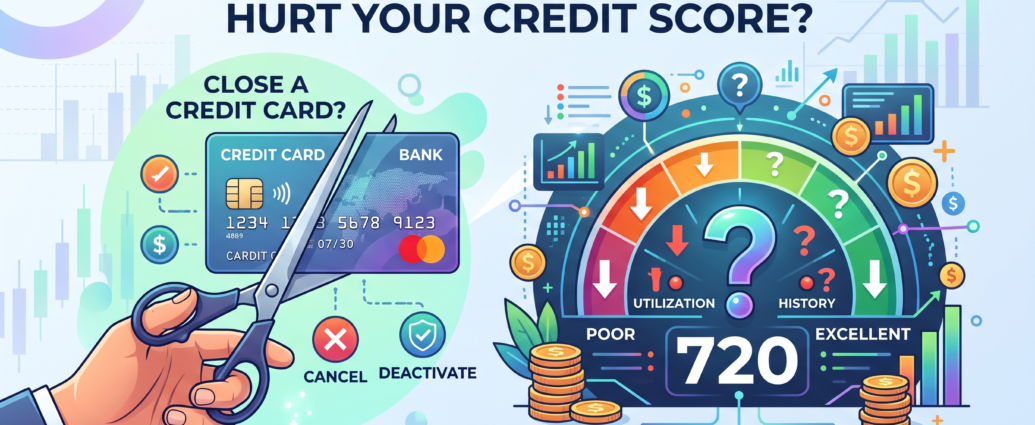
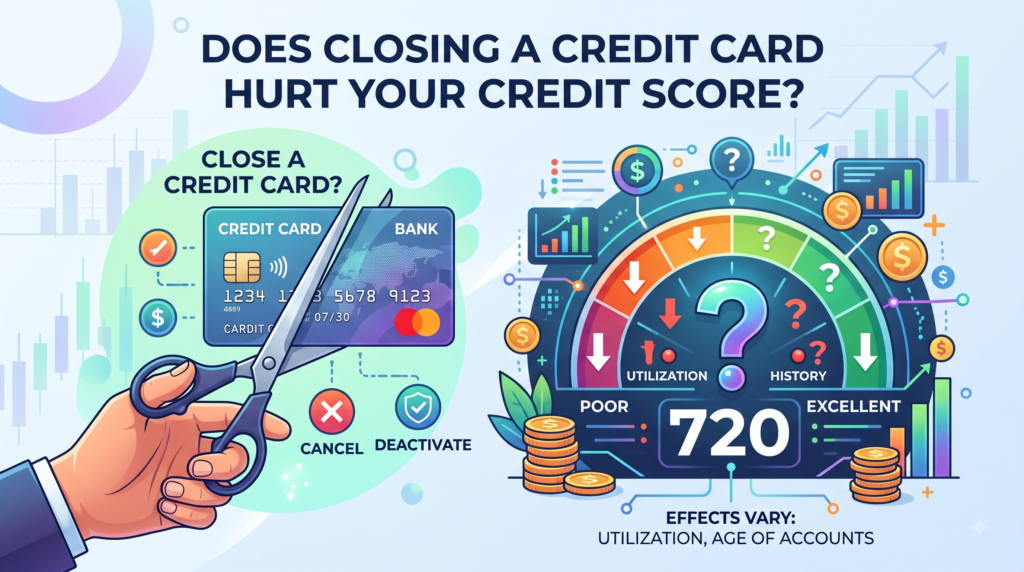
Closing a credit card can be a sensible financial decision, but it can also affect your credit score depending on the rest of your credit profile. The important point is that closing a credit card does not automatically hurt your credit score, and it does not automatically improve it either.
The potential impact often comes from what happens to your overall credit utilization, your available revolving credit, and eventually the information associated with the closed account. Your payment history and existing balances also continue to matter.
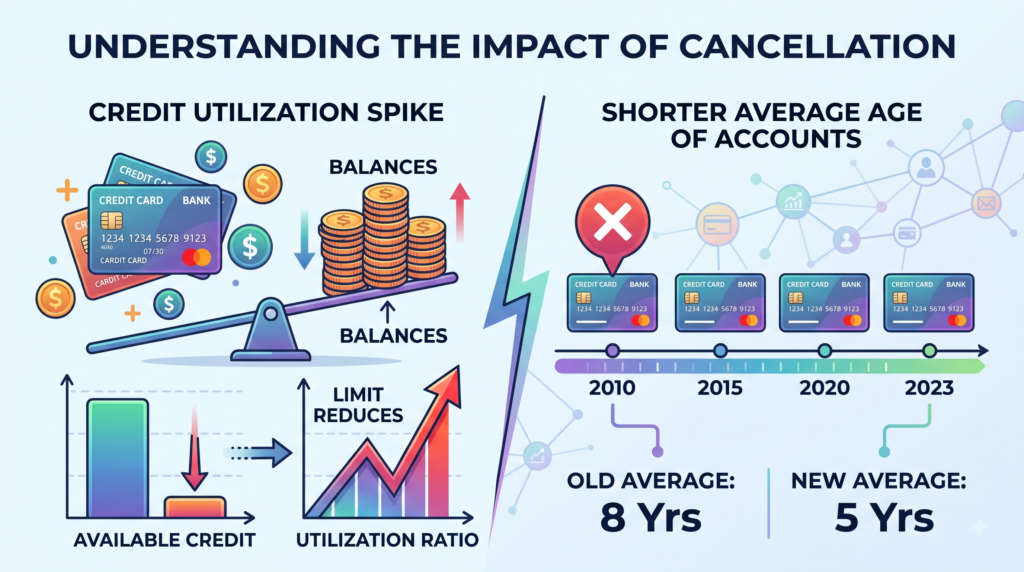
For example, suppose you have three credit cards with a combined credit limit of $20,000 and balances totaling $4,000. Your overall utilization is 20%. If you close a card with a $10,000 limit while keeping the same $4,000 balance, your available credit could fall to $10,000 and your utilization could rise to 40%. That change could put downward pressure on your score.
The Consumer Financial Protection Bureau (CFPB) also warns that closing credit cards can hurt a score when it causes the percentage of available credit being used to increase.
So, does closing a credit card hurt your credit score? Sometimes—but the answer depends on why you’re closing the card, which card you’re closing, your balances, and the rest of your credit history.
What Happens When You Close a Credit Card?
When you close a credit card, the account is generally reported to the credit bureaus as closed. You can no longer make new purchases on that account, but closing the account doesn’t erase its previous payment history.
If the card has a balance, you are still responsible for paying that balance according to the card agreement. Closing the account doesn’t cancel the debt.
The potential credit-score effect comes from changes to your credit profile after the account is closed.
The most important immediate consideration is usually your available revolving credit.
Your credit limit may disappear from your available credit
Suppose you have:
- Card A: $5,000 limit, $1,000 balance
- Card B: $10,000 limit, $0 balance
- Card C: $5,000 limit, $1,000 balance
Your total credit limit is $20,000, and your total balance is $2,000.
Your utilization is:
$2,000 ÷ $20,000 = 10%
If you close Card B, your available credit falls to $10,000 while your $2,000 balance remains.
Your utilization becomes:
$2,000 ÷ $10,000 = 20%
Nothing changed about your debt, but your utilization doubled.
That’s why closing an unused card can sometimes cause a credit-score decline.
What Is Credit Utilization?
Credit utilization is the amount of revolving credit you’re using compared with the total credit available to you.
A simple formula is:
Credit Utilization = Total Credit Card Balances ÷ Total Credit Limits × 100
For example, if your cards have combined limits of $30,000 and your balances total $6,000:
$6,000 ÷ $30,000 × 100 = 20%
If you close a card with a $10,000 limit, your available credit could fall to $20,000. If the balance remains $6,000:
$6,000 ÷ $20,000 × 100 = 30%
That higher utilization can potentially affect your score.
FICO identifies amounts owed as an important scoring category and considers revolving utilization when calculating FICO Scores.
Does a higher credit utilization always mean a lower score?
Not necessarily in a perfectly predictable way.
Credit scoring models consider many pieces of information, and the effect of a particular utilization change varies by individual credit profile and scoring model.
However, as a general principle, keeping revolving balances low relative to available credit is beneficial for maintaining a strong credit profile.
The CFPB similarly advises consumers not to get too close to their credit limits.
Does Closing an Old Credit Card Hurt Your Credit Age?
This is one of the most misunderstood parts of closing a credit card.
You may have heard:
“If I close my oldest credit card, my credit history immediately becomes shorter.”
That’s not necessarily what happens.
A closed account doesn’t simply disappear from your credit report the moment you close it. Positive account history can continue to be reported after closure, depending on the circumstances and credit bureau reporting practices.
FICO explains that closed accounts can continue to contribute to aspects of credit history while they remain on the credit report.
However, closing an old account can still matter eventually if the account later drops off your credit reports.
This means you shouldn’t assume that closing your oldest card will instantly destroy your credit age—but you also shouldn’t ignore the potential long-term effect.
Does Closing a Credit Card With a Zero Balance Hurt Your Credit?
It can.
This is one of the situations where people are often surprised.
Imagine you have:
- Total credit limits: $25,000
- Total balances: $5,000
- Utilization: 20%
One of your cards has a $10,000 limit and a $0 balance.
If you close that card, your total available credit could fall to $15,000.
Your $5,000 balance would then represent:
$5,000 ÷ $15,000 = 33.3%
Your debt didn’t increase, but your utilization did.
FICO specifically notes that closing a $0-balance card can potentially increase utilization because the card’s available credit is no longer available to you.
When Closing a Credit Card May Make Sense
Avoid the idea that every credit card should remain open forever.
There are legitimate reasons to close an account.
1. The annual fee isn’t worth it
If you’re paying a substantial annual fee and the card’s rewards and benefits don’t justify the cost, closing the account may make financial sense.
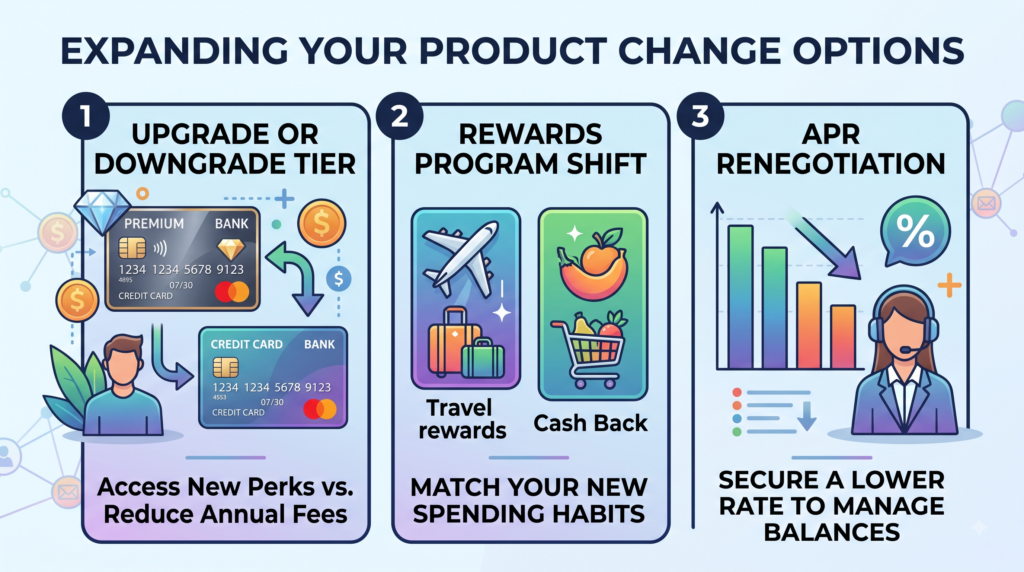
Before closing it, however, ask the issuer whether a product change or downgrade to a lower-fee card is available.
That may allow you to avoid the annual fee without completely closing the account.
2. The card encourages overspending
Credit-score optimization isn’t the only consideration.
If keeping an available line of credit makes it difficult for you to control spending, closing the account may be a reasonable financial decision.
A temporary credit-score decline could be less damaging than continuing to accumulate expensive credit-card debt.
FICO acknowledges that avoiding future overspending can be a legitimate reason to close a card.
3. The card has poor terms
You may have a card that no longer fits your financial needs.
Perhaps the annual fee increased, rewards became less useful, or the card’s features no longer match how you spend.
In that situation, keeping the account solely because you’re worried about your credit score may not be the best financial choice.
4. You need to simplify your finances
If you have too many accounts to manage effectively, reducing the number of cards can make it easier to keep track of payments and avoid missed due dates.
A credit card that you forget about isn’t automatically helping you.
If an unused card remains open, monitor statements for unexpected charges or fees.
The CFPB specifically recommends watching statements on unused accounts for unexpected activity.
When You May Want to Think Twice Before Closing a Card
Closing a card deserves more caution when several of the following apply:
- It has a large credit limit
- You carry balances on other cards
- It is one of your oldest accounts
- You have relatively few credit accounts
- You’re planning to apply for a mortgage
- You’re applying for an auto loan
- You’re applying for another major credit account
- The card has no annual fee
- You can manage the account responsibly
The biggest concern is usually the relationship between your existing balances and the credit limit you’re removing.
Example: Why timing matters
Suppose you have $8,000 in credit-card balances and $40,000 in total available credit.
Your utilization is:
$8,000 ÷ $40,000 = 20%
You close a card with a $15,000 limit.
Your available credit becomes $25,000.
Your utilization becomes:
$8,000 ÷ $25,000 = 32%
If you’re about to apply for a mortgage, you may want to consider the potential effect before closing the account.
This doesn’t mean that closing the card will definitely cause a score drop. It means the timing and consequences deserve consideration.
Does Closing a Credit Card Remove Negative Information?
No.
Closing a credit card doesn’t erase legitimate negative information associated with the account.
For example, if the account had a reported late payment, simply closing the card doesn’t make that history disappear.
FICO explains that closing an account doesn’t prevent previously reported payment history and other relevant information from continuing to be considered.
This is important because some people close a card hoping that past problems will disappear.
Closing the account is not a credit-repair strategy.
If there is inaccurate information on your credit report, the appropriate approach is to dispute the error with the relevant credit reporting company and information provider.
Should You Close a Credit Card Before Applying for a Mortgage?
Generally, don’t close a credit card simply because you think doing so will improve your mortgage application.
Closing a card can reduce your available credit and potentially increase utilization.
If you’re preparing for a mortgage, it’s usually better to understand your complete credit profile before making major changes.
That includes:
- Current balances
- Credit limits
- Payment history
- Recent applications
- Account ages
- Existing debt
- Credit report errors
If you’re unsure about a major credit decision before applying for a mortgage, consider discussing your situation with a qualified mortgage professional or financial adviser.
How to Close a Credit Card Without Unnecessary Problems
If you’ve decided that closing the card is the right financial choice, follow a deliberate process.
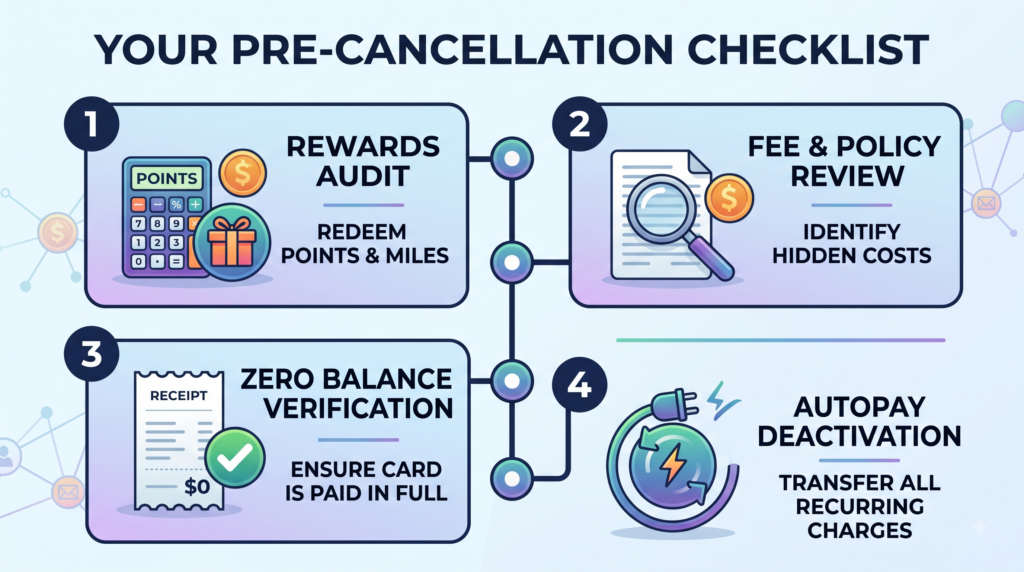
Step 1: Check the current balance
Ideally, pay the balance in full before closing if your circumstances allow.
If you cannot, understand that you remain responsible for the outstanding balance after closure.
Step 2: Redeem rewards
Check whether you have:
- Cash back
- Points
- Travel miles
- Promotional rewards
Some rewards may be forfeited when an account is closed.
Check the card issuer’s terms before closing.
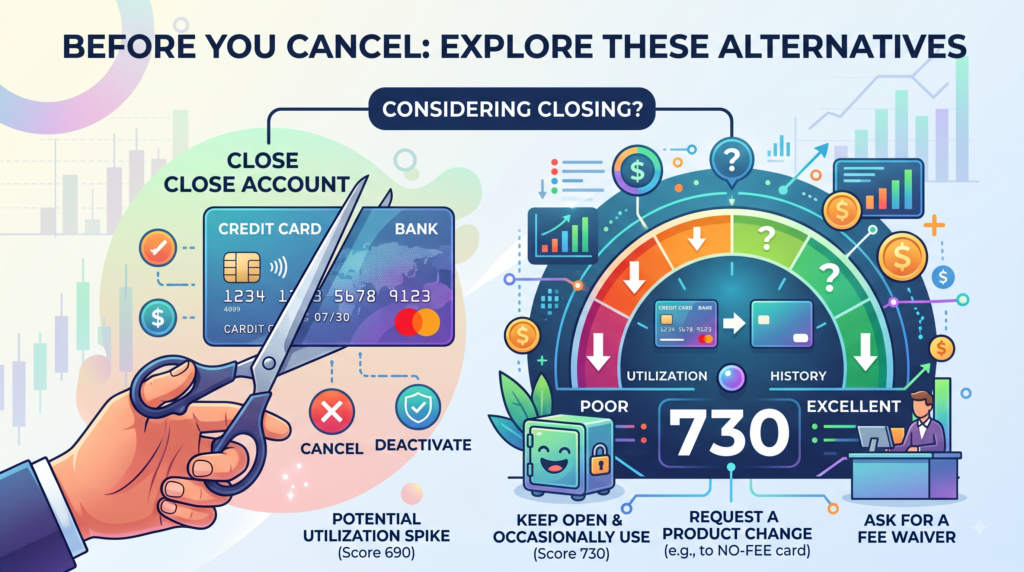
Step 3: Consider alternatives
Ask whether you can:
- Downgrade the card
- Change to another product
- Remove an annual fee
- Keep the account open without using it
A product change may sometimes preserve the account relationship without requiring you to keep an expensive card.
Step 4: Consider your utilization
Calculate your current overall utilization.
Then calculate it again assuming the card’s credit limit disappears.
This simple exercise can reveal whether closing the account could substantially change your credit profile.
Step 5: Contact the issuer
Follow the issuer’s official cancellation process.
Ask for confirmation that the account has been closed.
Step 6: Continue monitoring the account
Don’t immediately assume the process is finished.
Check your statements and credit reports afterward to confirm the account is reported accurately.
What Should You Do With an Unused Credit Card?
You have several choices.
Option 1: Keep it open
This can make sense when:
- There is no annual fee
- The credit limit is useful
- You can manage the account responsibly
- You don’t need to simplify your finances
Option 2: Use it occasionally
Some people make a small, planned purchase periodically and pay the statement balance in full.
This keeps the account active while avoiding unnecessary interest.
However, don’t make purchases you wouldn’t otherwise make simply to keep a card active.
Option 3: Ask for a product change
If the card’s annual fee is the problem, ask whether another card from the same issuer better fits your needs.
Option 4: Close it
If the card creates financial problems, has unfavorable terms, or no longer makes sense, closing it can be reasonable.
Your financial well-being should not be sacrificed solely to protect a credit score.
How Long Does a Closed Credit Card Stay on Your Credit Report?
The answer can vary depending on the account’s history and the credit reporting circumstances.
FICO explains that positive closed accounts can remain on credit reports for years and may continue contributing to aspects of credit history while reported. Negative information generally has different reporting timelines.
Because reporting practices and scoring models can differ, don’t assume that closing an account means its entire history immediately disappears.
If you want to understand what is currently affecting your score, review your credit reports rather than relying solely on the score shown by a credit-card issuer or financial app.
The CFPB provides consumer guidance on understanding credit reports and identifying potential errors.
A Simple Decision Checklist
Before closing a credit card, ask yourself:
1. Does the card charge an annual fee?
If yes, determine whether the benefits justify the cost.
2. Do I carry balances on other cards?
If yes, calculate how closing this card would change your utilization.
3. Is this one of my oldest accounts?
If yes, consider its role in your overall credit history.
4. Am I planning to apply for major credit soon?
If yes, avoid unnecessary changes until you understand the possible consequences.
5. Does the card encourage me to overspend?
If yes, financial discipline may be more important than preserving the account.
6. Can I downgrade the card instead?
A product change may be an alternative to cancellation.
7. Have I redeemed my rewards?
Check before closing.
8. Can I manage the account responsibly if I leave it open?
If yes, keeping it open may be worth considering.
The Most Important Lesson
There is no universal rule saying you should always keep every credit card open.
Likewise, there is no universal rule saying you should close unused cards.
The better question is:
What happens to my overall financial situation if I close this particular card?
Look at your balances, credit limits, account age, annual fees, spending behavior, upcoming borrowing needs, and financial goals together.
The CFPB says closing a card may be appropriate in some situations but cautions that it can lower a credit score if it causes utilization to rise.
For additional guidance, the Consumer Financial Protection Bureau’s credit-score resources explain how credit scores work and why consumers should be cautious when closing accounts.
FICO also provides detailed information about how closing revolving accounts can affect utilization and why the effect varies between consumers.
Frequently Asked Questions
Does closing a credit card always hurt your credit score?
No. Closing a card may have little or no immediate effect, but it can hurt your score if it significantly reduces your available credit and increases your utilization.
Will closing my oldest credit card destroy my credit history?
No. A closed account doesn’t necessarily disappear immediately from your credit report. Its history may continue to be considered while the account remains reported.
Should I close a credit card with a zero balance?
Not necessarily. A zero-balance card can still provide available credit, so closing it could increase your overall utilization if you carry balances elsewhere.
Does closing a credit card remove late payments?
No. Closing the account doesn’t erase accurately reported late payments or other legitimate negative information.
Can closing a credit card improve my credit score?
Usually, you shouldn’t close a card specifically to raise your score. FICO says closing a card for the sole purpose of increasing your score is generally not recommended.
Is it better to downgrade a credit card instead of closing it?
Sometimes. If an annual fee is the main problem, ask the issuer whether a lower-fee or no-fee product change is available.
How much can my credit score drop after closing a credit card?
There is no fixed number. The impact depends on your complete credit profile, including utilization, balances, account history and other accounts.
Should I close a credit card before applying for a mortgage?
Be cautious. Closing a card can reduce available credit and potentially increase utilization, so unnecessary account changes may not be helpful immediately before a major credit application.
Can I still owe money after closing a credit card?
Yes. Closing the account does not cancel an outstanding balance. You must continue making payments according to the account terms.
Should I keep an unused credit card open?
It depends. If it has no annual fee and you can manage it responsibly, keeping it open may preserve available credit. But if the account creates financial or security concerns, closing it may be reasonable.
Final Takeaway
Does closing a credit card hurt your credit score? It can, but it doesn’t always.
The most important factor to consider is what happens to your overall credit profile after the account closes. If removing the card substantially reduces your available credit while your balances remain the same, your credit utilization can increase and potentially lower your score.
At the same time, protecting your credit score shouldn’t mean keeping a costly or problematic credit card forever. If an annual fee is excessive, the card encourages overspending, or the account no longer fits your financial situation, closing it may be the better financial decision.
Before making the decision, calculate your utilization, consider the card’s age and fee, check your other balances, and think about any upcoming major credit applications.
The goal isn’t to keep every credit card open. The goal is to manage the accounts you have in a way that supports both your financial health and your credit profile.