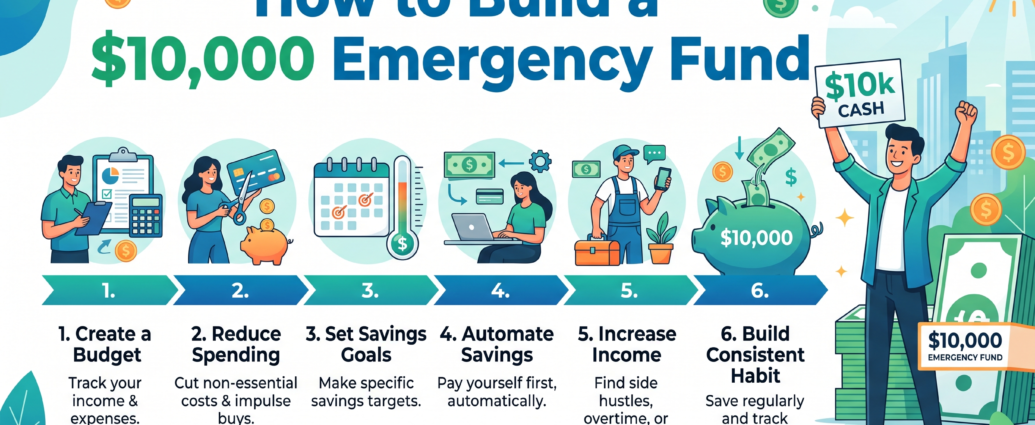
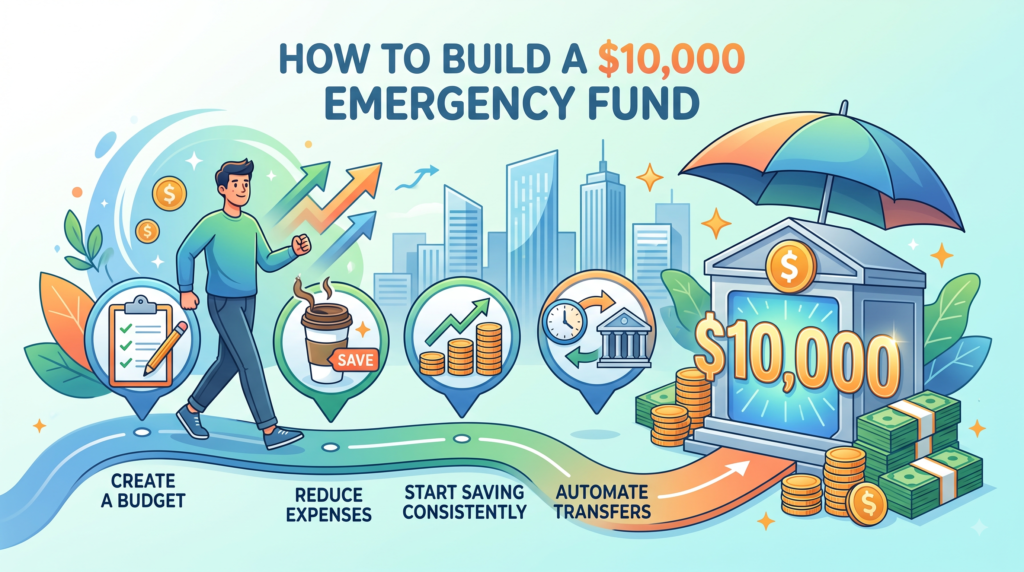
Building a $10,000 emergency fund can feel overwhelming, especially when you are starting with a small balance or dealing with a tight monthly budget. But you don’t need to save $10,000 all at once. The more practical approach is to turn the large goal into smaller milestones and create a savings system that you can maintain.
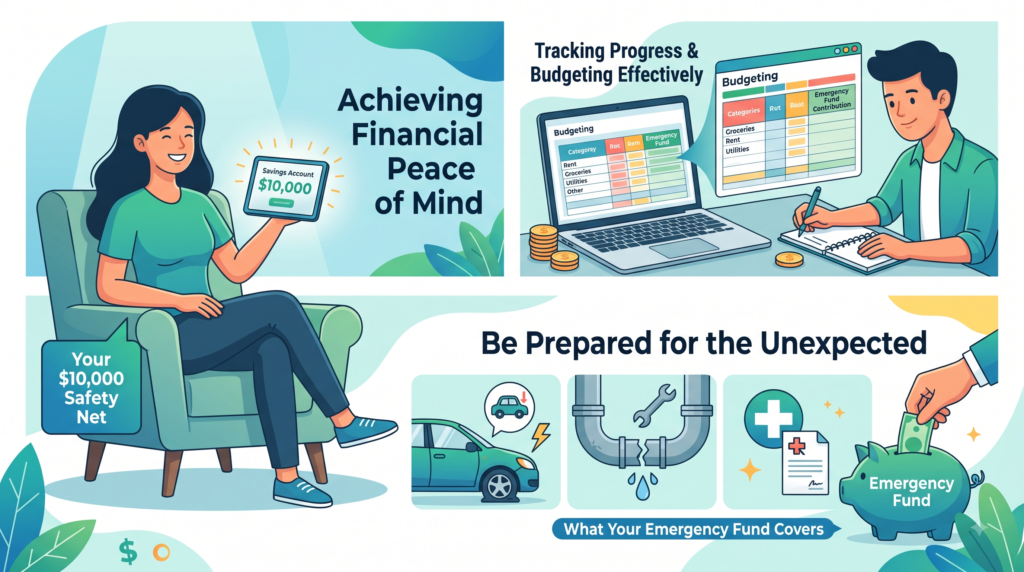
An emergency fund is money set aside specifically for unexpected and necessary expenses, such as a major car repair, medical bill, urgent home repair, or temporary loss of income. The Consumer Financial Protection Bureau (CFPB) recommends building savings for unexpected expenses and notes that even a small amount can provide additional financial security.
This guide explains how to build a $10,000 emergency fund, how much you need to save each month, where to keep the money, when you should use it, and how to rebuild it after an emergency.
What Is an Emergency Fund?
An emergency fund is a dedicated cash reserve for unexpected expenses that are important and difficult to postpone.
Examples can include:
- Unexpected medical expenses
- Major vehicle repairs
- Urgent home repairs
- Temporary loss of income
- Emergency travel
- Essential appliance replacement
- Unexpected insurance-related costs
- Other necessary expenses that aren’t part of your normal monthly budget
The key distinction is that an emergency fund is not the same as ordinary savings.
Your regular savings might be used for a vacation, new phone, annual insurance payment, or planned purchase. An emergency fund is intended for financial situations that are unexpected and necessary.
The CFPB describes emergency savings as a cash reserve specifically set aside for unplanned expenses or financial emergencies.
Why Build a $10,000 Emergency Fund?
There is nothing magical about the $10,000 figure. The right emergency-fund target depends on your income, expenses, household situation, job stability, insurance coverage, and other financial resources.
For one household, $5,000 may provide a meaningful cushion. Another household with higher expenses or less predictable income may need substantially more.
The value of a $10,000 goal is that it gives you a specific savings target instead of an indefinite goal such as “I should save more money.”
A well-funded emergency reserve can help you handle an unexpected expense without immediately turning to a credit card or high-cost loan. The CFPB notes that people without adequate savings may rely on credit cards or loans after a financial shock, potentially making the original problem more expensive.
How Much Should You Save for an Emergency Fund?
A common long-term target is several months of essential living expenses, but there isn’t one universal number that works for everyone.
FINRA notes that three to six months of savings is a common emergency-fund goal, while also emphasizing that saving any amount you can afford is a useful starting point.
Consider your essential monthly expenses.
For example:
| Essential Monthly Expenses | Approximate 6-Month Reserve |
|---|---|
| $1,500 | $9,000 |
| $2,000 | $12,000 |
| $2,500 | $15,000 |
| $3,000 | $18,000 |
| $4,000 | $24,000 |
This illustrates why $10,000 shouldn’t automatically be considered the perfect emergency fund for everyone.
If your essential expenses are $2,000 per month, $10,000 represents five months of expenses. If your essential expenses are $4,000, it represents only 2.5 months.
Your personal circumstances should determine whether $10,000 is a good target.
Step 1: Calculate Your Essential Monthly Expenses
Before deciding how quickly to save $10,000, determine how much you actually need each month.
Start with expenses that are necessary to maintain your household:
- Housing
- Utilities
- Groceries
- Transportation
- Insurance
- Minimum debt payments
- Essential healthcare expenses
- Childcare
- Necessary household expenses
You don’t necessarily need to include discretionary spending such as entertainment, expensive dining, vacations, or nonessential shopping.
Review several months of bank and credit-card statements rather than relying only on memory. The CFPB recommends reviewing spending over multiple months because irregular expenses can easily be overlooked when creating a budget.
Step 2: Turn $10,000 Into Smaller Milestones
A $10,000 goal can look intimidating.
Instead, divide it into milestones:
$500 → $1,000 → $2,500 → $5,000 → $7,500 → $10,000
Your first goal could simply be reaching $500 or $1,000.
Once you reach that milestone, continue toward the next one.
This approach makes the goal easier to track and gives you several opportunities to see measurable progress.
Why Smaller Goals Work
Suppose you are starting with $0.
Thinking:
“I need to find $10,000.”
can feel impossible.
Instead, think:
“My first goal is $1,000.”
Then:
“My next goal is $2,500.”
The final target hasn’t changed. You’ve simply made the process easier to manage.
Step 3: Choose a Monthly Savings Target
The most useful question isn’t “How do I save $10,000?”
It’s:
How much can I consistently save every month?
Here’s what the math looks like if you’re starting from $0 and ignoring interest:
| Monthly Savings | Approximate Time to $10,000 |
|---|---|
| $100 | 100 months |
| $200 | 50 months |
| $250 | 40 months |
| $300 | 34 months |
| $400 | 25 months |
| $500 | 20 months |
| $750 | 14 months |
| $1,000 | 10 months |
You don’t have to choose the largest possible amount.
A sustainable $300 monthly contribution is generally more useful than promising yourself $800 and repeatedly failing to maintain it.
Step 4: Automate Your Savings
One of the simplest ways to build an emergency fund is to automate the process.
For example, you could arrange for $250 to move into a dedicated savings account after every monthly paycheck.
At $250 per month:
$250 × 12 = $3,000 per year
At $500 per month:
$500 × 12 = $6,000 per year
The CFPB recommends making saving automatic through recurring transfers or other mechanisms that make saving part of your regular financial routine.
Automation is powerful because you don’t have to make the same savings decision every month.
Step 5: Open a Separate Emergency Savings Account
Consider keeping your emergency fund separate from your everyday checking account.
This can create a psychological barrier between money intended for emergencies and money available for regular spending.
Look for an account that provides:
- Easy access to your money
- Low or no monthly fees
- Appropriate deposit protection
- Competitive interest
- No unnecessary withdrawal restrictions
- A reputable financial institution
Your emergency fund is primarily about financial stability and accessibility, not maximizing investment returns.
The CFPB recommends considering safety and accessibility when deciding where to keep emergency savings.
Should You Keep Your Emergency Fund in Cash?
Keeping a small amount of physical cash at home can be useful in certain situations, but storing your entire emergency fund as cash has disadvantages.
Cash can be:
- Lost
- Stolen
- Damaged
- Difficult to replace
For most people, the majority of an emergency fund is better kept in an accessible financial account rather than as physical cash.
The CFPB also cautions that cash kept at home can be vulnerable to theft, loss, or destruction.
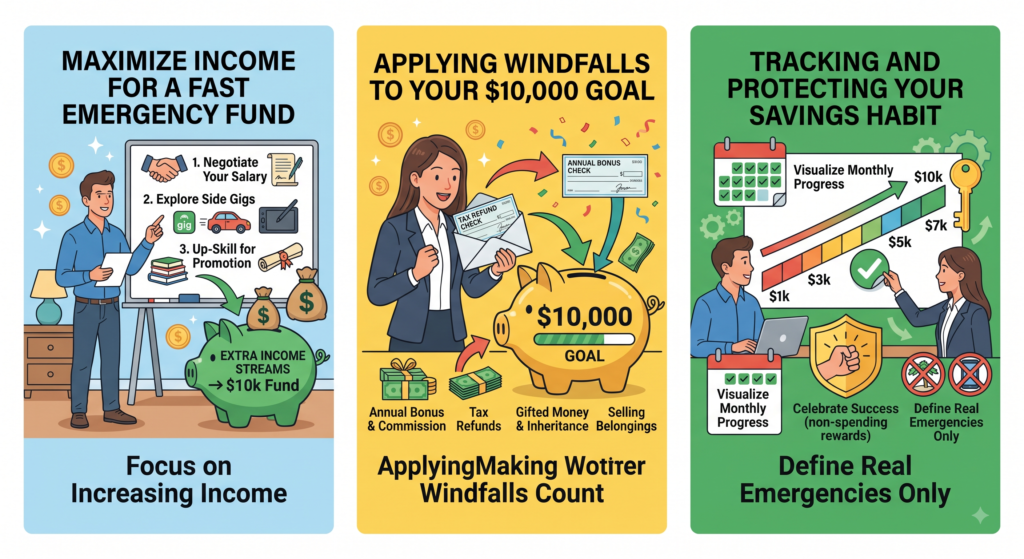
Step 6: Look for Extra Money Without Destroying Your Budget
You don’t necessarily need to make huge lifestyle changes.
Start by looking for expenses that are recurring but not essential.
For example:
- Unused subscriptions
- Excessive delivery fees
- Unused memberships
- Impulse purchases
- Frequent restaurant meals
- Unnecessary app subscriptions
- Banking fees
- Insurance premiums that could potentially be reduced through legitimate comparison shopping
Suppose you identify an extra $150 per month.
Instead of spending it, direct it toward your emergency fund.
That’s:
$150 × 12 = $1,800 per year
Combined with a regular $350 monthly contribution, you could potentially save $6,000 per year.
Step 7: Use Windfalls Strategically
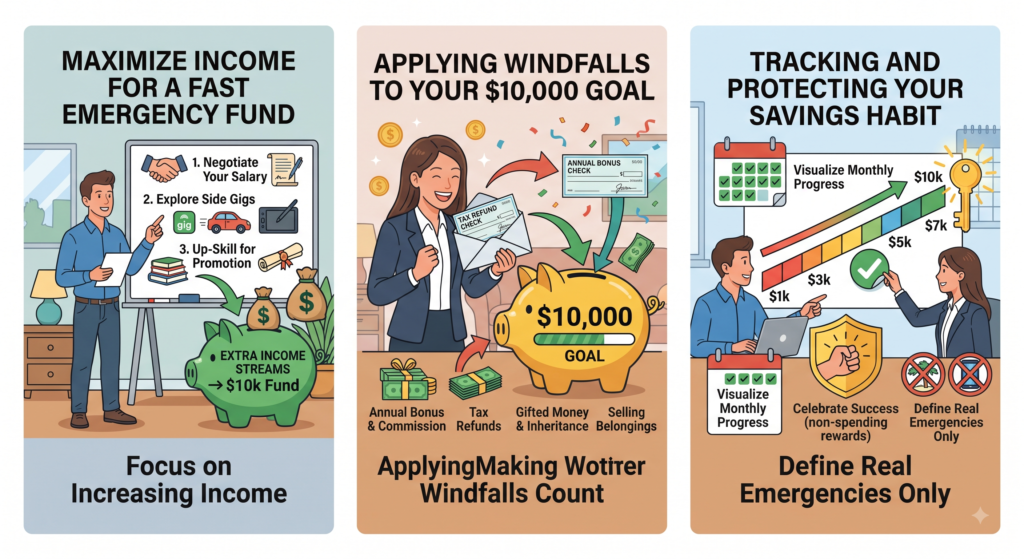
Regular monthly savings aren’t your only opportunity.
You may occasionally receive:
- Tax refunds
- Work bonuses
- Cash gifts
- Overtime income
- Freelance income
- Proceeds from selling unused items
- Other unexpected income
You don’t necessarily need to put 100% of every windfall into your emergency fund.
But directing a meaningful portion toward the $10,000 goal can accelerate your progress.
For example, imagine you save $400 per month and receive an additional $1,500 that you decide to put into your emergency fund.
Your annual contribution could become:
$400 × 12 + $1,500 = $6,300
That is substantially faster than relying only on the monthly contribution.
Step 8: Try a Three-Level Savings Strategy
If saving $10,000 feels impossible, use three stages.
Level 1: Starter Emergency Fund
Target:
$500–$1,000
The purpose is to handle smaller financial shocks without immediately borrowing money.
Level 2: One Month of Essential Expenses
Next, aim to save enough to cover approximately one month of essential expenses.
If your necessary monthly expenses are $2,000, your next target would be around $2,000.
Level 3: Full Emergency Fund
Continue building toward your $10,000 goal or another amount that fits your circumstances.
This staged approach is often more realistic than waiting until you can somehow save thousands of dollars before considering yourself financially prepared.
Step 9: Decide What Counts as an Emergency
One of the biggest challenges isn’t building an emergency fund.
It’s protecting it from unnecessary withdrawals.
Before you reach $10,000, create your own rules.
Good reasons to use an emergency fund
- Unexpected medical expense
- Major essential vehicle repair
- Urgent home repair
- Unexpected loss of income
- Necessary emergency travel
- Essential expense that you cannot reasonably postpone
Usually not emergencies
- Vacation
- New smartphone
- New television
- Routine shopping
- Entertainment
- Planned holiday spending
- An expensive purchase you’ve wanted for months
The CFPB recommends setting personal guidelines for what constitutes an emergency while also emphasizing that you should not be afraid to use the fund when a genuine need arises.
Step 10: Don’t Stop Saving Once You Reach $10,000
Reaching $10,000 is a milestone, not the end of financial planning.
Your circumstances can change.
For example, you may:
- Buy a home
- Have children
- Change jobs
- Take on a larger loan
- Become self-employed
- Experience a significant increase in monthly expenses
If your expenses increase, your emergency-fund target may need to increase too.
Similarly, if you use $3,000 from your $10,000 emergency fund, your balance becomes $7,000.
That’s not failure.
You used the fund for its intended purpose.
The next objective is simply to rebuild it.
A Realistic $10,000 Emergency Fund Plan
Here’s one example of how someone could structure the goal.
Assume they start with $1,000 and save $500 every month.
| Milestone | Starting Balance | Monthly Contribution | Approximate Progress |
|---|---|---|---|
| Starter | $1,000 | — | Already achieved |
| $2,500 | $1,000 | $500 | 3 months |
| $5,000 | $2,500 | $500 | 5 more months |
| $7,500 | $5,000 | $500 | 5 more months |
| $10,000 | $7,500 | $500 | 5 more months |
At that rate, the remaining $9,000 would take approximately 18 months, before considering any interest earned.
The important lesson isn’t that $500 is the correct savings amount.
It’s that a specific contribution + a specific target + a specific timeline makes the goal measurable.
What If You Can’t Save $500 a Month?
Don’t abandon the goal.
If you can save only $50 or $100 per month, start there.
For example:
$100 × 12 months = $1,200
After one year, you haven’t reached $10,000, but you are no longer starting from zero.
The CFPB emphasizes that even small amounts can provide additional financial security and that savings can be built gradually.
You can also increase your contribution later when your income rises or expenses fall.
Should You Pay Off Debt or Build an Emergency Fund First?
This is not always an either-or decision.
If you have no emergency savings at all, building a small initial cash cushion can help protect you from having to borrow for every unexpected expense.
At the same time, high-interest debt can be expensive, so it may make sense to balance emergency savings with debt repayment rather than putting every available dollar toward one goal.
A practical approach for some households could be:
- Build a small starter emergency fund.
- Continue making required debt payments.
- Attack expensive high-interest debt.
- Increase emergency savings over time.
- Build toward your longer-term emergency-fund target.
Your income, interest rates, job stability, dependents, and other obligations should influence the decision.
Where Should You Keep a $10,000 Emergency Fund?
The emergency fund generally shouldn’t be invested in assets that can lose substantial value when you urgently need the money.
The purpose is different from retirement investing.
You want the money to be:
Safe + accessible + separate from everyday spending.
A bank or credit-union savings account can be appropriate for many people. FINRA similarly recommends keeping emergency funds in a safe place where the money is accessible and not exposed to investment risk.
For U.S. readers, the FDIC provides information about deposit insurance and eligible bank deposits. Readers should verify the insurance status and applicable limits of their particular institution and account.
For broader financial-education guidance, the CFPB’s emergency-fund guide is an excellent authoritative resource.
Consumer Financial Protection Bureau — An essential guide to building an emergency fund
Common Mistakes to Avoid
Saving only when you have leftover money
If you wait until the end of the month, there may be nothing left.
Better approach: Treat savings as a planned expense.
Keeping the emergency fund in your spending account
If your emergency savings is mixed with everyday money, you’re more likely to spend it.
Better approach: Use a separate account.
Setting an unrealistic monthly target
A savings target that consistently causes you to miss bills isn’t sustainable.
Better approach: Choose an amount you can maintain.
Investing your emergency fund aggressively
Emergency savings should be available when you need it.
Better approach: Prioritize accessibility and stability over investment returns.
Using the fund for planned purchases
A vacation isn’t an emergency simply because you don’t have enough money for it.
Better approach: Create separate savings goals for planned expenses.
Feeling guilty after using the fund
An emergency fund exists to be used when a genuine emergency occurs.
Better approach: Use it when necessary, then make rebuilding the balance your next goal.
How to Stay Motivated While Saving $10,000
Large savings goals can become boring because progress isn’t always visible.
Make progress easier to see.
You could create a simple tracker:
$0 → $1,000 → $2,500 → $5,000 → $7,500 → $10,000
You can also track your savings percentage.
For example, if you have $3,500:
$3,500 ÷ $10,000 = 35%
You’re already 35% of the way to your target.
That can make the goal feel much more achievable.
Frequently Asked Questions
1. How long does it take to build a $10,000 emergency fund?
It depends on how much you can save each month. Saving $500 monthly would take about 20 months from a $0 starting balance, before interest.
2. Is $10,000 enough for an emergency fund?
It depends on your essential monthly expenses and personal circumstances. For someone with $2,000 in essential monthly expenses, $10,000 represents five months of expenses.
3. Can I build an emergency fund while paying off debt?
Yes. Many people can maintain a starter emergency fund while paying required debt payments and then focus more aggressively on expensive debt.
4. Should my emergency fund be in a savings account?
A savings account can be a practical option because it can provide accessibility while keeping the money separate from everyday spending.
5. Should I invest my emergency fund?
Generally, an emergency fund should prioritize stability and accessibility rather than investment growth. You don’t want to depend on market conditions when an urgent expense occurs.
6. What expenses should an emergency fund cover?
It can cover unexpected and necessary expenses such as major repairs, medical costs, or temporary income loss.
7. What if I can save only $50 a month?
Start with $50. Consistency matters. You can increase your contribution later when your financial situation improves.
8. Should I keep $10,000 in cash at home?
Keeping a small amount of physical cash may be useful, but storing the entire emergency fund at home exposes it to risks such as theft, loss, or damage.
9. What should I do after using my emergency fund?
Rebuild it gradually. If you had to use $3,000, your new short-term goal could be restoring that $3,000 before returning to other savings goals.
10. Is a three-to-six-month emergency fund mandatory?
No. Three to six months is a common guideline, not a universal rule. Your appropriate target depends on your expenses, income stability, household responsibilities, and financial situation.
Final Thoughts
Learning how to build a $10,000 emergency fund is less about finding one dramatic way to save money and more about creating a repeatable system.
Start with a smaller milestone. Calculate your essential expenses. Choose a monthly contribution that you can realistically maintain. Automate the transfers. Keep the money accessible and separate from everyday spending. Then increase your savings rate whenever your financial situation allows.
Most importantly, don’t let the $10,000 target discourage you if you’re starting with $0.
$500 is better than $0.
$1,000 is better than $500.
And consistent progress is what eventually turns a small savings habit into meaningful financial protection.
An emergency fund isn’t designed to make you rich. Its purpose is to give you financial breathing room when something goes wrong—and that protection can be valuable long before you reach $10,000.