Paying back student loans can feel complicated, especially when you are faced with different repayment plans, changing monthly payments, interest charges, consolidation decisions, and potential forgiveness programs.
The good news is that borrowers generally have more than one way to manage their student debt. The challenge is choosing an option that fits both your current income and your long-term financial goals.
This Student Loan Repayment Options guide explains the major federal repayment plans, income-driven repayment, the newer repayment changes that took effect in 2026, Public Service Loan Forgiveness, consolidation, deferment and forbearance, strategies for paying loans faster, and what to do if your monthly payment is no longer affordable.
Important: This article focuses primarily on U.S. federal student loans. Federal student loan rules and repayment programs are changing, particularly following changes that took effect in 2026. Private student loans have different rules and should be evaluated directly with the lender. Always verify your current eligibility and payment options through StudentAid.gov and your loan servicer.
What Are Student Loan Repayment Options?
Student loan repayment options are the different methods available for paying back borrowed education debt.
For federal student loans, your available choices can depend on:
- Type of federal loan
- When the loan was first disbursed
- Loan balance
- Income
- Family size
- Whether you work for a qualifying employer
- Whether you have consolidated loans
- Other eligibility requirements
The U.S. Department of Education provides a Loan Simulator that allows borrowers to compare estimated monthly payments, total amounts paid, payoff dates, and potential forgiveness under available repayment options.
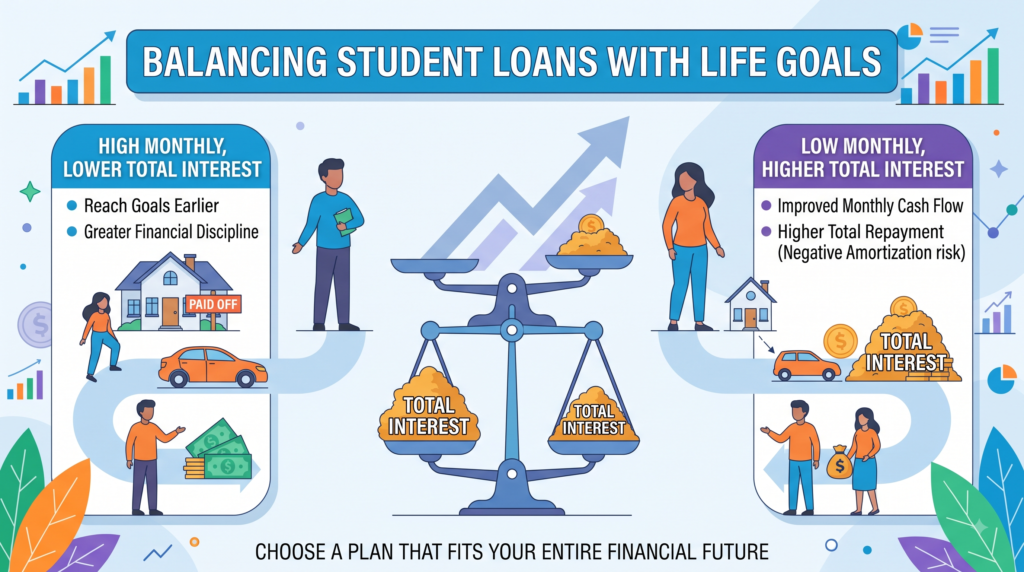
This is important because the plan with the lowest monthly payment is not necessarily the plan that costs the least over the life of the loan.
Why Choosing the Right Repayment Plan Matters
Consider a borrower with $40,000 in federal student debt.
One repayment plan might require a relatively high monthly payment but pay the debt off quickly.
Another might provide a substantially lower monthly payment but extend repayment over many years.
A third option could tie payments to income and potentially provide forgiveness after the borrower meets the applicable requirements.
These plans can produce very different financial outcomes.
When comparing Student Loan Repayment Options, look at at least four things:
- Monthly payment
- Total amount paid
- Expected payoff date
- Potential forgiveness
Federal Student Aid’s Loan Simulator specifically allows borrowers to compare these types of outcomes side by side.
Federal vs. Private Student Loan Repayment
Before choosing a repayment strategy, determine whether your loans are federal or private.
This distinction is extremely important.
Federal student loans
Federal loans can provide access to programs such as:
- Income-driven repayment
- Public Service Loan Forgiveness
- Certain deferment options
- Certain forbearance options
- Federal consolidation
- Other federal protections
Private student loans
Private loans are governed by the lender’s contract rather than the federal student loan system.
Your options may depend on:
- Lender
- Loan agreement
- Credit profile
- Income
- Refinancing eligibility
- Lender-specific hardship programs
Federal Student Aid notes that federal loans generally offer more repayment flexibility than private student loans, including income-based options and certain postponement programs.
Never assume that a private student loan qualifies for a federal repayment plan.
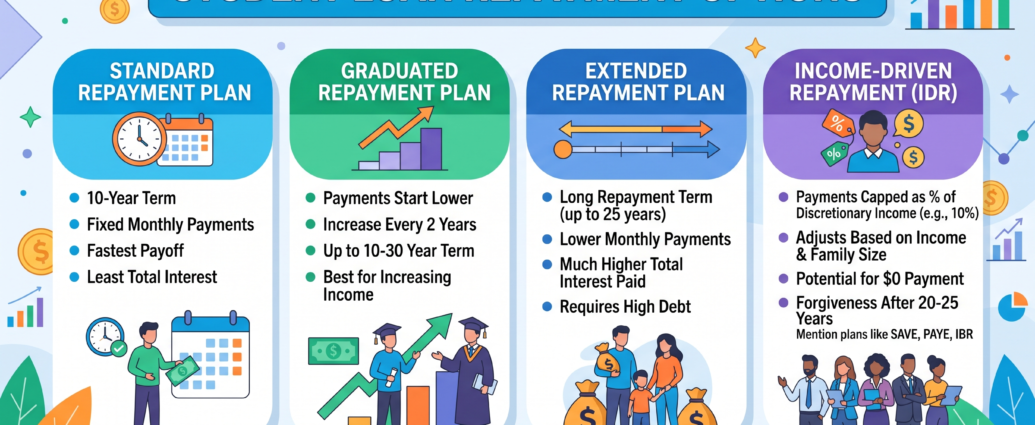
Standard Repayment Plan
The Standard Repayment Plan is designed around fixed payments over a defined repayment period.
For borrowers with eligible older federal loans, the traditional Standard Plan generally provides equal monthly payments and is commonly associated with a 10-year repayment period.
One major advantage is simplicity.
You know approximately what your payment will be and when the loan is expected to be paid off.
Advantages
- Predictable payments
- Faster payoff than many extended plans
- Generally less total interest than a longer repayment period
- Simple to understand
Disadvantages
- Monthly payments can be relatively high
- May be difficult for borrowers with low income
- May not minimize payments for borrowers pursuing certain income-driven programs
If you can comfortably afford the Standard Plan, it can be an efficient way to eliminate student debt.
Tiered Standard Repayment Plan
Federal student loan repayment rules changed significantly in 2026.
A Tiered Standard Plan became available beginning July 1, 2026, for eligible borrowers with certain Direct Loans. Under this structure, the repayment period can vary based on the amount owed, with terms ranging from 10 to 25 years depending on the balance.
This is important for borrowers who may see different options than those described in older student-loan articles published before 2026.
Because eligibility depends on the timing and type of your federal loans, borrowers should use their current StudentAid.gov account and Loan Simulator rather than relying on an outdated repayment chart.
Graduated Repayment Plan
Under a Graduated Repayment Plan, payments generally start lower and increase over time.
This structure can make sense for someone who expects their income to grow substantially during their career.
For example, a recent graduate might begin with an entry-level salary and expect significantly higher earnings after several years.
A graduated payment structure can provide more manageable early payments.
The trade-off
You generally pay more interest than you would under a shorter, fixed repayment schedule because the balance takes longer to repay.
Federal student loan servicer guidance describes graduated repayment as a plan in which payments increase periodically and notes that it can result in more interest than the Standard Plan.
Extended Repayment Plan
The Extended Repayment Plan can provide a longer repayment period, potentially reducing the required monthly payment.
Eligible borrowers with more than $30,000 in qualifying federal loan debt may be able to use an Extended Plan, depending on the applicable loan and disbursement rules.
Payments may be structured as either:
- Fixed payments
- Graduated payments
Advantages
- Lower monthly payment
- Longer repayment period
- Can provide breathing room in a tight budget
Disadvantages
- More interest over time
- Debt remains outstanding for longer
- May not be the best choice if your goal is rapid debt elimination
A lower monthly payment should therefore be evaluated alongside the total amount you will eventually pay.
Income-Driven Repayment Plans
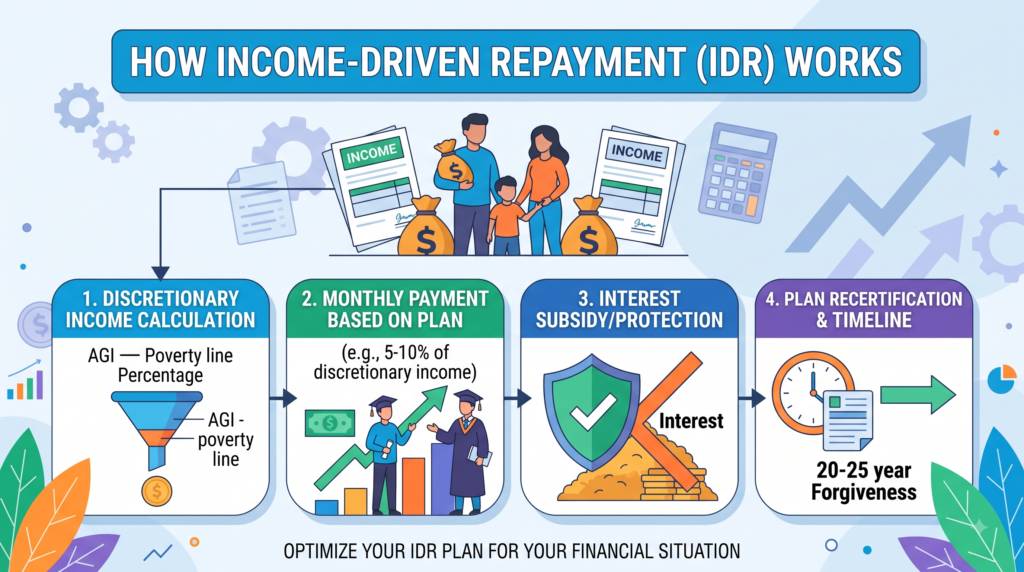
Income-driven repayment, commonly abbreviated IDR, is designed to make federal student loan payments more closely related to a borrower’s income and family circumstances.
Instead of basing the payment primarily on the amount owed, an IDR plan uses factors such as:
- Income
- Family size
- Eligible loan type
- Applicable federal rules
Federal Student Aid explains that income-driven plans can reduce monthly payments for eligible borrowers and that remaining balances may be forgiven after the applicable repayment period if the borrower meets the program requirements.
This can be particularly useful for borrowers whose student debt is large relative to their income.
Repayment Assistance Plan (RAP)
One of the major changes to federal student loan repayment in 2026 is the Repayment Assistance Plan (RAP).
RAP became available beginning July 1, 2026, as part of the updated federal student loan repayment framework.
The availability of RAP is especially important for borrowers reading older articles about student loan repayment because older content may focus on repayment programs that have since changed.
Federal Student Aid’s current guidance should be used to determine whether RAP applies to your specific loans and circumstances.
Who should investigate RAP?
Borrowers should consider checking RAP if:
- They have eligible Direct Loans
- Their income is relatively low compared with their student debt
- They want an income-based payment
- They are evaluating new repayment options after the 2026 changes
Because the rules surrounding federal repayment plans are changing, use the official Loan Simulator for a personalized estimate rather than relying on a generic payment example.
Income-Based Repayment (IBR)
Income-Based Repayment (IBR) is an income-driven repayment option for eligible federal student loan borrowers.
The payment is based on income and other applicable factors rather than simply dividing the loan balance into equal payments.
Under current Federal Student Aid guidance, qualifying borrowers can potentially receive forgiveness of a remaining balance after the applicable period of qualifying repayment. The exact period depends on when the borrower became a new borrower and other eligibility requirements.
IBR can be particularly relevant to borrowers whose monthly payment under a standard plan would be difficult to afford.
Pay As You Earn (PAYE)
The Pay As You Earn (PAYE) plan is another income-driven repayment program that has historically provided payments based on income.
However, borrowers should be careful when reading older PAYE information.
Federal student loan rules changed in 2026, and Federal Student Aid’s current guidance indicates that PAYE is among the existing plans affected by the transition rules.
Borrowers currently using or considering PAYE should check their StudentAid.gov account and current federal guidance rather than relying on older articles that describe PAYE as a permanently available option.
Income-Contingent Repayment (ICR)
The Income-Contingent Repayment (ICR) Plan is another federal income-driven option.
Eligibility depends on the borrower’s loan type and current federal rules.
Federal Student Aid currently explains that ICR has historically allowed eligible borrowers to make income-based payments and potentially receive forgiveness of a remaining balance after the applicable repayment period.
However, ICR is also subject to the 2026 transition rules.
If you are currently enrolled in ICR or considering it, check your current StudentAid.gov options before making a decision.
What Happened to the SAVE Plan?
This is an important update for anyone researching Student Loan Repayment Options in 2026.
The Saving on a Valuable Education (SAVE) Plan is no longer an available repayment option following a court order in March 2026.
Federal student loan servicer guidance states that the court order ended the SAVE Plan and that affected borrowers need to select another repayment plan after receiving appropriate notification.
This means older online articles recommending SAVE as a current repayment option may now be outdated.
If you were previously enrolled in SAVE or had a pending SAVE application, check your StudentAid.gov account and communications from your loan servicer for instructions about selecting a new plan.
Public Service Loan Forgiveness (PSLF)
Public Service Loan Forgiveness can be extremely valuable for qualifying borrowers.
PSLF is designed for eligible borrowers who work full time for qualifying government or nonprofit organizations.
Under current Federal Student Aid guidance, qualifying borrowers may receive forgiveness of the remaining balance on eligible Direct Loans after making 120 qualifying monthly payments while meeting the program’s employment and repayment requirements.
Who might qualify?
Potential qualifying employers include certain:
- Government organizations
- Nonprofit organizations
The employer—not simply your job title—is critical.
A person working as a nurse, accountant, teacher, IT professional, or administrator could potentially qualify if the employer and other program requirements are satisfied.
Important point
Don’t wait until you have made 120 payments before checking your eligibility.
Use the official PSLF tools and periodically verify that your employment and payments are being counted correctly.
Student Loan Consolidation
Federal loan consolidation combines eligible federal student loans into a single Direct Consolidation Loan with one monthly payment.
Federal Student Aid explains that consolidation can simplify repayment but also has potential disadvantages. Its Loan Simulator can help borrowers evaluate whether consolidation makes sense for their circumstances.
Why borrowers consider consolidation
You might consider consolidation if you want:
- One monthly payment
- Simplified loan management
- Access to certain repayment programs
- A way to manage multiple federal loans
Potential drawbacks
Consolidation is not automatically beneficial.
Depending on your situation, it may affect:
- Interest costs
- Repayment period
- Monthly payment
- Eligibility for certain benefits
- Treatment of prior qualifying payments under applicable rules
Never consolidate simply because someone tells you that “one payment is always better.”
Compare the financial consequences first.
Deferment vs. Forbearance
If you cannot afford your payments temporarily, you may hear about deferment and forbearance.
Both can allow borrowers to temporarily postpone or reduce payments under qualifying circumstances, but they are not identical.
Deferment
A deferment temporarily postpones required payments for eligible borrowers who meet specific conditions.
Depending on the loan type and deferment category, interest may continue to accrue.
Forbearance
Forbearance can temporarily pause or reduce payments when the borrower meets applicable requirements.
Interest generally continues to accrue during forbearance.
Why this matters
A payment pause does not necessarily mean the debt stops growing.
If interest accumulates, your balance can increase unless the accrued interest is handled according to the applicable program rules.
Federal Student Aid’s Loan Simulator allows borrowers to estimate how a payment pause could affect interest, principal, and future payments.
What Happens If You Can’t Afford Your Student Loan Payment?
Do not simply stop paying.
Contact your loan servicer as soon as you realize that your payment is becoming unaffordable.
Depending on your circumstances, you may be able to:
- Change repayment plans
- Apply for an income-driven plan
- Explore deferment
- Explore forbearance
- Consolidate eligible federal loans
- Seek other assistance
Federal Student Aid specifically recommends using Loan Simulator to explore options when borrowers are struggling with payments.
The worst strategy is often ignoring the problem until you miss multiple payments.
How to Pay Off Student Loans Faster
If your income allows you to pay more than the required amount, you can consider an accelerated repayment strategy.
Strategy 1: Pay extra toward principal
Additional payments can reduce your outstanding balance more quickly.
However, check your servicer’s instructions to make sure additional payments are applied as you intend.
Strategy 2: Use windfalls
Consider directing part of:
- Tax refunds
- Bonuses
- Overtime income
- Gifts
- Side-income
toward your loans if doing so fits your broader financial plan.
Strategy 3: Avoid lifestyle inflation
If your income increases after graduation, consider increasing your student loan payment before significantly increasing discretionary spending.
Example
Your monthly income increases by $500.
Instead of spending the entire increase, you could direct:
$300 → student loans
$200 → savings
That approach can accelerate debt reduction while still improving your financial cushion.
Should You Pay Student Loans Early?
There is no universal answer.
Paying loans early can reduce future interest and eliminate debt faster.
But you should also consider other financial priorities.
For example, it may not make sense to aggressively pay a student loan while you have:
- No emergency fund
- High-interest credit card debt
- No retirement savings
- Unaffordable essential expenses
A reasonable order of priorities might be:
- Cover essential expenses
- Build a basic emergency fund
- Address high-interest debt
- Capture available employer retirement matches
- Then accelerate lower-interest student debt
The correct order depends on your financial situation.
How Autopay Can Help
Automatic payments can reduce the chance of accidentally missing a payment.
Federal student loan servicers may also provide an interest-rate reduction for qualifying borrowers who enroll in automatic payments.
Current 2026 federal servicing guidance indicates that the automatic-payment interest-rate reduction increased to 1% for eligible Direct Loans disbursed on or after July 1, 2012, subject to the applicable temporary program rules and enrollment requirements.
Because this benefit is subject to specific eligibility and timing requirements, verify the current terms with your federal loan servicer before relying on it.
How Marriage Can Affect Student Loan Payments
Marriage can affect income-driven repayment calculations depending on the repayment plan and applicable rules.
Federal Student Aid explains that how a spouse’s income is treated can vary by repayment plan. Some plans may use joint income, while others may use individual income depending on circumstances and current program rules.
This is an important consideration for borrowers who are:
- Getting married
- Recently married
- Both carrying student loans
- Considering an income-driven repayment plan
Do not assume that filing taxes jointly or separately will automatically produce the lowest student loan payment.
Compare the actual numbers under the applicable plan.
Student Loan Repayment Strategy for Different Borrowers
There is no single best repayment plan.
If you have a stable, high income
A Standard or other fixed-payment plan may make sense if your goal is to eliminate debt quickly and minimize interest.
If your income is low
An income-driven option may provide a more manageable monthly payment if you qualify.
If you work for government or a qualifying nonprofit
Investigate PSLF before making extra payments that could reduce the balance potentially eligible for forgiveness.
If you have multiple federal loans
Compare consolidation with keeping the loans separate.
If your payments are unaffordable
Contact your servicer immediately and investigate available income-driven or temporary relief options.
If you have private loans
Speak directly with your private lender about refinancing, hardship programs, modified payments, or other available options.
How to Compare Student Loan Repayment Options
Use this simple framework.
| Factor | What to Ask |
|---|---|
| Monthly payment | Can I comfortably afford it? |
| Interest | How much interest will I pay? |
| Term | When will the loan be paid off? |
| Forgiveness | Could I qualify for forgiveness? |
| Income | Will my payment change if my income changes? |
| Family size | Does family size affect the calculation? |
| Employment | Does my employer qualify for PSLF? |
| Loan type | Are my loans eligible? |
| Consolidation | Would combining loans help or hurt? |
| Flexibility | What happens if my income falls? |
The official Federal Student Aid Loan Simulator is particularly useful because it can compare estimated monthly payments, total repayment, payoff dates, and potential forgiveness.
Where to Find Reliable Student Loan Repayment Information
Student loan rules can change, and 2026 has brought significant changes to federal repayment programs. That makes official sources especially important.
The U.S. Department of Education’s Federal Student Aid website is the primary source borrowers should use to check current federal repayment options.
Federal Student Aid — Loan Repayment and Loan Simulator
Federal Student Aid’s Loan Simulator can compare available repayment plans and estimate monthly payments, total amounts paid, payoff dates, and potential forgiveness.
The Consumer Financial Protection Bureau (CFPB) also provides independent consumer education about income-driven repayment plans and federal student loan repayment.
CFPB — Student Loan Repayment Information
When researching repayment options, be particularly cautious with old articles. Programs such as SAVE have changed or ended, while new repayment options such as RAP and Tiered Standard became available in 2026.
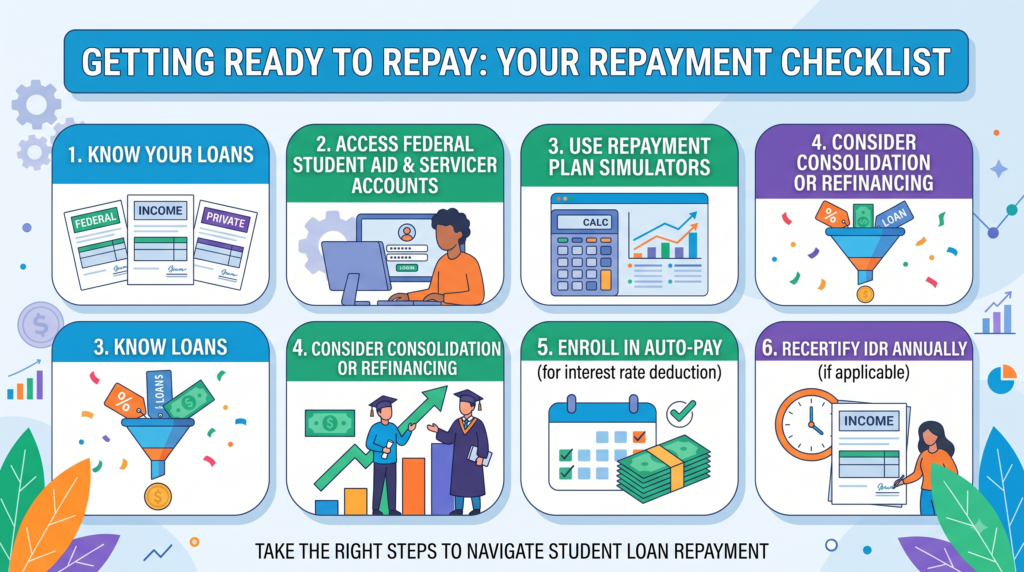
A Practical Student Loan Repayment Checklist
Before choosing a repayment plan, review:
- Loan type
- Current balance
- Interest rate
- Current monthly payment
- Income
- Family size
- Employer
- PSLF eligibility
- Available repayment plans
- Total projected repayment
- Potential forgiveness
- Consolidation consequences
- Deferment and forbearance options
- Autopay benefits
Then use the official Loan Simulator to compare your options.
Final Thoughts on Student Loan Repayment Options
Choosing among Student Loan Repayment Options is ultimately a financial planning decision, not simply a matter of finding the smallest monthly payment.
A lower payment can provide valuable breathing room, but a longer repayment period may increase the total amount of interest you pay.
On the other hand, aggressively paying down loans may not always be the best move if you are pursuing a forgiveness program such as PSLF or if you have more expensive financial obligations elsewhere.
The most important step is understanding your specific loans.
Check your StudentAid.gov account, determine which loans you have, review your current repayment plan, and use the official Loan Simulator to compare alternatives.
And because federal student loan rules changed substantially in 2026, avoid relying on older articles that present programs such as SAVE as current options.
The best student loan repayment strategy is the one that fits your income, loan type, career plans, financial priorities, and long-term goals—not simply the plan with the lowest payment today.
Frequently Asked Questions About Student Loan Repayment Options
1. What are the main student loan repayment options?
Federal borrowers may have fixed-payment, graduated, extended, and income-driven repayment options, depending on their loan type and when the loans were disbursed.
2. What is the Standard Repayment Plan?
The Standard Plan generally uses fixed payments over a defined repayment period and can help borrowers repay their loans relatively quickly.
3. What is the Tiered Standard Plan?
The Tiered Standard Plan is a federal repayment option introduced beginning July 1, 2026, with the repayment period determined in part by the borrower’s eligible loan balance.
4. What is an income-driven repayment plan?
An income-driven repayment plan bases the required payment on factors such as income and family size rather than only the amount borrowed.
5. Is the SAVE Plan still available?
No. The SAVE Plan ended following a court order in March 2026. Borrowers affected by the change should review their current repayment options through StudentAid.gov and their loan servicer.
6. What is the Repayment Assistance Plan?
The Repayment Assistance Plan, or RAP, is a new federal repayment option available beginning July 1, 2026, for eligible borrowers.
7. What is Public Service Loan Forgiveness?
PSLF can forgive the remaining balance on eligible Direct Loans after qualifying borrowers make 120 qualifying payments while working full time for an eligible employer and meeting other program requirements.
8. Can student loans be forgiven?
Some federal student loans may qualify for forgiveness through programs such as IDR forgiveness and PSLF, but eligibility requirements must be satisfied.
9. Should I choose the repayment plan with the lowest monthly payment?
Not necessarily. A lower payment can result in a longer repayment period and potentially more interest. Compare the total projected cost as well as the monthly payment.
10. How do I know which repayment plan is best for me?
Use the Federal Student Aid Loan Simulator and compare your monthly payment, total repayment, payoff date, and potential forgiveness under the plans available to you.
11. Can I change my student loan repayment plan?
Eligible federal borrowers can generally change repayment plans when permitted by current federal rules. Your available options depend on your loans and circumstances.
12. What happens if I cannot afford my student loan payment?
Contact your loan servicer immediately. You may be able to change repayment plans or explore income-driven repayment, deferment, forbearance, or other available assistance.
13. What is student loan consolidation?
Federal consolidation combines eligible federal student loans into one Direct Consolidation Loan with one monthly payment. It can simplify repayment but may have financial and eligibility consequences.
14. Is student loan consolidation always a good idea?
No. Consolidation can be useful in some situations but can also affect repayment terms, interest costs, and certain benefits. Compare the results before consolidating.
15. What is deferment?
Deferment is a temporary postponement of required student loan payments available to eligible borrowers who meet specific conditions.
16. What is forbearance?
Forbearance can temporarily pause or reduce payments for eligible borrowers, but interest may continue to accrue.
17. Does interest continue during deferment or forbearance?
Interest treatment depends on the loan type and specific relief program. Borrowers should check their loan terms because interest can continue to accumulate during many payment pauses.
18. Should I pay my student loans off early?
Paying loans early can reduce interest, but consider your emergency savings, higher-interest debt, retirement contributions, and potential forgiveness eligibility before aggressively accelerating repayment.
19. Can I make extra payments on federal student loans?
Generally, borrowers can make extra payments, and doing so can reduce the principal faster. Check with your servicer about how additional payments are applied.
20. Does autopay lower student loan interest?
Eligible federal borrowers may receive an interest-rate reduction for qualifying automatic payments. Current 2026 guidance indicates a 1% reduction for certain eligible Direct Loans, subject to program requirements.
21. Can I use an income-driven plan if I have private student loans?
Federal income-driven repayment plans generally apply to eligible federal student loans, not ordinary private student loans. Contact your private lender to learn about its repayment options.
22. Does marriage affect student loan payments?
It can. How your spouse’s income affects an income-driven payment depends on the specific repayment plan and applicable federal rules.
23. What happens if I miss student loan payments?
Missing payments can result in fees, delinquency, credit consequences, and potentially default if the problem continues. Contact your servicer as soon as possible if you are struggling.
24. Where can I calculate my student loan payment?
Federal Student Aid’s Loan Simulator can estimate monthly payments, total repayment, payoff dates, and potential forgiveness under available plans.
25. Where should I check my current federal student loan information?
Log in to your StudentAid.gov account. Your account can show your federal loans, balances, interest information, repayment plan, servicer, and upcoming payment information.
Editorial and E-E-A-T Note
Last Updated: August 2026
Federal student loan repayment rules are undergoing significant changes. This article has been updated to reflect the 2026 repayment framework, including the availability of the Repayment Assistance Plan and Tiered Standard Plan and the end of the SAVE Plan.
Because eligibility depends on individual loan types, disbursement dates, income, family circumstances, and other factors, readers should verify their options through StudentAid.gov and their federal loan servicer before making a repayment decision.
This article is for educational purposes only and is not personalized financial, legal, or tax advice.