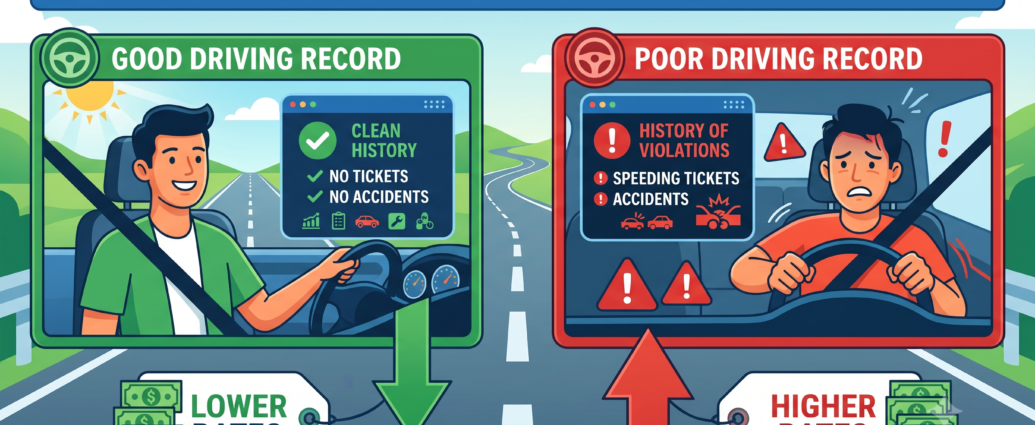
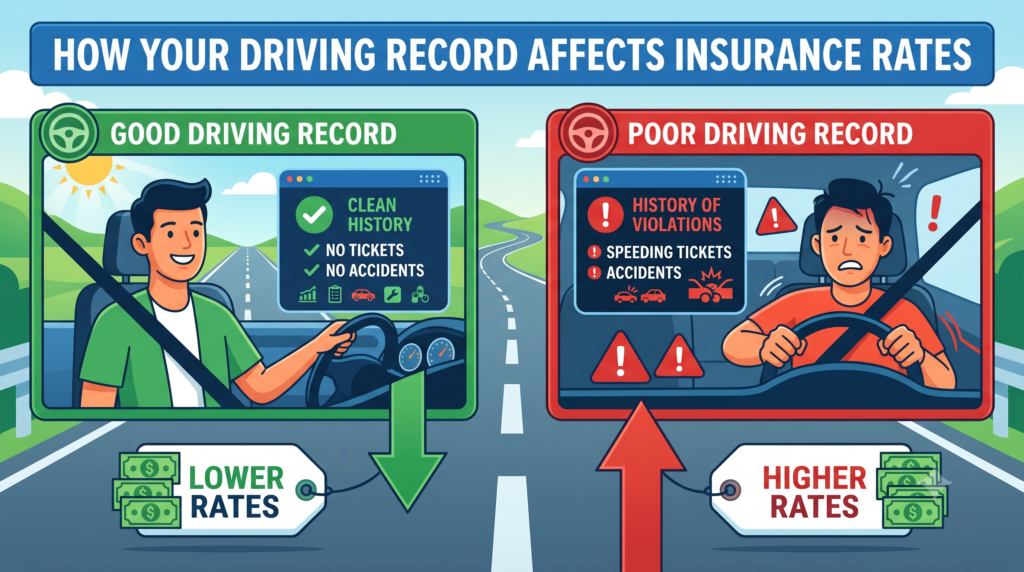
Your driving record is one of the most important pieces of information insurers can use when determining how much you pay for car insurance. Speeding tickets, at-fault accidents, reckless driving convictions, and other violations can signal a higher likelihood of future claims, which may lead to higher premiums.
However, a driving violation does not automatically mean every insurer will charge you the same amount. Insurance companies use different rating systems, and the effect of an incident can depend on its severity, when it occurred, whether you were at fault, your claims history, and other characteristics of your policy.
Understanding how your driving record affects insurance rates can help you make better decisions when comparing policies, renewing coverage, or trying to reduce your premium after a ticket or accident.
What Is a Driving Record?
A driving record is a history of your driving-related activity maintained by government licensing authorities. Depending on where you live, it can contain information such as traffic violations, license suspensions, serious driving offenses, and accident-related information.
When you apply for insurance, an insurer may review your driving history as part of its underwriting and rating process. The National Association of Insurance Commissioners (NAIC) explains that driving records are among the factors insurers can consider when determining premiums.
Insurers generally use this information to estimate risk. A driver with a history of serious violations or multiple accidents may statistically represent a greater risk than someone with a clean record.
That does not mean the insurer is predicting that you will definitely have an accident. Rather, your past driving behavior is one data point used to estimate the probability and potential cost of future claims.
Why Does Your Driving Record Affect Insurance Rates?
Insurance pricing is fundamentally based on risk.
An insurer collects premiums from many policyholders and uses those premiums to pay covered claims and operating expenses. To set prices, insurers evaluate characteristics associated with the likelihood and potential cost of claims.
The NAIC describes two major parts of this process: underwriting and rating. Underwriting evaluates risk and determines how an applicant fits within the insurer’s risk categories, while rating translates that risk assessment into a premium.
Your driving record matters because past driving behavior can provide information about future risk.
For example, a driver with several recent speeding violations may be viewed differently from a driver with no recent violations. Likewise, multiple at-fault accidents may suggest a higher level of risk than a long accident-free driving history.
How Different Driving Violations Can Affect Your Premium
Not every violation carries the same consequences. Insurers can distinguish between relatively minor offenses and serious violations.
Speeding Tickets
Speeding tickets are among the most common driving violations.
A single minor speeding ticket may have a relatively limited effect, depending on the insurer and the circumstances. However, repeated speeding violations can make the driver appear riskier.
The severity of the violation can also matter. A ticket for exceeding the speed limit by a small amount may be treated differently from a major speeding offense.
If you receive a speeding ticket, avoid assuming that your insurance will automatically increase by a specific percentage. There is no universal surcharge that applies to every driver and insurer.
Reckless or Dangerous Driving
Reckless driving is generally more serious than an ordinary speeding violation because it indicates a potentially greater safety risk.
A serious conviction may therefore have a more significant impact on insurance pricing than a minor traffic citation. Depending on local regulations and the insurer’s underwriting rules, serious violations can also affect whether a company is willing to continue providing coverage.
Driving Under the Influence
Driving under the influence of alcohol or drugs is one of the most serious driving offenses from an insurance perspective.
A DUI or similar conviction can result in substantially more complicated and expensive insurance arrangements. The driver may face higher premiums, difficulty finding standard coverage, or requirements imposed by the relevant licensing authority.
The exact consequences depend heavily on state or national law and the insurer’s underwriting rules.
At-Fault Accidents
An at-fault accident can have a particularly important effect on insurance pricing because it provides evidence that a covered loss occurred and that the insured driver was responsible, at least in part.
Insurers may consider factors such as:
- Whether you were at fault
- The severity of the accident
- Whether a claim was filed
- The amount paid on the claim
- Whether similar accidents occurred previously
- How recently the accident happened
The NAIC specifically identifies driving record and claims history among the factors insurers may use in determining premiums.
Multiple Accidents
One accident does not necessarily tell the same story as several accidents.
If a driver has multiple accidents within a relatively short period, an insurer may consider the pattern more concerning than an isolated incident.
This is important because insurers are interested not only in individual events but also in patterns that may indicate continuing risk.
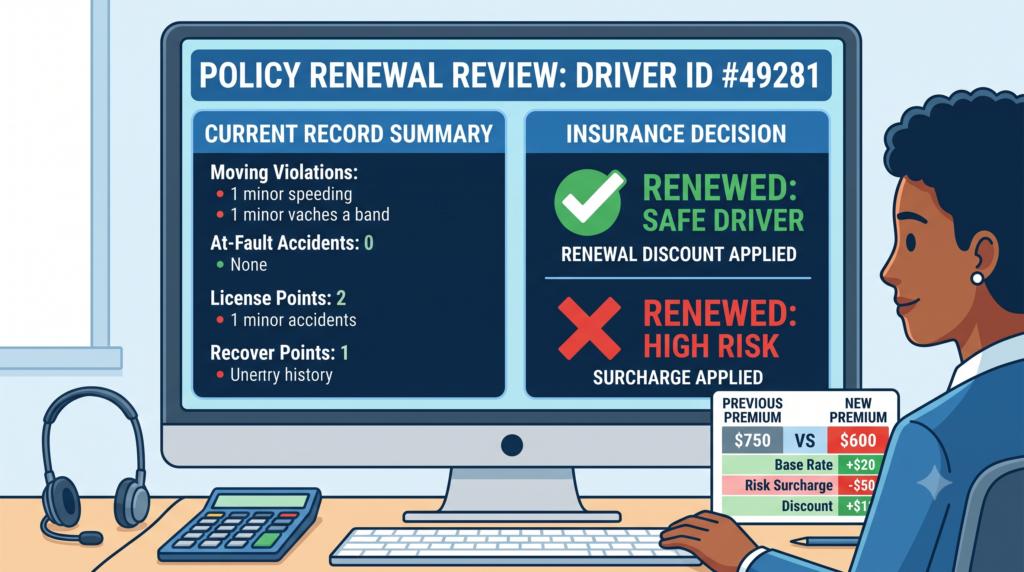
Do Not-At-Fault Accidents Increase Insurance Rates?
Many drivers assume that an accident they did not cause can never affect their premium. The reality can be more complicated.
Premium increases are generally more likely when an accident is the driver’s fault. However, insurers may consider claims and accident history more broadly, and local rules can affect what insurers are allowed to do.
The NAIC notes that even not-at-fault accidents can sometimes affect premiums, particularly when there are multiple incidents within a policy period.
Therefore, it is important to distinguish between fault for an accident and the insurer’s overall assessment of claims risk.
How Long Does a Driving Record Affect Insurance Rates?
There is no single nationwide period that applies to every insurer and every type of violation.
The NAIC’s consumer guidance indicates that insurers commonly consider driving records from approximately the previous three to five years, although the precise period can vary.
This means an old ticket may not have the same effect as a recent violation.
For example, imagine two drivers have each received one speeding ticket. Driver A received the ticket last month, while Driver B received the ticket several years ago. An insurer may treat their records differently because the incidents have different levels of recency.
Serious offenses can have different legal and underwriting consequences, so drivers should not assume that every violation disappears from consideration after exactly three or five years.
Does a Clean Driving Record Lower Insurance Rates?
A clean driving record can help you qualify for better pricing with insurers that offer good-driver or claim-free discounts.
Insurers may view drivers without recent violations or accidents as lower-risk customers. The NAIC lists good-driver and renewal discounts among the types of discounts consumers should ask insurers about.
However, a clean driving record does not guarantee the lowest possible premium.
Insurance companies consider multiple factors, including:
- Age and driving experience
- Location
- Vehicle type
- Annual mileage
- Coverage limits
- Deductible
- Claims history
- Prior insurance coverage
- Other drivers on the policy
- Applicable credit-based insurance information, where permitted
Therefore, a driver with an excellent record could still pay more than another driver because of differences in vehicle, location, coverage, or other rating factors.
Your Driving Record Is Not the Only Factor
One of the biggest mistakes consumers make is assuming that their driving record completely determines their insurance price.
It does not.
The NAIC identifies several major rating factors, including location, age, driving experience, driving record, claims history, vehicle type, vehicle use, mileage, previous insurance coverage, and selected coverage and deductible levels.
Consider two drivers with identical driving histories.
One drives an expensive performance vehicle in a high-traffic urban area and travels 20,000 miles per year. The other drives an older vehicle in a lower-risk area and travels 7,000 miles per year.
Their premiums could be substantially different even though their driving records are identical.
How Insurance Companies Check Your Driving History
When you apply for coverage, an insurer may obtain information from motor vehicle records and other data sources.
The NAIC notes that insurers may obtain information about traffic convictions from state motor vehicle authorities and claims information from third-party sources such as claims databases.
This is one reason you should provide accurate information when requesting a quote.
If you forget about an old violation or accidentally provide incorrect information, the initial quote may not match the final price after the insurer verifies your information.
What Happens When You Add Another Driver?
Your insurance premium can also be affected by the driving record of another driver covered by your policy.
This is particularly important in households with multiple drivers.
The NAIC notes that insurers can consider the driving records of other drivers covered by the policy. Some insurers may also use rules involving the principal operator or highest-risk driver when determining the premium for a vehicle.
For example, adding a young driver with several violations can potentially affect the household’s overall insurance cost.
This is why it is important to understand who is listed on your policy and how your insurer evaluates household drivers.
Can You Lower Your Insurance Rate After a Ticket?
Yes, there are several steps that may help, although none guarantees an immediate reduction.
1. Maintain a Clean Record Going Forward
The simplest long-term strategy is to avoid accumulating additional violations.
As older incidents become less relevant to an insurer’s rating period, a cleaner recent record may improve your insurance options.
2. Compare Multiple Insurers
Do not assume your current insurer will always offer the best price after a violation.
Different insurers can evaluate the same driving record differently. Comparing several quotes can reveal meaningful differences.
The NAIC recommends comparing insurance products carefully and making sure quotes use comparable coverage limits and deductibles.
3. Ask About Driver Discounts
Depending on the insurer and your location, you may qualify for discounts based on safe driving, driver education, vehicle safety features, low mileage, multiple vehicles, or bundling policies.
Ask specifically which discounts are available rather than assuming you automatically receive them.
4. Consider Usage-Based Insurance
Some insurers offer usage-based insurance programs that evaluate driving behavior through telematics.
These programs can consider factors such as mileage, time of day, hard braking, rapid acceleration, and other driving behaviors.
For a driver who has improved their habits, such a program may be worth investigating.
However, understand what data the program collects and how the insurer uses that information before enrolling.
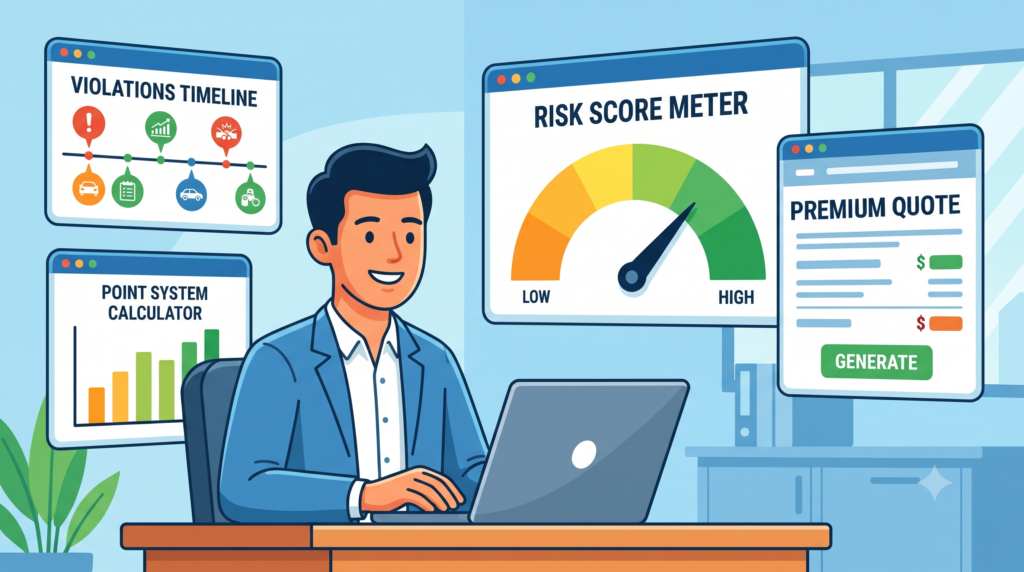
How to Shop for Insurance With a Bad Driving Record
Having a ticket or accident does not mean you should stop comparing insurance.
In fact, comparison shopping may become even more important.
When requesting quotes, provide the same information to every insurer, including:
- Vehicle details
- Driver information
- Driving history
- Coverage limits
- Deductibles
- Annual mileage
- Vehicle use
Comparing policies on price alone can be misleading. A cheaper quote may provide lower coverage limits or a higher deductible.
A useful comparison should evaluate both premium and protection.
How Driving Record Affects Insurance in India
The insurance system differs significantly between countries, so U.S.-based explanations should not automatically be applied to Indian motor insurance.
In India, the Insurance Regulatory and Development Authority of India (IRDAI) states that own-damage motor insurance pricing can vary between insurers and may take factors such as vehicle age, applicable discounts or loadings, past claims experience, and Insured Declared Value (IDV) into account. Third-party liability premium rates are regulated by IRDAI.
This distinction is important.
A driver’s traffic history and an insurance claim history are not necessarily treated as identical factors. For Indian consumers, past claims experience, previous insurance history, vehicle characteristics, IDV, and applicable discounts or loadings can be especially important when comparing motor insurance.
The practical lesson is simple: do not assume that an insurance pricing rule described for the United States applies directly to an Indian motor insurance policy.
For authoritative information about Indian motor insurance and premium factors, consumers can consult the Insurance Regulatory and Development Authority of India (IRDAI).
Driving Record vs. Claims History: What Is the Difference?
These two concepts are related but should not be confused.
Your driving record describes driving-related events such as traffic violations and licensing actions.
Your claims history describes insurance claims associated with your coverage.
A driver could have a traffic ticket without filing an insurance claim. Similarly, an insurance claim can arise from circumstances that do not necessarily represent a traffic violation.
Insurers may consider both when assessing risk.
This distinction is especially useful when comparing quotes because one insurer may place more emphasis on a particular rating factor than another.
Practical Example: How a Driving Record Can Change Your Insurance Cost
Imagine a driver has maintained a clean record for several years.
During one year, the driver receives a speeding ticket and later causes a minor accident.
At renewal, the insurer reviews the driver’s updated risk information. The premium may increase because the recent record now contains events that suggest greater risk.
The driver then avoids further violations and accidents for the next several years.
As those older incidents become less relevant under the insurer’s rating rules, the driver may eventually qualify for better pricing with some companies.
This example illustrates an important point: your insurance premium is not necessarily permanently damaged by one mistake.
Insurance pricing is dynamic, and your future driving behavior can matter.
Smart Ways to Protect Your Insurance Premium
You cannot control every factor used by an insurer, but you can control many aspects of your driving behavior.
A few practical habits can make a significant difference:
- Follow posted speed limits.
- Never drive under the influence.
- Avoid distracted driving.
- Use seat belts and appropriate safety equipment.
- Maintain a safe following distance.
- Keep your vehicle properly maintained.
- Review your policy at renewal.
- Ask about available discounts.
- Compare quotes periodically.
- Keep your personal and vehicle information accurate.
Safe driving is not simply a strategy for avoiding higher premiums. It reduces the likelihood of injuries, property damage, legal problems, and expensive claims.
Frequently Asked Questions
Does one speeding ticket increase car insurance rates?
It can. The effect depends on the insurer, the severity of the violation, your previous driving record, and local insurance rules.
How long does a speeding ticket affect insurance?
There is no universal period. Insurers commonly review several years of driving history, with the NAIC indicating that three to five years is typical in many circumstances.
Does an at-fault accident increase insurance premiums?
It can. At-fault accidents may indicate higher risk and can affect premiums, particularly when they involve significant claims or occur repeatedly.
Does a not-at-fault accident affect insurance?
It can in some circumstances. Insurers may consider accident and claims history even when you were not responsible, although the impact can depend on the insurer and applicable law.
Can a clean driving record lower my insurance premium?
Yes. Some insurers offer good-driver or claim-free discounts, although your driving record is only one factor used to determine your overall premium.
Does a DUI affect car insurance?
Yes. A DUI or similar serious driving offense can make insurance substantially more difficult or expensive to obtain.
Can I switch insurance companies after an accident?
Generally, you can shop for another insurer, subject to the rules and circumstances applicable to your policy and location. You should disclose relevant information accurately when obtaining quotes.
Does my spouse’s driving record affect my insurance?
It can if your spouse is a driver covered by your policy. Insurers may consider the driving records of other drivers included on the policy.
Can defensive driving reduce insurance costs?
Potentially. Some insurers offer discounts for approved driver education or defensive-driving courses, but availability varies by insurer and location.
Does my driving record affect every type of car insurance coverage?
Not necessarily in the same way. Insurers may use driving history as a broader rating factor, while the price of individual coverages can also depend on the vehicle, coverage limits, claims history, and other factors.
Can telematics help a driver save money?
It can. Usage-based insurance programs may evaluate mileage and driving behaviors such as braking and acceleration, and some insurers use this information when pricing coverage.
How can I reduce my insurance premium after a traffic violation?
Maintain a clean record, compare insurers, ask about discounts, review your coverage, and consider usage-based insurance if it is available and appropriate for you.

Final Thoughts
Your driving record can have a meaningful influence on what you pay for insurance because insurers use past driving behavior as one indicator of future risk. Recent speeding tickets, serious violations, and at-fault accidents can make coverage more expensive, while a sustained clean record may help you qualify for better rates or discounts.
But your driving history is only one piece of the pricing equation. Vehicle type, location, mileage, claims history, coverage choices, prior insurance, and other factors can also affect your premium.
The smartest approach is to treat your driving record as something you can improve over time rather than as a permanent financial penalty. Drive safely, keep your record clean, review your coverage regularly, and compare insurers when your circumstances change.
For consumers in the United States, the National Association of Insurance Commissioners (NAIC) consumer auto insurance guidance is a useful authoritative resource. For Indian consumers, the IRDAI motor insurance guidance provides regulatory information relevant to Indian motor insurance.
Understanding how your driving record affects insurance rates ultimately gives you more control: you may not be able to erase yesterday’s mistake, but responsible driving and informed insurance shopping can help protect your premiums in the years ahead.