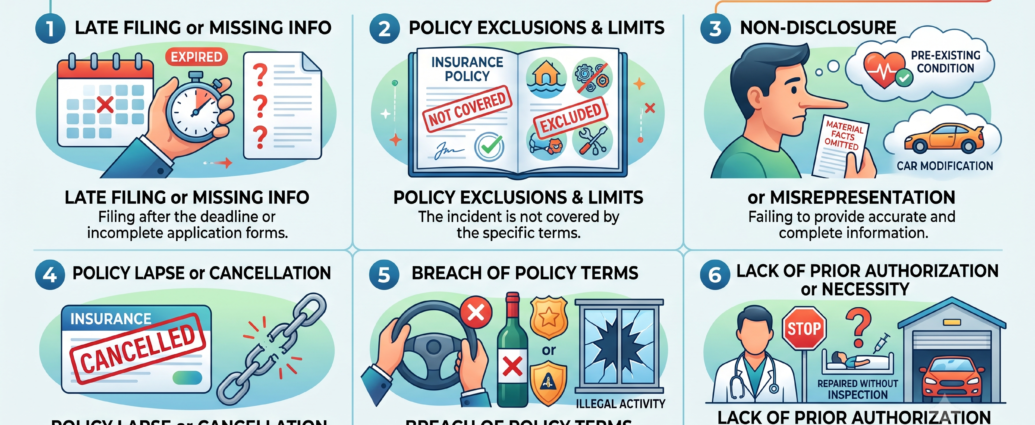
An insurance policy is designed to provide financial protection when something goes wrong. But buying a policy and successfully receiving a claim payment are two different things. A claim can be denied when the loss, treatment, accident, or event does not meet the policy’s coverage conditions, or when the insurer cannot verify that the claim satisfies the policy requirements.
Understanding why insurance claims get denied before you need to file one can save considerable time, money, and frustration. In many cases, claim problems are not caused by an insurer simply refusing to pay. They can result from exclusions, missing information, incorrect disclosures, late notification, inadequate documentation, policy conditions, or misunderstandings about what the policy actually covers.
This guide explains the most common reasons insurance claims are denied, what you can do to reduce the risk of denial, and what steps to take if your claim has already been rejected.
What Does an Insurance Claim Denial Mean?
An insurance claim denial means the insurer has decided that the submitted claim is not payable under the terms of the policy, either fully or in some cases for a particular portion of the claim.
Insurance coverage is contractual. The policy defines what is covered, what is excluded, what conditions must be satisfied, and what documentation may be required. The National Association of Insurance Commissioners (NAIC) explains that insurance generally covers the specific events listed in the policy, while exclusions and other policy provisions define situations that are not covered.
A denial therefore does not automatically mean the insurer acted unfairly. However, it also does not mean every denial is necessarily correct.
If you believe the insurer misunderstood the facts, applied the wrong policy provision, or overlooked supporting evidence, you may have grounds to challenge the decision.
Why Insurance Claims Get Denied
There is no single reason behind every denied insurance claim. The reason depends on the type of insurance, the policy wording, the circumstances of the loss, and the evidence submitted.
Here are some of the most common causes.
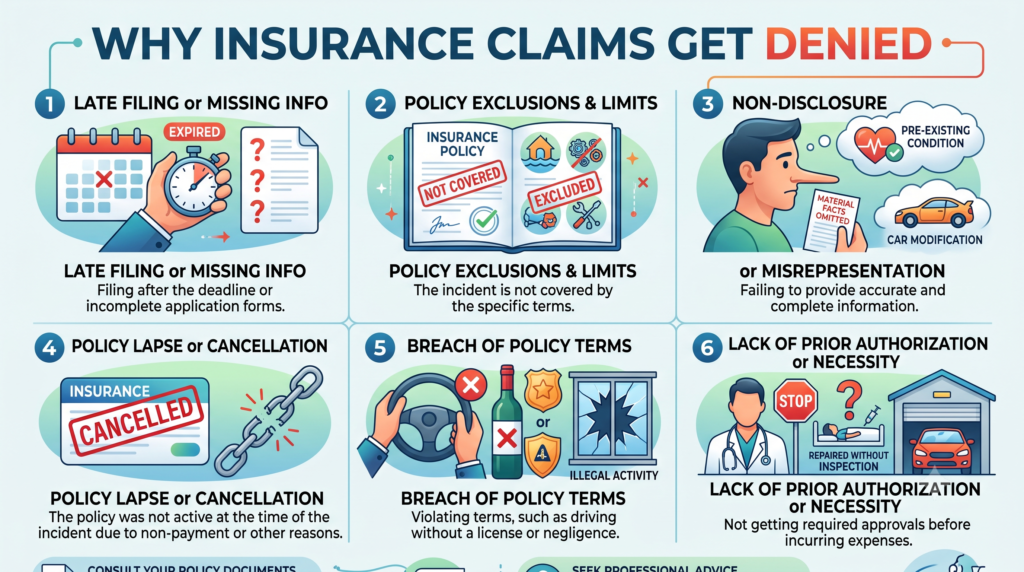
1. The Event Is Not Covered by the Policy
One of the most straightforward reasons an insurance claim gets denied is that the event itself is outside the policy’s coverage.
For example, a policy may cover accidental damage but exclude normal wear and tear. A health insurance policy may cover certain medical treatments but exclude particular procedures or conditions. A homeowners policy may cover some forms of water damage while excluding specific types of flooding.
The important distinction is between what a consumer assumes is covered and what the policy actually promises to cover.
Before filing a claim, check:
- The coverage section
- Definitions
- Exclusions
- Conditions
- Limits and sub-limits
- Deductibles
- Waiting periods
- Endorsements or additional coverage
Never rely solely on a sales conversation or a policy summary when making a significant claim decision.
Practical example
Suppose a homeowner assumes every type of water damage is covered. If the policy specifically excludes flood damage but covers certain accidental internal water losses, the cause of the damage becomes critical.
The insurer may investigate how the loss occurred, not simply whether damage exists.
2. A Policy Exclusion Applies
An exclusion is a situation, event, item, treatment, or type of loss that the policy specifically says is not covered.
Exclusions are one of the biggest reasons people are surprised by claim denials.
Common examples can include:
- Certain pre-existing medical conditions during applicable periods
- Cosmetic or elective medical procedures
- Normal deterioration
- Certain natural disasters
- Intentional damage
- Unlicensed driving
- Specific high-risk activities
- Certain types of property or personal belongings
- Losses occurring outside defined circumstances
The exact exclusions vary significantly between insurance policies.
How to avoid this problem
Do not stop reading once you find the coverage amount. Read the exclusions associated with that coverage.
A policy offering ₹10 lakh or $100,000 of coverage does not necessarily mean every loss up to that amount is payable.
3. Incorrect or Incomplete Information Was Provided
Insurance applications depend heavily on information supplied by the applicant.
A claim can become difficult when the information provided during policy purchase was inaccurate, incomplete, or materially different from the actual circumstances.
Examples may include:
- Incorrect age or personal information
- Failure to disclose relevant medical history
- Incorrect vehicle information
- Incorrect property details
- Misrepresentation of how a vehicle or property is used
- Incorrect occupation or business information
- Failure to disclose previous insurance or claims where required
This is why honesty at the application stage matters.
A cheaper premium obtained by providing incomplete information can create a much larger financial problem when a claim is filed.
4. The Policy Was Not Active
A claim generally requires valid coverage on the date of the insured event.
Problems can occur when:
- The policy expired
- Premiums were not paid as required
- A renewal was not completed
- Coverage had been cancelled
- A waiting period had not ended
- The particular coverage had not yet become effective
Always verify the policy period after purchasing or renewing insurance.
Do not assume that receiving a renewal reminder means coverage has automatically continued.
5. The Claim Was Reported Too Late
Insurance policies commonly contain requirements regarding when and how a loss should be reported.
Waiting too long can make an otherwise legitimate claim harder to investigate.
For example, evidence may disappear, damage may change, witnesses may become difficult to contact, or medical and repair records may become less reliable.
The correct approach is to notify the insurer as soon as reasonably possible and follow the notification requirements in the policy.
Importantly, a delay does not necessarily mean every claim automatically becomes invalid. The consequences depend on the policy and applicable law.
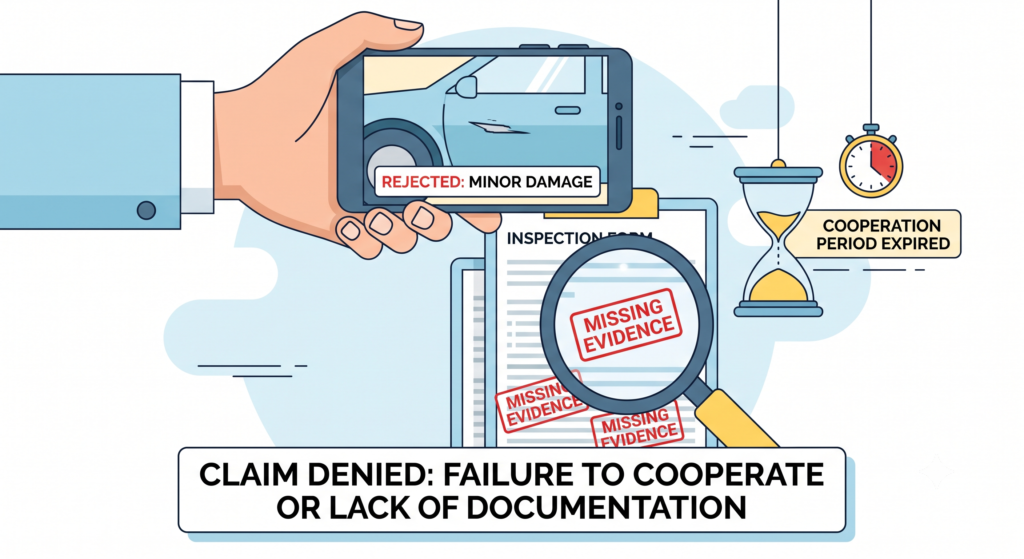
6. Required Documents Were Missing
Insurance claims are evidence-based decisions.
An insurer may need documents to establish:
- That the insured event occurred
- That the policy was active
- That the loss falls within coverage
- The amount of the loss
- That the claimant is entitled to payment
Depending on the type of claim, documentation could include:
- Claim forms
- Bills and invoices
- Medical records
- Police reports
- Repair estimates
- Photographs or videos
- Proof of ownership
- Receipts
- Discharge summaries
- Bank information
- Witness statements
- Previous reports or records
Missing documentation can result in delays, requests for additional information, or potentially a denial if eligibility cannot be established.
7. The Claim Contains Inconsistent Information
Insurers may compare information from multiple sources during a claim investigation.
Problems can arise when the information in:
- The claim form
- Police report
- Medical records
- Repair estimate
- Witness statements
- Previous correspondence
- Policy application
does not match.
An inconsistency does not automatically prove fraud. However, it can lead to additional investigation.
The safest approach is to provide factual, consistent information and correct genuine mistakes promptly.
8. The Required Pre-Authorization Was Not Obtained
Pre-authorization is particularly important in some health insurance arrangements.
Certain policies may require approval before specific treatments, procedures, hospitalizations, or services are provided.
If the policy requires prior authorization and it was not obtained, the insurer may limit or deny the claim depending on the applicable policy terms.
The key lesson is simple: understand the approval process before receiving planned treatment whenever possible.
For emergencies, different rules may apply, so check the policy rather than assuming the same procedure applies to every situation.
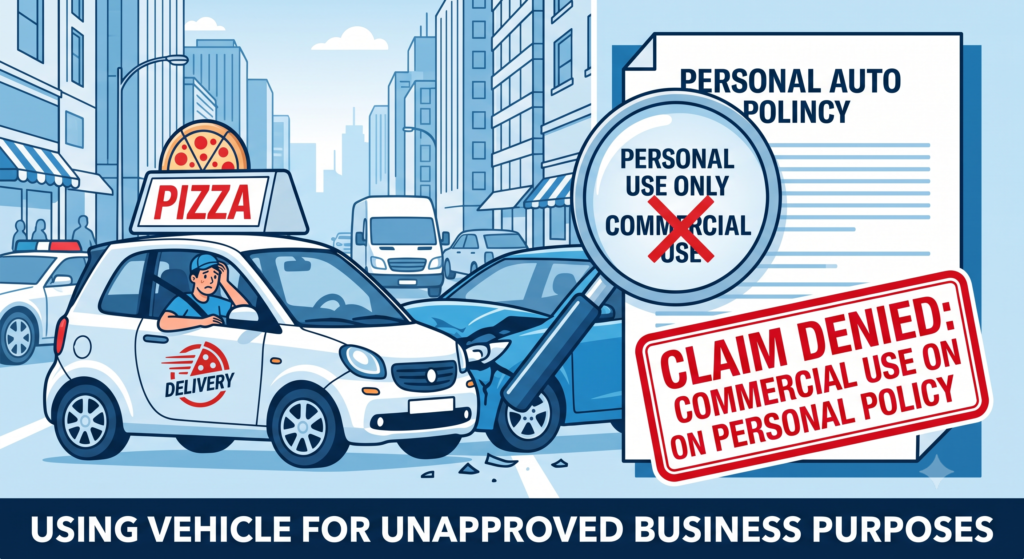
9. The Loss Was Caused by Negligence or a Policy Violation
Some policies contain conditions concerning how the insured must behave or maintain the insured property.
Examples could include:
- Driving without the required legal authorization
- Using a vehicle contrary to declared usage
- Failing to take reasonable steps to prevent further damage
- Violating specific safety requirements
- Using property for an undisclosed commercial purpose
The effect of such circumstances depends on the policy wording and applicable law.
This is another reason why understanding policy conditions is just as important as knowing the headline coverage amount.
10. The Damage Occurred Before Coverage Started
Insurance generally protects against covered events occurring during the applicable coverage period.
If damage existed before the policy began, the insurer may determine that the new policy did not cover that particular loss.
This issue frequently becomes important when someone purchases insurance shortly before discovering or reporting a problem.
Insurance is designed to transfer defined future risks—not to retroactively insure an event that has already happened.
11. The Claim Amount Is Not Supported by Evidence
A claim can involve a genuine covered event but still result in a dispute over the amount payable.
For example, an insurer may agree that a covered loss occurred but question:
- The repair cost
- Replacement value
- Depreciation
- The value of damaged property
- Medical charges
- Whether certain expenses are reasonable or covered
- Application of deductibles or policy limits
This is different from a complete denial.
A claim may be partially paid while certain expenses are excluded or reduced according to the policy.
Keep original invoices, receipts, estimates, photographs, and other evidence supporting the amount you are claiming.
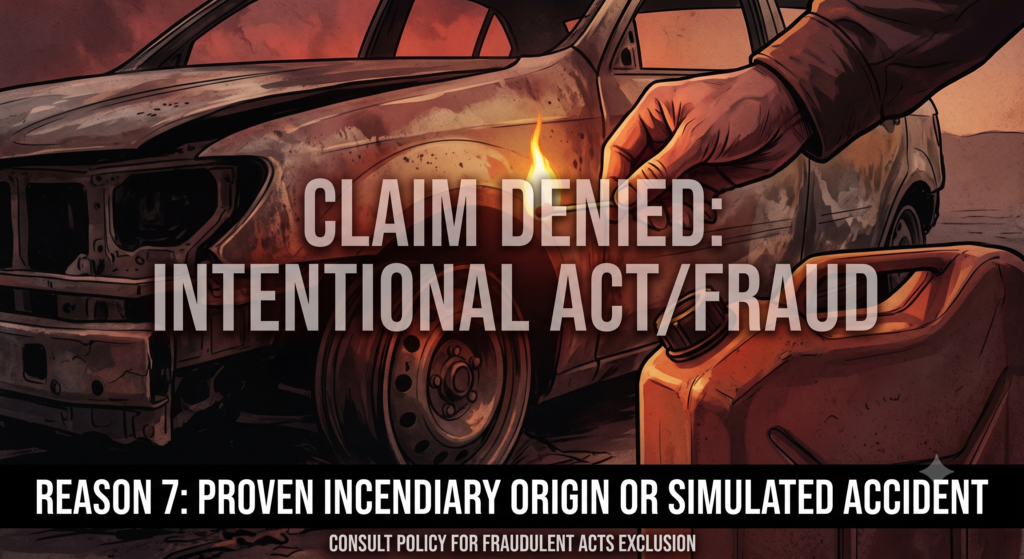
12. Suspected Fraud or Deliberate Misrepresentation
Insurance fraud is a serious issue and can involve deliberately providing false information, exaggerating a loss, staging an incident, or submitting fabricated documentation.
Insurers may investigate suspicious claims before making a final decision.
However, consumers should distinguish between an investigation and a finding of fraud. A request for additional documents or clarification does not necessarily mean the insurer has accused someone of fraudulent conduct.
If you make a legitimate claim, provide accurate information and preserve supporting evidence.
How to Reduce the Risk of an Insurance Claim Denial
The best time to prevent a claim problem is before the claim happens.
Read the Policy, Not Just the Brochure
Marketing materials usually highlight benefits. The actual policy contains the contractual terms.
Pay particular attention to:
- Exclusions
- Waiting periods
- Deductibles
- Coverage limits
- Sub-limits
- Conditions
- Notification requirements
- Documentation requirements
If you do not understand a provision, ask the insurer or a qualified insurance professional for clarification.
Keep Your Records Organized
Create a digital insurance folder containing:
- Policy documents
- Renewal notices
- Premium receipts
- Important correspondence
- Relevant invoices
- Medical records where applicable
- Property photographs
- Previous claim information
Good documentation can make a claim considerably easier to substantiate.
Document Damage Before Making Major Repairs
For property-related claims, take clear photographs and videos before repairing or disposing of damaged items whenever it is safe to do so.
The NAIC specifically advises consumers, where possible, to document damage before making repairs and to avoid permanent repairs before inspection when doing so would interfere with the insurer’s ability to assess the loss.
Emergency measures to prevent further damage can be necessary, but preserve evidence and communicate with the insurer as soon as possible.
Report the Claim Promptly
Do not wait unnecessarily.
When reporting the claim, record:
- Date and time
- Claim reference number
- Name of the person you spoke with
- Instructions provided
- Documents requested
- Deadlines mentioned
A written communication trail is particularly useful if the claim later becomes disputed.
What to Do If Your Insurance Claim Is Denied
Receiving a denial letter can be frustrating, but it should not automatically be the end of the process.
Step 1: Read the Denial Carefully
Look for the specific reason for denial.
A useful denial explanation should allow you to understand the basis of the decision and the relevant policy provision. NAIC claims-handling standards emphasize that denied claims should be handled according to policy provisions and applicable law, with denial notices identifying the relevant policy basis where required.
Step 2: Compare the Decision With Your Policy
Locate the exact section cited by the insurer.
Ask:
- Does the exclusion actually apply?
- Was the policy provision interpreted correctly?
- Did the insurer have all relevant documents?
- Was important evidence overlooked?
- Is the denial based on an incorrect fact?
Step 3: Request Clarification
If the explanation is unclear, ask the insurer to explain the decision in writing.
Keep your questions specific rather than simply saying, “Why was my claim denied?”
Step 4: Submit an Appeal or Reconsideration
If the policy provides an appeal or review process, follow it carefully.
Include evidence that directly addresses the reason for denial.
The NAIC recommends gathering relevant documentation and keeping detailed records of communications when challenging a denied health insurance claim.
Step 5: Escalate When Appropriate
If you believe the insurer has handled the claim unfairly, you may have access to a regulatory complaint process.
For consumers in India, the Insurance Regulatory and Development Authority of India (IRDAI) provides the Bima Bharosa grievance mechanism. IRDAI advises policyholders to first approach the insurer’s grievance redressal mechanism and provides an escalation route when the response is unsatisfactory or the complaint is not resolved within the prescribed timeframe.
IRDAI Bima Bharosa grievance portal
For U.S. consumers, the appropriate state insurance department can investigate certain complaints involving unfair claim delays or denials.
Because insurance laws and complaint procedures differ by country and jurisdiction, always use the regulator applicable to your policy.
Insurance Claim Denied vs. Claim Delayed
A denied claim and a delayed claim are not the same.
A denied claim means the insurer has made a decision that the claim is not payable, in whole or in part.
A delayed claim means the claim has not yet reached a final decision or payment has been delayed.
A request for additional documents does not necessarily mean a claim has been denied.
If your insurer repeatedly requests information without explaining what is still required, ask for a written list of outstanding documents and the current status of the claim.
A Simple Insurance Claim Checklist
Before submitting a claim, ask yourself:
- Is the policy active?
- Did the event occur during the coverage period?
- Is the event covered?
- Does an exclusion apply?
- Have I met any waiting-period or authorization requirements?
- Did I notify the insurer promptly?
- Do I have supporting documents?
- Are my statements consistent with the available records?
- Have I documented the damage or expenses?
- Do I understand the deductible and coverage limit?
- Have I kept copies of everything submitted?
This simple review can identify many avoidable problems before they become claim disputes.
Final Thoughts: Why Insurance Claims Get Denied
Understanding why insurance claims get denied is ultimately about understanding the contract you purchased.
The strongest protection is not simply choosing the cheapest premium. It is choosing coverage that matches your actual risk, reading the exclusions and conditions, providing accurate information, maintaining documentation, and following the claims procedure when something goes wrong.
A denied claim should also be examined carefully. Some denials are clearly supported by policy exclusions or conditions, while others may result from missing documents, administrative mistakes, incorrect information, or disagreements about how the policy applies.
If you believe a denial is wrong, do not rely on a verbal conversation alone. Request the decision and its policy basis in writing, gather evidence, follow the insurer’s review process, and use the appropriate regulator or grievance mechanism when necessary.
Insurance works best when policyholders understand both what they are buying and what they must do when making a claim.
Frequently Asked Questions
1. Why do insurance claims get denied?
Insurance claims commonly get denied because the event is excluded, the policy does not cover the loss, required information is missing, the policy was inactive, a condition was not satisfied, or the circumstances do not match the policy terms.
2. Can an insurance claim be denied because of missing documents?
Yes. Missing or inadequate documentation can prevent an insurer from verifying the claim, its eligibility, or the amount being requested.
3. Can a late insurance claim be denied?
It can create problems if the policy contains notification requirements. However, the effect of late notification depends on the policy terms and applicable law.
4. Does a denied claim mean I cannot get the money?
Not necessarily. You may be able to request clarification, provide additional evidence, appeal the decision, or use an applicable complaint or dispute-resolution process.
5. What should I do first after my claim is denied?
Read the denial notice carefully and identify the exact reason and policy provision used to support the decision. Then compare it with your policy and supporting evidence.
6. Can incorrect information cause an insurance claim to be denied?
Yes. Materially incorrect or incomplete information provided during the application process can affect coverage and may become important when the insurer investigates a claim.
7. Can an insurer deny a claim because of an exclusion?
Yes. Exclusions define situations that the policy does not cover. The specific exclusion and the circumstances of the claim must be considered.
8. What is the difference between a denied and delayed claim?
A denied claim has received a decision that payment is not owed, fully or partly. A delayed claim has not been resolved within the expected timeframe or payment has not yet been completed.
9. Should I keep copies of documents submitted with my claim?
Yes. Keep copies of the claim form, documents, photographs, receipts, correspondence, and records of conversations with the insurer.
10. Can I appeal a denied insurance claim?
Many insurance products provide a review, reconsideration, or appeal mechanism. The exact procedure depends on the policy and applicable jurisdiction.
11. What if the insurer does not explain why my claim was denied?
Ask for the denial and the policy basis in writing. If the response remains inadequate, consider using the insurer’s grievance process and, where available, the relevant insurance regulator.
12. Can I complain to a regulator about a denied insurance claim?
Potentially, yes. The available process depends on where the policy was issued. In India, policyholders can use the insurer’s grievance mechanism and escalate eligible complaints through IRDAI’s Bima Bharosa system.
13. Is every claim denial unfair?
No. A claim can legitimately be denied when the loss is outside coverage or a valid policy condition or exclusion applies. The important question is whether the decision is supported by the policy and applicable rules.
14. Can a claim be partially denied?
Yes. An insurer may accept that a covered loss occurred while declining particular expenses, items, or amounts that are excluded, unsupported, or above applicable limits.
15. How can I prevent an insurance claim from being denied?
Understand your coverage before you need it, provide accurate information, keep your policy active, follow notification requirements, preserve evidence, submit complete documentation, and respond promptly to requests from the insurer.
Important note: Insurance policies and claim procedures differ by product and jurisdiction. This article provides general educational information and should not be treated as legal, financial, or insurance-specific advice. Always review your actual policy wording and applicable local regulations before making a claim or challenging a denial.