
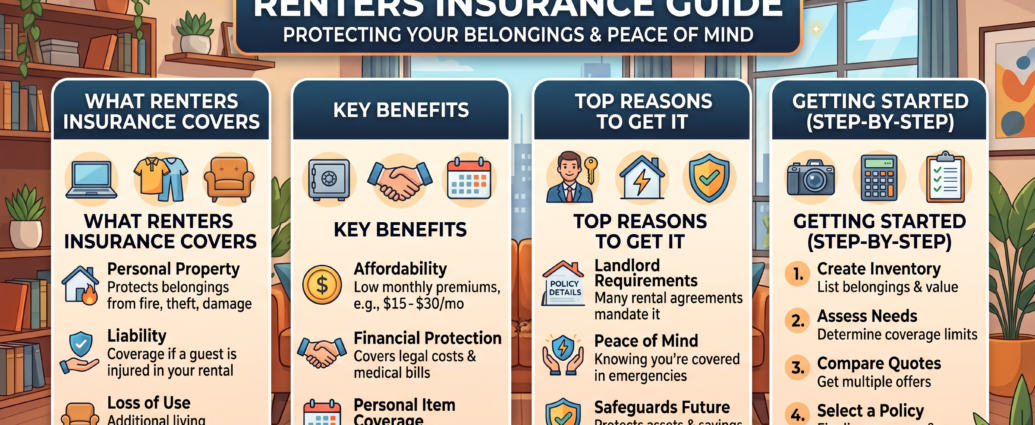
Renting a home or apartment gives you flexibility without the financial responsibility of owning the building. But there is one common misconception many renters make: the landlord’s insurance does not normally protect the renter’s personal belongings.
If a fire damages your apartment, a thief steals your electronics, or a covered incident makes your rental temporarily unlivable, you could face thousands of dollars in unexpected expenses. This is where renters insurance can provide valuable financial protection.
This Renters Insurance Guide explains what renters insurance is, what it typically covers, what it does not cover, how much it can cost, how deductibles and coverage limits work, and what to look for before purchasing a policy.
Important: Insurance policies differ by insurer, state, coverage form, exclusions, limits, and endorsements. Always read your policy documents and confirm coverage with your insurance company or licensed insurance professional before relying on a particular benefit.
What Is Renters Insurance?
Renters insurance is a type of insurance designed to protect people who rent an apartment, house, condominium, or other residential property.
Unlike homeowners insurance, renters insurance generally does not insure the physical structure of the building. The landlord is typically responsible for insuring the building itself.
Instead, a renters policy can protect the renter in three major areas:
- Personal property
- Personal liability
- Additional living expenses after certain covered losses
The National Association of Insurance Commissioners (NAIC) explains that renters insurance can protect personal property against covered damage or loss and can also provide liability protection when someone is injured or their property is damaged under circumstances covered by the policy.
For many renters, the biggest value is not the cost of replacing one item. It is protection against a situation where many possessions are lost at once.
Imagine a renter has:
- $2,000 worth of furniture
- $1,500 in clothing
- $2,000 in electronics
- $1,000 in kitchen items
- $1,500 in other personal belongings
That is already an estimated $8,000 in possessions. A major covered loss could make replacing everything financially difficult without insurance.
Why Do Renters Need Insurance?
Some renters assume insurance is unnecessary because they do not own the property.
That reasoning overlooks an important distinction: the building and your belongings are two different risks.
The landlord’s insurance generally protects the landlord’s interest in the building. It does not automatically reimburse you for your furniture, laptop, clothing, television, bicycle, or other personal property.
The NAIC specifically warns renters that a landlord’s insurance policy generally does not cover the renter’s personal belongings after events such as theft or fire.
Renters insurance can also be useful because accidents can create liability exposure.
For example, suppose:
- A guest visits your apartment.
- The guest is injured in an accident.
- You are alleged to be legally responsible.
- The resulting claim includes medical expenses or legal costs.
Depending on the policy and circumstances, renters liability coverage may provide protection.
Therefore, renters insurance is not simply about protecting a television or sofa. It can also protect your finances from certain liability claims.
What Does Renters Insurance Cover?
Most renters insurance policies provide several important categories of protection. However, the exact coverage depends on the policy.
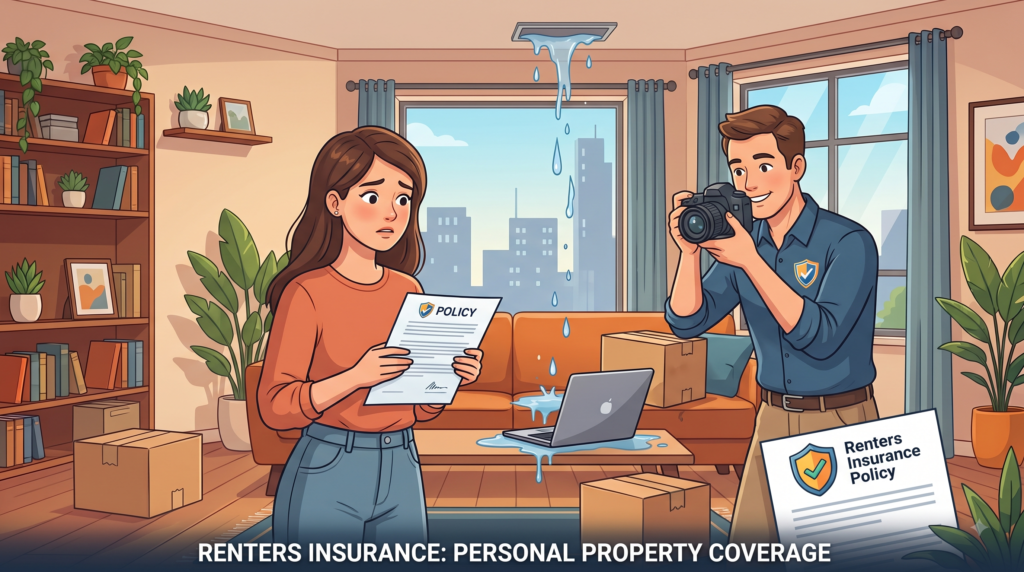
1. Personal Property Coverage
Personal property coverage protects your belongings against covered causes of loss.
Depending on the policy, covered property can include:
- Furniture
- Clothing
- Electronics
- Computers
- Televisions
- Kitchen equipment
- Bicycles
- Books
- Personal appliances
- Certain jewelry and valuables
Common covered causes of loss may include events such as fire, theft, vandalism, smoke damage, and certain types of water-related damage.
However, renters should never assume that every type of damage is covered.
Your policy’s covered-perils section and exclusions determine whether a particular loss qualifies.
Example
Suppose a burglar breaks into your apartment and steals your laptop, television, and other belongings.
If theft is a covered peril under your policy, personal property coverage may help pay for the covered loss, subject to:
- Your coverage limit
- Deductible
- Policy conditions
- Exclusions
- Valuation method
This is why simply asking, “Do I have renters insurance?” is not enough.
The better question is:
“How much coverage do I have, and exactly what does my policy cover?”
2. Personal Liability Coverage
Liability coverage is another important component of renters insurance.
It may help protect you when you are legally responsible for bodily injury to another person or property damage, depending on the circumstances and policy terms.
For example, a visitor could fall inside your rental property and claim that your negligence caused the injury.
Or you could accidentally cause damage to another person’s property.
A renters policy may provide liability protection and potentially legal defense costs, subject to the policy’s terms and limits. The NAIC identifies liability protection as one of the fundamental components of renters insurance.
Why liability coverage matters
A renter might think:
“I don’t own a house, so nobody can sue me for property-related issues.”
That is not necessarily true.
You can still have legal and financial responsibility for certain accidents or damage. Liability insurance is designed to help address some of these risks.
3. Additional Living Expenses
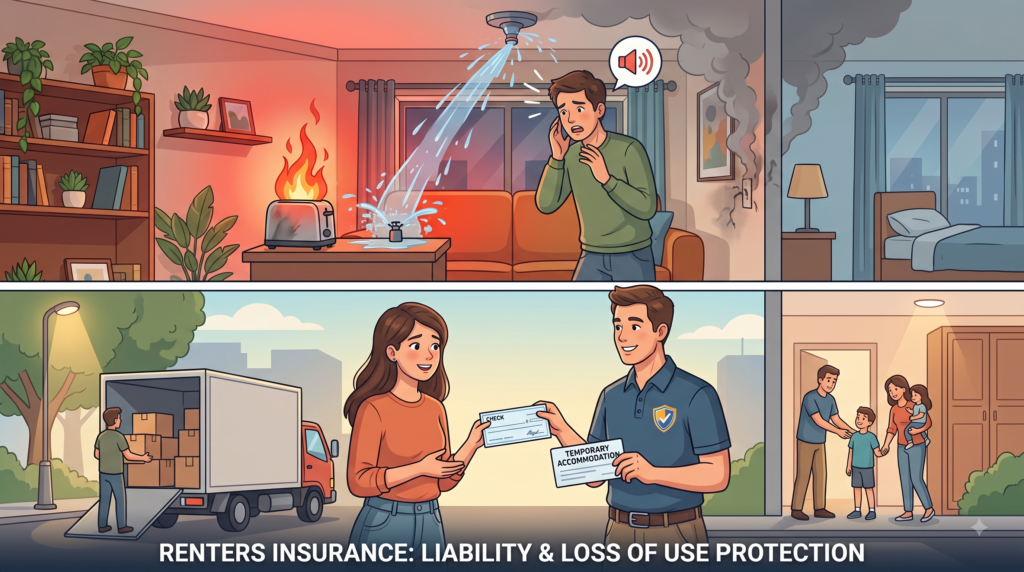
Another valuable feature can be Additional Living Expenses (ALE) or loss-of-use coverage.
Suppose your rented apartment becomes uninhabitable because of a covered event.
You may temporarily need to stay somewhere else.
Depending on the policy, coverage may help with certain additional expenses associated with temporarily living elsewhere.
For example, eligible expenses could include:
- Temporary accommodation
- Additional food expenses
- Certain transportation costs
- Other necessary increases in living expenses
The NAIC notes that some renters policies provide coverage for living expenses when a rental becomes uninhabitable because of an insured loss.
However, this does not mean the insurer will automatically pay every expense you incur.
Coverage limits, eligibility requirements, time limits, and policy conditions apply.
What Does Renters Insurance Not Cover?
Understanding exclusions is just as important as understanding coverage.
A renters insurance policy is not a blanket guarantee against every possible loss.
Common exclusions or limitations may involve:
- Flood damage
- Earthquake damage
- Certain types of water damage
- Normal wear and tear
- Intentional damage
- Certain high-value possessions beyond specified limits
- Business property beyond policy limits
- Certain types of mold or maintenance-related problems
The exact exclusions depend on the policy.
For example, a renter living in a flood-prone location should not automatically assume that a standard renters policy provides flood protection.
Likewise, someone living in an earthquake-prone area should investigate whether separate earthquake coverage or an endorsement is appropriate.
Never choose a policy solely because the premium is inexpensive. Check the exclusions first.
Actual Cash Value vs. Replacement Cost
One of the most important decisions in renters insurance is understanding how your personal property will be valued after a covered loss.
Two terms you may encounter are:
- Actual Cash Value (ACV)
- Replacement Cost
Actual Cash Value
Actual cash value generally considers depreciation when determining the value of damaged or destroyed property.
For example, imagine you purchased a laptop several years ago for $1,500.
At the time of a covered loss, the laptop may be worth considerably less because of age and depreciation.
Your settlement could therefore be based on its depreciated value, subject to the policy terms and deductible.
Replacement Cost
Replacement-cost coverage generally aims to pay the amount needed to replace covered property with a similar new item, subject to policy conditions and limits.
Because replacement-cost coverage can provide broader financial protection for personal belongings, it is important to understand whether your policy uses ACV or replacement cost.
The NAIC specifically recommends that renters pay attention to this distinction because it can significantly affect the amount received after a claim.
How Much Renters Insurance Do You Need?
Choosing the right coverage limit requires more than guessing a round number.
Start by estimating the total value of everything you own.
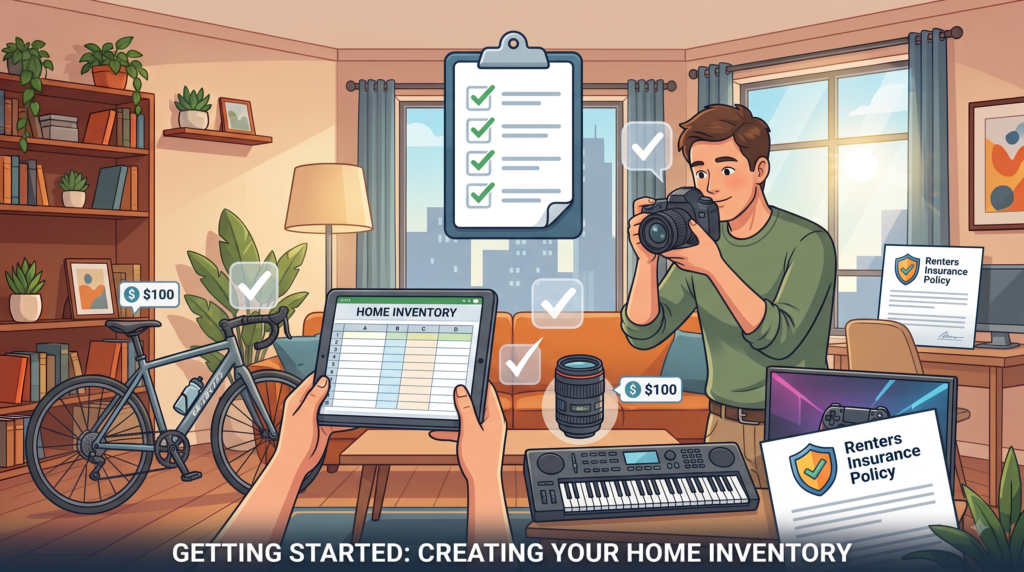
Create a home inventory
Walk through every room and record your belongings.
For example:
| Category | Estimated Value |
|---|---|
| Furniture | $4,000 |
| Electronics | $5,000 |
| Clothing | $3,000 |
| Kitchen items | $1,500 |
| Computers | $2,500 |
| Jewelry | $2,000 |
| Sports equipment | $1,000 |
| Miscellaneous items | $2,000 |
| Estimated Total | $21,000 |
This simple exercise can reveal that your possessions are worth much more than you initially expected.
Keep photographs, receipts, serial numbers, and other documentation for expensive items where practical.
A digital home inventory stored somewhere outside the rental property can also be useful if you ever need to document a claim.
What Is a Renters Insurance Deductible?
A deductible is the amount you are generally responsible for paying toward a covered loss before insurance pays the remaining eligible amount.
For example, assume:
- Covered loss: $8,000
- Deductible: $1,000
- Eligible claim: $8,000
The insurer may pay $7,000, while you are responsible for the $1,000 deductible, subject to the policy.
Generally, choosing a higher deductible can reduce your premium, while a lower deductible may increase the premium.
But there is an important practical rule:
Do not choose a deductible you could not comfortably afford after an unexpected loss.
Insurance is most valuable when it provides meaningful protection without creating a financial problem when you actually need to use it.
How Much Does Renters Insurance Cost?
The cost of renters insurance varies based on factors such as:
- Location
- Coverage amount
- Deductible
- Type of coverage
- Claims history
- Property characteristics
- Security features
- Insurer
- Additional endorsements
The NAIC has historically cited average premiums in the range of roughly $15 to $30 per month, while emphasizing that premiums vary according to factors such as location, rental size, and possessions.
Treat such figures as general reference points rather than a quote.
A renter in one state could receive a very different price from a renter with similar belongings somewhere else.
How to potentially reduce your premium
Ask insurers about available discounts for:
- Smoke alarms
- Security systems
- Deadbolts
- Sprinkler systems
- Multiple policies with the same insurer
- Claims-free history
The NAIC notes that insurers may offer discounts for certain safety features and policy combinations.
The best strategy is not simply to find the cheapest policy. Instead, compare price against coverage.
How to Choose the Best Renters Insurance
There is no single renters insurance policy that is best for every renter.
Use this checklist when comparing policies.
1. Calculate your belongings
Do not choose a coverage limit based only on what sounds inexpensive.
Estimate what it would cost to replace your possessions.
2. Check the valuation method
Find out whether personal property is covered on an actual-cash-value or replacement-cost basis.
3. Review liability limits
Consider whether the available liability limit provides an appropriate level of protection for your circumstances.
4. Understand the deductible
A low premium with a very high deductible may not be the best value.
5. Read exclusions
Pay particular attention to flood, earthquake, water damage, valuables, business property, and other exclusions relevant to your location and lifestyle.
6. Check special limits
Certain categories of expensive belongings may have special sublimits.
If you own valuable jewelry, collectibles, cameras, musical instruments, or other expensive items, ask whether additional coverage is necessary.
7. Ask about Additional Living Expenses
Find out what happens if a covered loss makes your rental temporarily uninhabitable.
8. Compare several insurers
Do not assume the first quote is the best option.
Compare similar coverage levels, deductibles, exclusions, and limits.
Renters Insurance for College Students
College students living away from home should also evaluate renters insurance.
A student’s parents may have homeowners or renters insurance that provides some coverage under certain circumstances, but the rules and limits can vary.
The NAIC recommends that students and parents check the existing policy rather than assuming that belongings are automatically protected.
Students living in off-campus apartments may especially want to determine whether their existing family policy provides adequate protection.
Items such as:
- Laptops
- Phones
- Bicycles
- Furniture
- Clothing
- Gaming equipment
can quickly add up to thousands of dollars.
Renters Insurance and Roommates
Sharing a rental property with roommates can make insurance decisions more complicated.
Do not automatically assume that one roommate’s renters insurance protects everyone in the home.
Coverage for roommates depends on the insurer, policy structure, relationship between the occupants, and applicable policy terms.
Before moving into a shared apartment, each roommate should understand:
- Who is insured
- Whose belongings are covered
- What liability protection exists
- Whether separate policies are required
- How claims involving shared property are handled
For many renters, having an individual policy can make coverage easier to understand and manage.
How to File a Renters Insurance Claim
If you experience a covered loss, act promptly.
Step 1: Protect yourself
If there is a fire, major water leak, or other dangerous situation, leave the property and contact emergency services when appropriate.
Step 2: Notify the landlord
Report property damage to the landlord or property manager when appropriate, particularly when building repairs are involved.
Step 3: Contact your insurer
Notify your insurance company as soon as reasonably possible.
Step 4: Document the damage
Take photographs and videos of damaged belongings if it is safe to do so.
Step 5: Prepare your inventory
Use receipts, photographs, purchase records, warranties, or other documentation to establish ownership and value.
Step 6: Keep records
Save communications, claim numbers, estimates, receipts, and other relevant documents.
Do not throw away damaged property unless it creates a health or safety issue or your insurer instructs you to do so.
Renters Insurance Guide: Smart Questions to Ask Before Buying
Before purchasing a policy, ask the insurer:
- What exactly is covered?
- What are the major exclusions?
- Is personal property coverage ACV or replacement cost?
- What is my deductible?
- What is my personal property limit?
- What is my liability limit?
- Are jewelry and other valuables subject to special limits?
- Is flood damage covered?
- Is earthquake damage covered?
- Does the policy include Additional Living Expenses?
- Are my belongings covered while I travel?
- Are roommates covered?
- Can I add endorsements for valuable property?
- Are there discounts available?
- What documentation should I keep for a future claim?
These questions can prevent a common mistake: purchasing a policy based entirely on its monthly price without understanding what you are actually buying.
Where to Get Reliable Renters Insurance Information
Because insurance is a regulated financial product, renters should prioritize authoritative sources over anonymous social media posts or generic comparison articles.
The National Association of Insurance Commissioners (NAIC) provides consumer guidance on renters insurance, including coverage, policy options, deductibles, and valuation methods. You can review its consumer resources here:
NAIC — Renters Insurance Consumer Guide
The Insurance Information Institute (III) also provides an overview of renters insurance protections, including personal possessions, liability, and additional living expenses.
Insurance Information Institute — Your Renters Insurance Guide
For state-specific requirements, consumer protections, and insurance regulations, renters should also consult their state’s department of insurance.
Is Renters Insurance Worth It?
For many renters, renters insurance can be worthwhile because the potential financial loss from a serious incident can be much greater than the annual premium.
Consider the difference between these two situations.
Without renters insurance
A major covered event destroys $20,000 worth of personal belongings.
The renter may need to pay for replacements personally.
With appropriate renters insurance
The policy may provide eligible compensation for covered personal property losses, subject to the coverage limit, deductible, valuation method, exclusions, and policy conditions.
The policy may also provide liability protection and additional living-expense coverage when applicable.
Insurance cannot prevent an accident, theft, or fire.
Its purpose is to transfer certain financial risks to an insurer in exchange for a premium.
That is the fundamental reason renters insurance can be valuable.
Final Thoughts: A Practical Renters Insurance Guide
Renters insurance is relatively simple at first glance, but the details matter.
The landlord’s insurance generally protects the building, while your renters policy can protect your personal belongings and provide liability and additional living-expense protection.
The most important decisions are not simply about finding the lowest premium. You should understand:
- How much your belongings are worth
- What causes of loss are covered
- What is excluded
- Your deductible
- Your liability limit
- Whether coverage uses actual cash value or replacement cost
- Whether expensive belongings require additional coverage
- Whether your policy provides adequate protection for your specific location and circumstances
Before purchasing or renewing a policy, review the declarations page and policy documents carefully. If something is unclear, ask the insurer or a licensed insurance professional to explain it.
The best renters insurance policy is not necessarily the cheapest one. It is the one whose coverage, limits, exclusions, deductible, and price make sense for your actual financial risks.
Frequently Asked Questions About Renters Insurance
1. What is renters insurance?
Renters insurance is coverage designed to protect a tenant’s personal belongings and provide certain liability and additional living-expense protections, depending on the policy.
2. Is renters insurance required?
It depends. Some landlords or lease agreements require tenants to carry renters insurance, while others do not. Check your rental agreement and local requirements.
3. Does my landlord’s insurance cover my belongings?
Generally, no. A landlord’s insurance typically protects the building owner’s property interest rather than the renter’s personal possessions.
4. Does renters insurance cover theft?
Many renters policies provide coverage for theft, subject to the policy’s terms, limits, deductible, and exclusions.
5. Does renters insurance cover a stolen laptop?
It may, if the theft is a covered loss and the laptop falls within your policy’s coverage. Special limits or exclusions may apply.
6. Does renters insurance cover flood damage?
Standard renters insurance may exclude flood damage. Renters in flood-prone areas should ask their insurer about appropriate flood coverage.
7. Does renters insurance cover earthquakes?
Earthquake damage is commonly excluded from standard policies, so renters in earthquake-prone areas should ask about separate coverage or an endorsement.
8. What is a renters insurance deductible?
A deductible is the amount you are generally responsible for paying toward a covered claim before the insurer pays the eligible remainder.
9. What is replacement-cost coverage?
Replacement-cost coverage is designed to help pay the cost of replacing covered belongings with similar new items, subject to policy terms and limits.
10. What is actual cash value?
Actual cash value generally accounts for depreciation when determining the value of covered property after a loss.
11. Does renters insurance cover liability?
Yes, renters policies commonly include personal liability coverage, although the specific protection and limits depend on the policy.
12. Does renters insurance cover temporary housing?
Some policies provide Additional Living Expenses when a covered loss makes the rental uninhabitable. Coverage limits and conditions apply.
13. Can college students get renters insurance?
Yes. College students living independently can purchase renters insurance, although they should first check whether their parents’ existing policy provides any applicable coverage.
14. Does renters insurance cover roommates?
Not necessarily. Roommate coverage depends on the policy and insurer. Each roommate should verify who is insured and whose belongings are protected.
15. How much renters insurance should I buy?
Choose a personal-property limit based on a realistic estimate of the replacement value of your belongings, while considering your liability needs and any special coverage requirements.
16. Is renters insurance expensive?
The cost varies by location, coverage, deductible, insurer, and other factors. The NAIC has cited premiums averaging around $15 to $30 per month in its consumer guidance, but your actual quote may differ significantly.
17. What should I do before buying renters insurance?
Create a home inventory, estimate your belongings’ value, compare quotes, review exclusions, understand the deductible, and check whether valuable possessions need additional coverage.
18. Is renters insurance worth it?
For many renters, yes. It can protect against potentially large financial losses from covered property damage, theft, liability claims, and certain additional living expenses.
Editorial note: This article is intended for general educational purposes and is not personalized insurance, legal, or financial advice. Insurance coverage varies by insurer, state, policy form, endorsements, exclusions, and individual circumstances. Always review the actual policy and consult a qualified insurance professional when making coverage decisions.