Buying a home is one of the biggest financial decisions you can make. Before you start attending open houses or making offers, one of the most useful steps is understanding how much you may realistically be able to borrow.
That is where mortgage pre-approval comes in.
A mortgage pre-approval can give you a better idea of your potential borrowing range, demonstrate to sellers that you are a serious buyer, and help you identify financing problems before you are deep into the home-buying process.
However, pre-approval is often misunderstood. A pre-approval letter is not the same as final mortgage approval, and it does not guarantee that a lender will ultimately finance the home you choose.
This Mortgage Pre-Approval Guide explains how mortgage pre-approval works, what lenders typically review, what documents you may need, how pre-approval differs from prequalification, how it affects your home-shopping budget, and what you should do after receiving a pre-approval letter.
Important: This article is for general educational purposes and focuses primarily on the U.S. mortgage market. Mortgage requirements, underwriting standards, rates, fees, and programs vary by lender and borrower. Always review your specific loan terms with your lender or a qualified housing professional.
What Is Mortgage Pre-Approval?
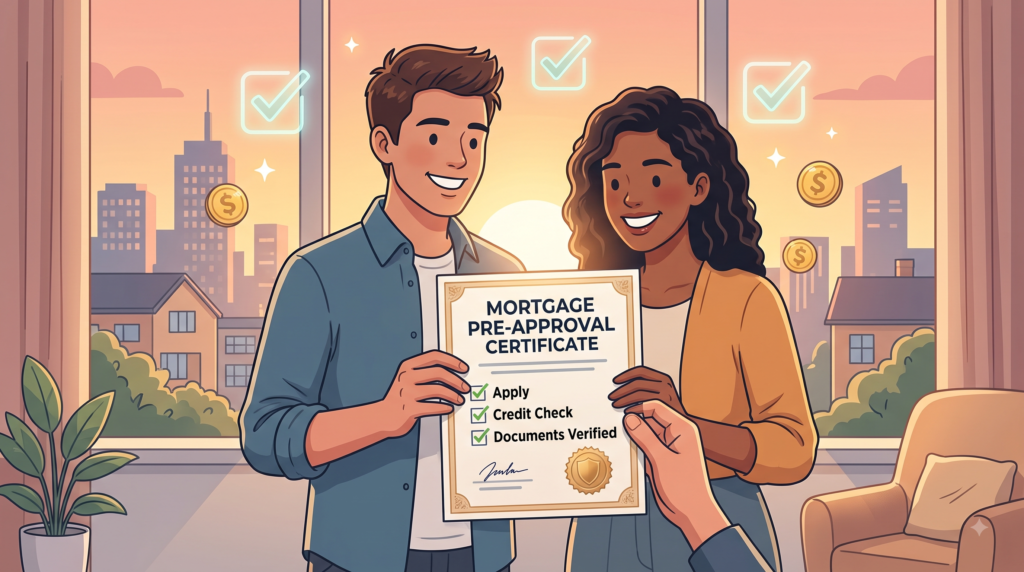
A mortgage pre-approval is a statement from a lender indicating that the lender is tentatively willing to lend you up to a specified amount, based on information and assumptions used during the pre-approval process.
The Consumer Financial Protection Bureau (CFPB) emphasizes that a pre-approval letter is not a guaranteed loan offer. Instead, it indicates that the lender is likely willing to provide financing subject to further verification and conditions.
For example, suppose a lender issues you a pre-approval for:
Maximum loan amount: $400,000
That does not necessarily mean you should buy a $400,000 home.
Your actual home-buying budget also needs to account for:
- Down payment
- Property taxes
- Homeowners insurance
- Mortgage insurance, if applicable
- HOA dues
- Closing costs
- Maintenance
- Utilities
- Emergency savings
- Other monthly debts
The lender is determining what you may qualify for. You are responsible for determining what you can comfortably afford.
Why Is Mortgage Pre-Approval Important?
Getting pre-approved before seriously shopping for a home can make the buying process more organized.
1. It Helps Establish a Price Range
Without pre-approval, buyers may look at homes based on an assumed budget.
After reviewing your income, debts, credit profile, and other financial information, a lender may give you a more realistic borrowing range.
That can help you focus your home search.
2. It Shows Sellers You Are Serious
A seller may receive multiple offers.
A buyer who provides a pre-approval letter can appear more prepared because a lender has already reviewed at least some of the buyer’s financial information.
The CFPB notes that sellers frequently require a pre-approval letter before accepting a home offer.
3. It Can Identify Financial Problems Early
The pre-approval process may uncover issues involving:
- Credit history
- Income documentation
- Debt levels
- Employment history
- Bank statements
- Down-payment funds
Finding a problem before making an offer gives you more time to address it.
4. It Helps You Move Faster
Once you find the right home, you may have only a limited amount of time to arrange financing.
Starting the mortgage process early means you are not beginning from zero after your offer is accepted.
The CFPB recommends exploring mortgage options before finding a home because financing decisions can move quickly once an offer is accepted.
Mortgage Pre-Approval vs. Prequalification
These terms are often used interchangeably, but the process behind them can be different.
What Is Prequalification?
Prequalification may involve providing financial information to a lender so the lender can estimate how much you might qualify to borrow.
Depending on the lender, the information may be largely based on what you report.
What Is Pre-Approval?
Pre-approval generally involves a more detailed review.
A lender may review information such as:
- Credit
- Income
- Assets
- Debts
- Employment
- Documentation supporting your financial information
However, lenders use these terms differently.
The CFPB specifically warns that the distinction between “prequalification” and “preapproval” varies among lenders. Some lenders may use prequalification for a less-verified process, while others use the term differently.
The important question to ask
Instead of focusing only on the label, ask the lender:
“What information have you verified, what assumptions are you making, and what conditions remain before final approval?”
That question can tell you much more than the word printed on the letter.
When Should You Get Mortgage Pre-Approval?
The ideal timing depends on your situation, but many buyers seek pre-approval when they are ready to begin seriously shopping for a home.
Getting pre-approved too early can create problems if your financial situation changes before you purchase.
For example, a lender may need to reassess your application if you:
- Change jobs
- Take on new debt
- Open several credit accounts
- Make a large purchase
- Change your income
- Move significant amounts of money
- Change your down payment
Pre-approval letters may also have expiration dates. The CFPB notes that many pre-approval letters are valid for approximately 30 to 60 days, although this varies by lender.
A practical approach is to get pre-approved when you are financially prepared and expect to begin home shopping seriously.
What Do Lenders Look at for Mortgage Pre-Approval?
Mortgage lenders generally evaluate several parts of your financial profile.
1. Credit History
Your credit history helps the lender evaluate how you have handled borrowing in the past.
The lender may review:
- Credit scores
- Payment history
- Outstanding balances
- Credit utilization
- Recent credit applications
- Delinquent accounts
- Collections or other negative information
A stronger credit profile can potentially improve your financing options, although the exact impact depends on the loan program and lender.
Before applying, review your credit reports for errors.
If you discover incorrect information, address it before beginning the mortgage process when possible.
2. Income
Lenders need evidence that you have sufficient income to support the proposed mortgage payment and other financial obligations.
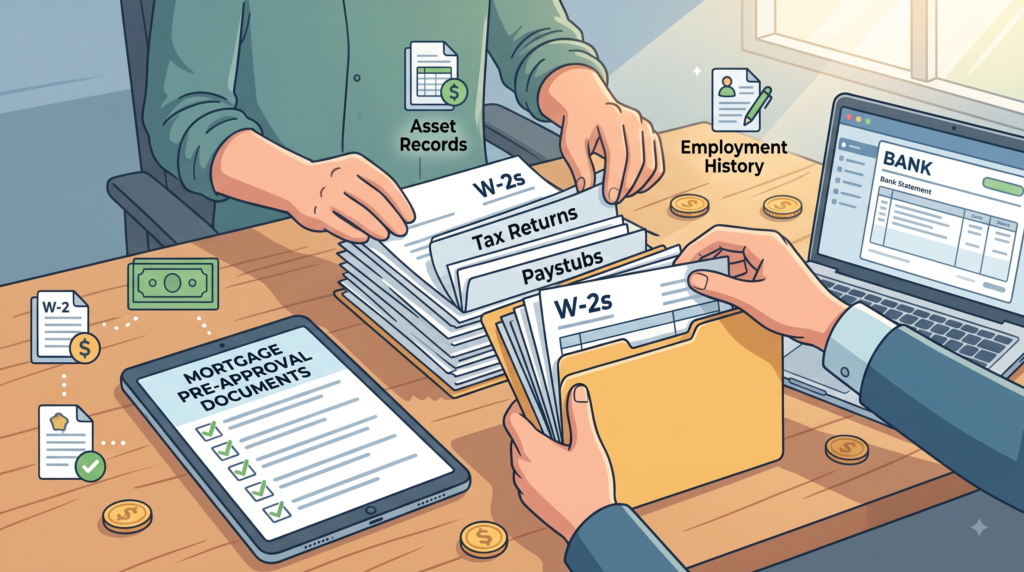
Depending on your employment situation, documentation may include:
- Pay stubs
- W-2 forms
- Tax returns
- Employment verification
- Bank statements
- Business records for self-employed borrowers
Self-employed borrowers may face additional documentation requirements because income can be more complicated to verify.
If your income includes bonuses, commissions, overtime, rental income, or other sources, ask the lender how those earnings will be treated.
3. Debt
Your existing debts matter because the lender wants to understand how much of your income is already committed to financial obligations.
Common debts include:
- Car loans
- Student loans
- Credit cards
- Personal loans
- Existing mortgages
- Other recurring obligations
This is one reason two people with similar salaries can qualify for different mortgage amounts.
A borrower with significant monthly debt payments may have less available income for a new mortgage.
4. Assets and Savings
Lenders may verify your assets to determine whether you have sufficient funds for:
- Down payment
- Closing costs
- Reserves
- Other required expenses
Your lender may ask for bank statements or other documentation showing where your funds came from.
Large unexplained deposits can create additional questions during underwriting.
If you receive money from a gift, sale of an asset, or another unusual source, tell your lender rather than assuming it will automatically be accepted.
What Documents Do You Need for Mortgage Pre-Approval?
The exact list varies by lender and borrower, but preparing common documents in advance can make the process smoother.
You may need:
Income documents
- Recent pay stubs
- W-2 forms
- Tax returns
- Employment information
Asset documents
- Bank statements
- Investment account statements
- Retirement account statements
Identification
- Government-issued identification
- Social Security information
Debt information
- Credit accounts
- Student loan information
- Auto loan statements
- Other recurring debts
Self-employed documentation
Self-employed borrowers may need additional business and tax records.
Other documentation
The lender may request additional documents depending on your circumstances.
A useful strategy is to create a digital folder before applying so you can quickly provide documents when requested.
How Much Can You Get Pre-Approved For?
Your maximum pre-approved mortgage amount depends on multiple factors.
Lenders may consider:
- Income
- Credit
- Existing debt
- Down payment
- Loan program
- Interest rate
- Property type
- Assets
- Other underwriting factors
But there is a major distinction between:
How much the lender will approve
and
How much you should spend.
These are not necessarily the same number.
For example, suppose a lender pre-approves you for a $500,000 mortgage.
That does not mean a $500,000 mortgage is financially comfortable for you.
You may prefer a lower purchase price so you can maintain:
- Emergency savings
- Retirement contributions
- Travel or lifestyle spending
- Education expenses
- Home maintenance reserves
Your personal budget should remain the final decision-maker.
The CFPB specifically advises consumers that they are the ones who decide how much they are comfortable spending; a lender’s maximum pre-approval amount does not determine their personal home-buying budget.
How Much House Can You Afford?
Instead of starting with the maximum loan amount, start with a monthly housing budget.
Consider the complete monthly cost.
Mortgage principal and interest
This is the basic loan payment.
Property taxes
Property taxes can vary substantially depending on location.
Homeowners insurance
Insurance premiums should be included in your housing budget.
Mortgage insurance
Depending on your loan and down payment, mortgage insurance may apply.
HOA fees
If you purchase a property within a homeowners association, monthly or annual dues may apply.
Maintenance
Homeowners should budget for repairs and ongoing maintenance.
A house that looks affordable based only on principal and interest can become much more expensive after these additional costs are included.
Does Mortgage Pre-Approval Guarantee a Mortgage?
No.
This is one of the most important points in this entire guide.
A pre-approval is not final mortgage approval.
The lender may still need to verify:
- Your income
- Your assets
- Your employment
- Your debts
- Your credit
- The property
- The home’s value
- Title information
- Other loan conditions
The lender may also require an appraisal and additional documentation.
The CFPB clearly states that receiving a pre-approval letter does not mean you have been finally approved for the mortgage.
Therefore, don’t treat the pre-approval letter as a guarantee.
Can You Make an Offer Without Pre-Approval?
Technically, you may be able to make an offer without a pre-approval depending on the market and transaction.
But it may put you at a disadvantage.
A seller may prefer an offer accompanied by evidence that the buyer has financing support.
In competitive markets, a buyer without pre-approval could appear less prepared than another buyer who already has a lender’s letter.
Getting pre-approved before making offers can therefore make your offer more credible.
Does Mortgage Pre-Approval Affect Your Credit Score?
The answer depends on the lender’s process and the type of credit inquiry involved.
Mortgage lenders typically review your credit as part of the process.
However, multiple mortgage credit checks within a limited shopping period are generally treated differently from unrelated credit inquiries.
The CFPB states that within a 45-day window, multiple mortgage lender credit checks are recorded on your credit report as a single inquiry for purposes of its guidance.
This makes it practical to shop around rather than automatically choosing the first lender you contact.
Ask lenders how they will conduct the credit check and when it will occur.
Should You Get Pre-Approved by Multiple Lenders?
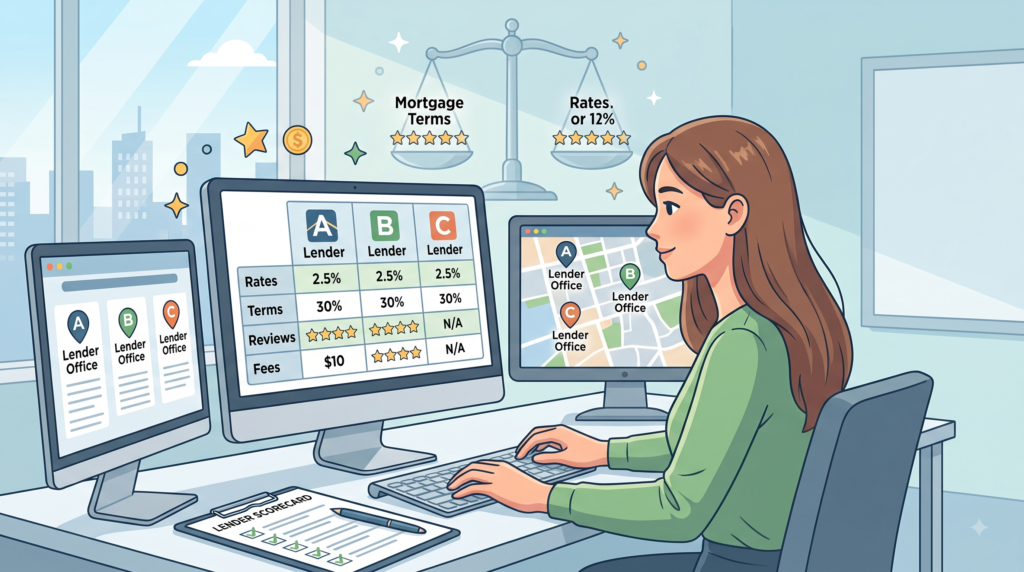
Yes, comparing lenders can be extremely valuable.
You could approach:
- Banks
- Credit unions
- Mortgage companies
- Online mortgage lenders
- Community lenders
The CFPB currently recommends getting at least three pre-approvals so you can compare lenders, loan programs, rates, and terms.
However, don’t compare lenders based only on the interest rate.
Also consider:
- Loan fees
- Points
- Closing costs
- Customer service
- Loan processing speed
- Communication
- Loan program availability
- Rate-lock policies
- Closing reliability
The cheapest rate is not always the best overall mortgage experience.
What Is a Mortgage Rate Lock?
A mortgage rate lock is an agreement that protects an interest rate for a specified period, subject to the lender’s terms and conditions.
Without a rate lock, mortgage rates can change.
A pre-approval does not necessarily mean your interest rate is locked.
The CFPB advises borrowers to check whether the rate is locked and, if so, how long the lock lasts.
Ask:
- Is my rate locked?
- When does the lock expire?
- How much does an extension cost?
- What happens if closing is delayed?
- Can the rate change before closing?
These questions can prevent unpleasant surprises.
What Happens After Mortgage Pre-Approval?
Once you receive your pre-approval, you can begin shopping for a home within your budget.
When you find a property and your offer is accepted, the lender moves into the formal mortgage process.
This can involve:
- Full loan application
- Property appraisal
- Income verification
- Asset verification
- Employment verification
- Title work
- Underwriting
- Additional documentation
- Final approval
- Closing
The pre-approval gives you a head start, but it does not eliminate the remaining underwriting process.
What Is a Loan Estimate?
Once you apply for a mortgage and provide the required information, the lender generally provides a standardized Loan Estimate.
The Loan Estimate contains important information about the proposed mortgage, including:
- Interest rate
- Monthly payment
- Loan amount
- Closing costs
- Taxes and insurance estimates
- Certain loan features
- Other important terms
The CFPB explains that lenders generally must provide a Loan Estimate within three business days after receiving the required application information.
This document becomes extremely important when you are comparing actual mortgage offers.
A pre-approval letter helps you shop for a home.
Loan Estimates help you compare the actual mortgage deals available to you.
How to Compare Mortgage Offers After Pre-Approval
Don’t automatically choose the lender that gave you the highest pre-approval amount.
Instead, compare the actual mortgage offers.
Look at:
Interest rate
A lower rate can reduce borrowing costs, but make sure you are comparing the same loan type and assumptions.
APR
APR provides a broader measure of the cost of the mortgage.
Points
Points are upfront costs that may reduce your interest rate.
Closing costs
Compare lender-controlled costs carefully.
Monthly payment
Understand exactly what is included.
Total interest
Consider the long-term cost of borrowing.
Five-year cost
The CFPB recommends examining the five-year cost of borrowing when comparing Loan Estimates. The Loan Estimate’s comparison section provides information that can help you calculate this figure.
Can You Negotiate a Mortgage After Pre-Approval?
Yes.
A pre-approval does not mean you must accept the lender’s first offer.
Once you have multiple offers, you may be able to negotiate:
- Interest rate
- Points
- Origination charges
- Certain lender fees
- Closing costs
The CFPB recommends comparing Loan Estimates from multiple lenders and notes that having competing offers can give you leverage when negotiating.
For example:
Lender A
- Lower rate
- Higher points
- Higher upfront costs
Lender B
- Slightly higher rate
- Lower points
- Lower closing costs
Rather than asking which rate is lower, ask:
Which loan produces the better total cost for my expected time in the home?
That is a much more useful comparison.
Common Mortgage Pre-Approval Mistakes to Avoid
Mistake 1: Shopping based on the maximum approval
Being approved for more does not mean you should spend more.
Mistake 2: Getting only one lender’s offer
You may miss better pricing or loan terms.
Mistake 3: Opening new credit accounts
New debt can affect your financial profile during the mortgage process.
Mistake 4: Changing jobs without discussing it
Employment changes can complicate income verification.
Mistake 5: Making unexplained large deposits
Lenders may ask where unusual funds came from.
Mistake 6: Spending your entire savings on the down payment
You still need money for closing, emergencies, repairs, and moving expenses.
Mistake 7: Assuming pre-approval equals final approval
The property and your financial information still need to satisfy the lender’s underwriting requirements.
Mistake 8: Choosing the lowest advertised rate
A low rate may come with points or higher fees.
Always compare the complete offer.
How to Improve Your Chances of Mortgage Pre-Approval
Before applying, consider taking these steps.
Review your credit
Check for inaccurate information and address errors.
Reduce unnecessary debt
Lower monthly obligations can improve your financial profile.
Build savings
A larger financial cushion can help with the down payment and closing costs.
Avoid unnecessary new credit
Don’t make major financial changes immediately before applying without discussing them with your lender.
Organize your documents
Having income, asset, and identification documents ready can make the process faster.
Create a realistic budget
Determine what monthly payment you can comfortably afford before asking a lender for the maximum possible amount.
Compare lenders
Get multiple pre-approvals and compare their programs and pricing.
Mortgage Pre-Approval Guide: Questions to Ask Your Lender
Before accepting a pre-approval, ask:
- What loan amount am I pre-approved for?
- What assumptions were used?
- Has my income been verified?
- Has my employment been verified?
- Which credit score was used?
- What loan programs am I eligible for?
- Is the interest rate locked?
- If not, when can I lock it?
- How long is the pre-approval valid?
- What documents will you need later?
- What could cause the pre-approval to change?
- What are the estimated closing costs?
- Are points included?
- What down payment did you assume?
- What monthly payment should I realistically budget for?
- Are there any conditions attached to the pre-approval?
These questions can help you understand what the letter actually represents.
Where to Find Reliable Mortgage Pre-Approval Information
Mortgage financing is a major financial commitment, so it is better to rely on authoritative sources than generic mortgage advertisements.
The Consumer Financial Protection Bureau (CFPB) provides a detailed mortgage shopping process covering preparation, pre-approval, comparing lenders, Loan Estimates, rate locks, and closing.
The CFPB recommends comparing multiple mortgage offers and currently advises consumers to seek at least three pre-approvals when shopping for a mortgage.
Its guidance also explains that a pre-approval is not a guaranteed loan offer and that borrowers should ask lenders what assumptions and conditions apply.
For an additional authoritative resource, the U.S. Department of Housing and Urban Development (HUD) provides information about housing counseling and homeownership resources. Consumers who need help understanding their mortgage options can consider working with a HUD-approved housing counseling agency.
HUD Housing Counseling Resources
Using government resources alongside lender-provided information can help you distinguish between general advertising and the actual terms that apply to your financial situation.
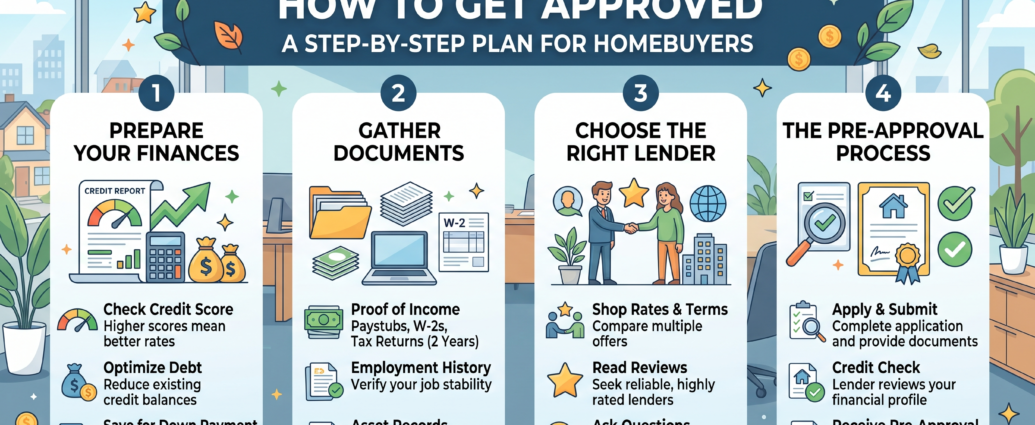
Mortgage Pre-Approval Guide: A Simple Step-by-Step Process
Here is a practical summary of the entire process.
Step 1: Review your finances
Check income, savings, debts, expenses, and credit.
Step 2: Set your personal home budget
Decide what payment is comfortable before asking a lender for its maximum approval.
Step 3: Gather documents
Prepare income, asset, employment, and identification records.
Step 4: Contact multiple lenders
Compare banks, credit unions, mortgage companies, and other reputable lenders.
Step 5: Request pre-approval
Provide the information requested by each lender.
Step 6: Compare the pre-approvals
Look at loan programs, estimated rates, fees, and assumptions.
Step 7: Choose your home-shopping range
Use the pre-approval as a financing guideline, not as a command to spend the maximum.
Step 8: Make an offer
Submit the pre-approval letter when appropriate.
Step 9: Request and compare Loan Estimates
After applying for the mortgage, compare standardized Loan Estimates from lenders.
Step 10: Complete underwriting
Provide additional documentation and address lender conditions.
Step 11: Lock your rate when appropriate
Understand the lock period and extension terms.
Step 12: Close
Review the final documents carefully before signing.
Final Thoughts on Mortgage Pre-Approval
A mortgage pre-approval can be one of the most useful steps in the home-buying process, but it should be viewed as a planning and negotiating tool, not a guarantee that you will receive a mortgage.
The strongest approach is to prepare your finances before applying, understand your credit and debt position, gather your documentation, and compare multiple lenders.
Most importantly, don’t confuse the lender’s maximum approval amount with your personal definition of affordability.
A lender may approve a mortgage that leaves little room in your monthly budget for emergencies, repairs, retirement savings, or other goals.
Use the pre-approval to understand your financing options, but make your final home budget based on your complete financial picture.
Once you find a property, compare actual Loan Estimates rather than relying solely on the pre-approval letter. Look beyond the advertised interest rate and evaluate the APR, points, closing costs, monthly payment, and total borrowing cost.
The goal of mortgage pre-approval isn’t simply to qualify for the largest loan possible. It is to enter the home-buying process prepared, informed, and financially comfortable with the mortgage you ultimately choose.
Frequently Asked Questions About Mortgage Pre-Approval
1. What is mortgage pre-approval?
Mortgage pre-approval is a lender’s tentative indication that it is willing to lend you up to a specified amount, subject to further verification and conditions.
2. Is mortgage pre-approval the same as final approval?
No. Pre-approval is not a guaranteed mortgage. The lender still needs to complete underwriting and verify the borrower and property.
3. How long does mortgage pre-approval last?
It varies by lender, but many pre-approval letters are valid for approximately 30 to 60 days.
4. What documents are needed for mortgage pre-approval?
Common documents include pay stubs, W-2s, tax returns, bank statements, identification, employment information, and details about existing debts.
5. Does pre-approval affect my credit score?
A mortgage lender will generally check your credit, but multiple mortgage inquiries made within the applicable shopping period can generally be treated as a single inquiry for credit-scoring purposes.
6. Should I get pre-approved by multiple lenders?
Yes. Comparing multiple lenders can help you find better loan programs, pricing, and terms. The CFPB recommends getting at least three pre-approvals when shopping for a mortgage.
7. Can I get pre-approved without choosing a house?
Yes. You generally do not need to have a specific home selected to begin exploring mortgage options and obtaining pre-approval.
8. Does mortgage pre-approval guarantee a loan?
No. The lender can still require additional verification and underwriting before final approval.
9. How much mortgage can I get pre-approved for?
The amount depends on factors such as income, debts, credit, assets, down payment, loan program, and lender underwriting standards.
10. Should I buy a house at my maximum pre-approved amount?
Not necessarily. Your lender’s maximum approval may be higher than the monthly payment you personally consider comfortable.
11. What is the difference between prequalification and pre-approval?
The difference varies by lender. Prequalification may rely more heavily on information you provide, while some lenders use pre-approval for a more detailed verification process.
12. Can I make an offer without pre-approval?
You may be able to, depending on the transaction, but having pre-approval can demonstrate to sellers that you are a serious buyer and may strengthen your offer.
13. What happens after mortgage pre-approval?
You shop for a home, make an offer, submit the formal mortgage application, provide additional documentation, complete underwriting, and proceed toward closing if the loan is approved.
14. What is a Loan Estimate?
A Loan Estimate is a standardized three-page mortgage disclosure showing important information about the loan, including estimated rate, monthly payment, and closing costs.
15. When do I receive a Loan Estimate?
After you provide the lender with the required application information, the lender generally must provide the Loan Estimate within three business days.
16. Can I negotiate a mortgage rate after pre-approval?
Yes. You can compare competing lenders and may be able to negotiate rates, points, or certain fees.
17. Is a mortgage interest rate locked during pre-approval?
Not necessarily. Ask your lender whether the rate is locked, when the lock begins, and how long it lasts.
18. Can a mortgage pre-approval be denied later?
Yes. A pre-approval is conditional and can change if financial information cannot be verified, your circumstances change, or the property does not meet the lender’s requirements.
19. Can I change lenders after getting pre-approved?
Yes. A pre-approval does not generally commit you to using that lender. You can continue comparing lenders until you choose a mortgage offer.
20. What is the best way to prepare for mortgage pre-approval?
Review your credit, organize your financial documents, understand your debts and income, build savings, avoid unnecessary financial changes, and compare multiple lenders before choosing a mortgage.