
Choosing your first bank account is an important financial decision, especially when you are heading to college. Students often have a different set of banking needs than full-time workers: low or no monthly fees, convenient ATM access, a good mobile app, simple money-management tools, and an account that can grow with them after graduation.
The best banks for students are not necessarily the banks with the biggest sign-up bonus or the most features. A good student account should make everyday banking inexpensive and easy while helping you develop responsible money habits.
In this guide, we compare several student-friendly banking options in the U.S., explain what students should look for before opening an account, and discuss important considerations such as fees, ATM access, savings, overdrafts, international banking, and what happens after graduation.
Important: This article focuses primarily on U.S. banking options and is for educational purposes. Account eligibility, fees, bonuses, interest rates, and terms can change. Always review the bank’s current disclosures before opening an account.
What Is a Student Bank Account?
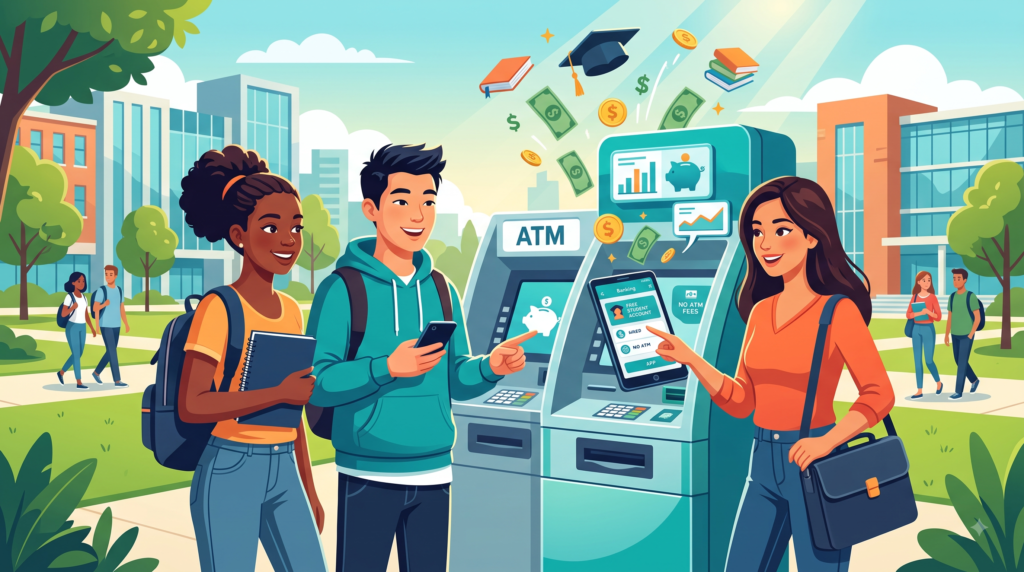
A student bank account is a checking or savings account designed specifically for college students or young adults.
Some banks offer accounts explicitly labeled “student checking,” while others provide regular checking accounts with features that are particularly useful for students.
Student-friendly accounts may offer:
- Low or no monthly maintenance fees
- No minimum balance requirements
- Convenient mobile banking
- Large ATM networks
- Early direct deposit
- Budgeting tools
- Overdraft protection or no overdraft fees
- Easy access to savings
- Student-specific promotions
Importantly, the word student on an account does not automatically make it a better choice.
A regular checking account with no monthly fee, excellent ATM access, and strong digital tools may be more useful than an account marketed specifically to students.
Chase itself notes that student checking accounts can provide features such as reduced fees and tools designed around student financial needs, while eligibility can depend on age and enrollment status.
What Should Students Look for in a Bank?
Before choosing among the best banks for students, identify the features that actually matter to your situation.
1. No Monthly Maintenance Fee
Students often have limited or irregular income.
A $10 or $15 monthly fee may not seem significant, but paying it every month can add up to more than $100 per year.
Look for an account that either has no monthly fee or provides an easy way to waive the fee.
Some banks waive fees based on age, student status, direct deposit, or account balance.
2. Low ATM Costs
ATM fees can quietly consume a student’s budget.
A good student account should provide convenient access to fee-free ATMs or reimburse certain out-of-network ATM fees.
This is particularly important for students who attend college away from home.
3. A Strong Mobile Banking App
For many students, the mobile app is effectively their bank branch.
Look for features such as:
- Mobile check deposit
- Instant transaction notifications
- Bill payments
- Account transfers
- Card locking
- Spending alerts
- Digital wallets
- Budgeting tools
The ability to immediately see where your money is going can be particularly useful when you’re learning to manage money independently.
4. No or Low Overdraft Fees
Students can sometimes miscalculate their available balance, particularly when several transactions are pending.
An account that does not charge overdraft fees can reduce the cost of an accidental mistake.
However, don’t interpret “no overdraft fee” as permission to spend more than you have.
Responsible spending remains the best protection.
5. A Good Savings Option
Checking is useful for everyday expenses, but students should also consider having a separate savings account.
You can use savings for:
- Emergency expenses
- Books
- Tuition-related costs
- Travel
- A new laptop
- Moving expenses
- Future housing costs
Separating spending money from savings can make it easier to avoid accidentally spending money you’ve intended to save.
Best Banks for Students in 2026
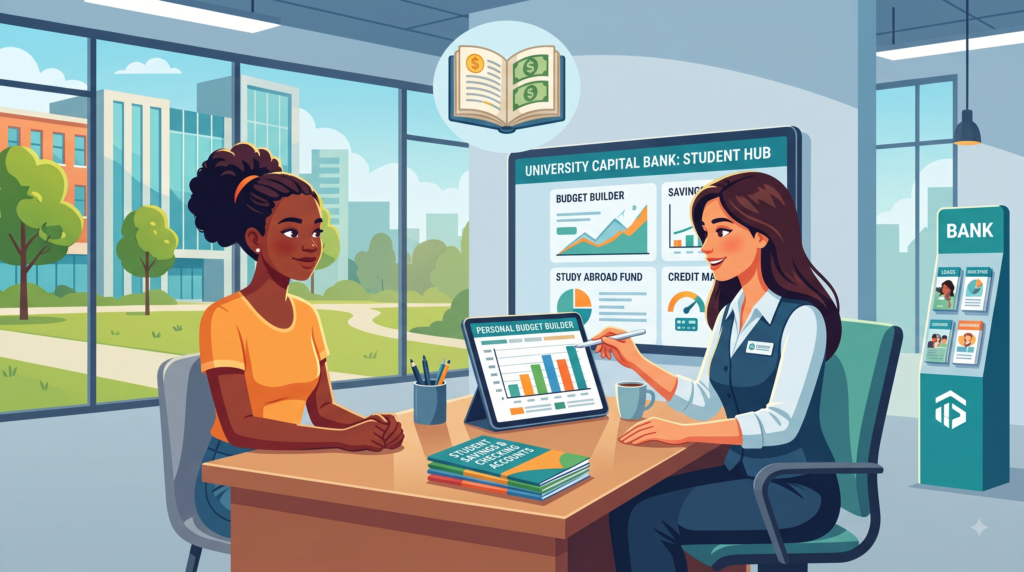
There is no single bank that is best for every student.
The following options stand out for different reasons, including student eligibility, low fees, digital banking, branch access, ATM availability, and savings features.
1. Chase — Best for Students Who Want Branch Access
Chase is one of the strongest options for students who value a combination of physical branches and digital banking.
Its current student-focused checking offer includes a $0 monthly service fee for eligible account owners ages 17 through 24, and Chase currently advertises a promotional bonus for qualifying new customers. The promotional offer has an expiration date and specific transaction requirements, so students should verify the terms before applying.
Why Chase can be good for students
- Large branch network
- Mobile banking
- Digital payment options
- Student-focused account eligibility
- No monthly service fee for eligible 17–24-year-old account owners
- No minimum opening deposit for the advertised student offer
- Access to a large ATM network
Chase can be particularly attractive if your college is near a Chase branch or ATM.
Potential drawback
If you attend college in an area with limited Chase locations, an online bank or another local bank may provide more convenient ATM access.
Students should also pay attention to what happens when they age out of student-related fee waivers.
2. Capital One — Best for No-Fee Everyday Banking
Capital One is another strong choice for college students, particularly those who prefer digital banking and want to avoid monthly account fees.
Capital One currently highlights its 360 Checking account for college students age 18 and older. The account has no monthly fees, no minimum balance requirements, and no overdraft fees.
Why Capital One stands out
- No monthly maintenance fee
- No minimum balance requirement
- No overdraft fees
- Mobile banking
- Access to fee-free ATMs
- Capital One Cafés for in-person assistance in some locations
This makes Capital One particularly appealing to students who want straightforward banking without having to maintain a specific balance.
Potential drawback
Capital One’s physical branch and Café availability is not the same everywhere, so students who prefer traditional branch banking should check local availability before choosing it.
3. Bank of America — Best for Students Who Want a Large Traditional Bank
Bank of America Advantage Banking
Bank of America can be a practical choice for students who want access to a large traditional banking network.
Its Advantage SafeBalance Banking account currently offers a monthly maintenance fee waiver when an account owner is under age 25, subject to the account’s eligibility and terms. Bank of America also provides digital banking, alerts, direct deposit, and access to its branch and ATM network.
Why students may choose Bank of America
- Large branch and ATM network
- Mobile banking
- Digital payment tools
- No monthly maintenance fee for eligible customers under 25
- Financial education resources
- Savings options
This can be particularly convenient if your family already banks with Bank of America or if there is a branch near your college.
Potential drawback
Students should pay attention to the conditions attached to fee waivers and what happens after reaching the applicable age.
A fee waiver that works during college may not continue forever.
4. Ally Bank — Best for Online Banking and Saving
Ally Bank is worth considering if you are comfortable with online-only banking and want a combination of low fees and savings tools.
Ally’s Spending Account currently has no monthly maintenance fee, no overdraft fees, and no minimum balance requirement. Ally also advertises access to more than 75,000 fee-free ATMs and 24/7 customer support.
Its savings account also has no monthly maintenance fee or minimum balance requirement and includes tools such as savings buckets.
Why Ally can work well for students
- No monthly maintenance fee
- No overdraft fee
- No minimum balance
- Large fee-free ATM network
- 24/7 customer support
- Savings buckets
- Strong digital banking experience
Potential drawback
Ally does not operate a traditional branch network.
If you frequently need to deposit cash or prefer face-to-face banking, a traditional bank may be more convenient.
5. SoFi Bank — Best for Students Focused on Digital Banking and Saving
SoFi can be attractive to students and young adults who want checking and savings features integrated into one digital banking experience.
SoFi currently advertises no account, monthly, or overdraft fees. It also offers savings tools such as Vaults and automated savings features.
As of August 2026, SoFi is also advertising promotional savings APY and cash-bonus opportunities tied to eligibility requirements, including direct deposit. These are promotional terms and can change, so students should verify the current offer before applying.
Why SoFi can be useful
- No account fees under its advertised terms
- Digital-first experience
- Automated savings
- Savings Vaults
- Early direct deposit features
- Checking and savings in one account
Potential drawback
Students who regularly need branch services may prefer a traditional bank.
Best Banks for Students: Quick Comparison
| Bank | Best For | Monthly Fee Highlights | Branch Access | Digital Banking |
|---|---|---|---|---|
| Chase | Students wanting branches | $0 for eligible 17–24-year-olds on qualifying account | Yes | Strong |
| Capital One | Simple no-fee checking | $0 monthly fee | Limited | Strong |
| Bank of America | Traditional banking | $0 for eligible customers under 25 on qualifying account | Yes | Strong |
| Ally | Online banking and saving | $0 monthly fee | No | Strong |
| SoFi | Digital banking and saving | No account/monthly fees advertised | No | Strong |
Important: This table is a high-level comparison, not a substitute for the bank’s current account disclosures. Fees, eligibility, promotional offers, and terms can change.

Should You Choose a Student-Specific Account?
Not necessarily.
This is one of the most important lessons when comparing the best banks for students.
A student-specific account may have useful benefits, but a regular checking account could provide better terms.
For example, imagine:
Student Account A
- $0 monthly fee
- Limited ATM network
- Basic mobile app
Regular Account B
- $0 monthly fee
- Large ATM network
- Excellent mobile app
- No overdraft fee
- Better savings integration
Even though Account A is marketed specifically to students, Account B may be the better financial choice.
The label matters less than the actual terms.
How Much Money Should a Student Keep in Checking?
There is no universal amount.
A practical approach is to keep enough money in checking to cover upcoming expenses while keeping longer-term savings separate.
For example, if your expected monthly expenses are:
- Food: $300
- Transportation: $100
- Phone: $50
- Entertainment: $100
- Miscellaneous: $100
Your expected monthly spending is approximately:
$650
You could keep enough in checking to cover your near-term expenses while placing money intended for emergencies or future expenses in savings.
The right amount depends on how frequently you receive money and whether your parents, scholarships, financial aid, or employment contribute to your expenses.
Checking Account vs. Savings Account for Students
A checking account is designed primarily for spending and transactions.
A savings account is designed primarily for holding money for future needs.
Checking is useful for:
- Debit card purchases
- Rent
- Food
- Transportation
- Bills
- Direct deposits
- Everyday expenses
Savings is useful for:
- Emergency funds
- Future purchases
- Tuition-related expenses
- Travel
- Moving costs
- Financial goals
Using both accounts can make budgeting easier.
For example:
Checking: money available for this month’s expenses
Savings: money you do not plan to spend immediately
That simple separation can prevent accidental overspending.
What Are the Most Important Bank Fees for Students?
Don’t look only at the monthly maintenance fee.
Review the complete fee schedule.
Important fees can include:
- Monthly maintenance fees
- Out-of-network ATM fees
- Overdraft fees
- Returned-item fees
- Wire-transfer fees
- Foreign transaction fees
- Cash deposit fees
- Expedited card replacement fees
A bank with a $0 monthly fee could still be expensive if you regularly pay ATM or international transaction charges.
For example, an international student who frequently travels outside the U.S. may care more about foreign transaction costs than a student who never leaves the country.

Best Banks for International Students
International students have additional considerations.
A student studying in the U.S. may not have the same documentation or credit history as a U.S. citizen.
Depending on the bank, an international student may need documents such as:
- Passport
- Visa
- Form I-20 or other immigration documentation
- U.S. address
- Student identification
- Tax identification or Social Security information, depending on eligibility
Bank requirements vary.
For example, Chase states that international students and 17-year-olds must open certain student accounts in a branch and bring acceptable identification.
International students should contact the bank before visiting a branch so they know exactly which documents are required.
Are Student Bank Accounts FDIC Insured?
If you keep money in an FDIC-insured bank, eligible deposit accounts are generally protected up to the applicable FDIC insurance limit.
The standard FDIC insurance amount is $250,000 per depositor, per insured bank, for each ownership category. FDIC insurance covers eligible deposit accounts such as checking and savings accounts.
FDIC Deposit Insurance Information
This is an important distinction:
FDIC insurance protects eligible bank deposits. It does not protect investments such as stocks or mutual funds simply because they are purchased through a bank.
Students should confirm that the institution they choose is FDIC-insured if deposit insurance is important to them.
How to Open a Student Bank Account
Opening an account is usually straightforward.
Step 1: Compare accounts
Look at fees, ATM access, mobile banking, savings options, and eligibility.
Step 2: Confirm eligibility
Check age, student-status, residency, and identification requirements.
Step 3: Prepare documents
You may need:
- Government-issued ID
- Social Security number or other required identification
- Address information
- Student ID or enrollment verification
Step 4: Apply
Depending on the bank, you may be able to apply online or in a branch.
Step 5: Set up direct deposit
If you have a job or other eligible recurring income, direct deposit may provide additional benefits.
Step 6: Set account alerts
Enable notifications for:
- Low balances
- Large transactions
- Deposits
- Withdrawals
- Card purchases
Alerts can help you catch unauthorized transactions and avoid accidental overspending.
What Happens to Your Student Bank Account After Graduation?
Student banking benefits often do not last forever.
Depending on the bank, your account may automatically convert to a standard checking account after you graduate or reach a certain age.
This is something many students overlook.
Before opening an account, ask:
“What happens to this account when I am no longer a student?”
You should understand:
- When student benefits end
- Whether the account automatically converts
- What the new monthly fee will be
- Whether minimum balances will apply
- Whether you need to open a new account
A bank that is excellent during college may not be the best option after graduation.
Common Mistakes Students Make When Choosing a Bank
Choosing based only on a bonus
A $100 or $200 bonus can be attractive, but a recurring fee can eventually cost more than the bonus.
Ignoring ATM availability
A free account isn’t necessarily free if you regularly pay out-of-network ATM fees.
Keeping all money in checking
Students may spend money intended for future expenses simply because it is easily accessible.
Using overdraft as extra money
Overdraft protection is not a substitute for budgeting.
Ignoring account conversion rules
Always find out what happens when student eligibility ends.
Opening too many accounts
Having several accounts can become difficult to track.
Start with a simple setup unless you have a specific reason for additional accounts.
How to Choose the Best Bank for Your Situation
Rather than asking:
“What is the best bank for students?”
ask:
“What bank is best for the way I manage money?”
Choose a traditional bank if:
- You want physical branches
- You deposit cash regularly
- Your family already banks there
- You want in-person assistance
Consider an online bank if:
- You rarely need branches
- You want low fees
- You prefer mobile banking
- You want competitive savings features
Look for a student-specific account if:
- It provides meaningful fee waivers
- You meet the eligibility requirements
- It offers useful student benefits
- The terms are better than regular alternatives
Consider a combination
You don’t necessarily need to keep checking and savings at the same institution.
For example, you might use one bank for everyday spending and another for savings if the overall combination provides better features.
A Simple Student Banking Strategy
For a student starting from scratch, a simple system can work well.
Account 1: Everyday checking
Use it for:
- Food
- Transportation
- Bills
- Debit card purchases
- Regular spending
Account 2: Emergency savings
Use it for:
- Unexpected expenses
- Medical costs
- Emergency travel
- Essential replacement purchases
Account 3: Goal-based savings
Optional.
Use it for:
- Laptop
- Vacation
- Moving
- Tuition-related expenses
- Graduation costs
You don’t need three accounts to manage money successfully, but separating goals can make budgeting easier.

Final Thoughts: Best Banks for Students
The best banks for students should make it easier—not harder—to manage money during college.
For students who want branches and a traditional banking experience, Chase and Bank of America are worth considering.
For students who prioritize simple, low-fee digital checking, Capital One can be attractive.
For students who prefer online banking and strong savings tools, Ally Bank is worth evaluating.
For students who want an integrated digital checking and savings experience, SoFi Bank can be another option.
But there is no universal winner.
The right choice depends on where you attend school, how often you need cash, whether you need branches, how much you save, whether you travel internationally, and what fees you are likely to encounter.
Before opening an account, compare the current fee schedule and eligibility requirements rather than relying solely on promotional advertisements or a “best bank” ranking.
A good student bank account should do three things:
- Keep everyday banking inexpensive.
- Make your money easy to manage.
- Help you develop financial habits that continue after graduation.
The bank you choose for college doesn’t have to be the bank you use forever. What matters most is choosing an account whose costs and features match your actual financial needs.
Frequently Asked Questions About the Best Banks for Students
1. What are the best banks for students in 2026?
Chase, Capital One, Bank of America, Ally Bank, and SoFi are among the student-friendly options worth comparing in 2026. The best choice depends on fees, branch access, ATM availability, digital features, and your personal needs.
2. What should students look for in a bank account?
Students should look for low or no monthly fees, convenient ATMs, a strong mobile app, low overdraft costs, easy transfers, and useful savings features.
3. Are student bank accounts free?
Some student accounts have no monthly maintenance fee, while others waive fees only if certain conditions are met. Always check the current fee schedule.
4. Is Chase a good bank for college students?
Chase can be a good choice for students who want branch access, a large ATM network, and digital banking. Its current student-related offers include fee waivers for eligible customers ages 17–24.
5. Is Capital One good for students?
Yes. Capital One’s 360 Checking is available to college students age 18 and older and currently has no monthly fees, no minimum balance requirements, and no overdraft fees.
6. Is Bank of America good for college students?
Bank of America can be useful for students who want traditional branch banking. Its Advantage SafeBalance account currently offers a monthly fee waiver for eligible account owners under age 25.
7. Is Ally Bank good for students?
Ally can be a strong option for students who prefer online banking. Its Spending Account currently has no monthly maintenance or overdraft fees and no minimum balance requirement.
8. Is SoFi a good bank for students?
SoFi may suit students who prefer digital banking and automated savings. Its current Checking and Savings product advertises no account, monthly, or overdraft fees, subject to its terms.
9. Do students need a checking account?
Most students can benefit from a checking account because it makes everyday spending, bill payments, direct deposits, and debit-card purchases easier to manage.
10. Should students have a savings account?
Yes, if possible. A separate savings account can help students build an emergency fund and save for predictable future expenses.
11. Can international students open a U.S. bank account?
Many international students can open U.S. bank accounts, but eligibility and documentation requirements vary by bank. Contact the bank before applying to confirm what identification and immigration documents are required.
12. Do student bank accounts require a minimum balance?
Not always. Several student-friendly accounts have no minimum balance requirement, but requirements vary by bank and account.
13. Do student accounts have overdraft fees?
Some accounts charge overdraft fees, while others do not. Students should check the bank’s current overdraft policy before opening an account.
14. What happens when I graduate?
Depending on the bank, your student account may remain open, convert to a standard account, or lose certain student benefits after you graduate or reach a specified age.
15. Can I open a bank account without a job?
Often, yes. Employment is not necessarily required to open a checking account, although banks may have identification and eligibility requirements.
16. Are online banks safe for students?
Online banks can be safe when they are properly regulated and insured. If you are concerned about deposit protection, verify that the bank is FDIC-insured and understand the applicable coverage limits.
17. Is it better to bank where my parents bank?
Not necessarily. A family bank can be convenient for transfers and familiarity, but compare its fees and features with other student-friendly accounts before deciding.
18. Should I choose a bank because it offers a sign-up bonus?
Not by itself. Compare the bonus with ongoing fees, eligibility requirements, ATM costs, and the account’s long-term usefulness.
19. Can I have checking accounts at two different banks?
Yes. Having accounts at different banks can be useful when each provides a specific benefit, although students should keep their banking setup simple enough to manage effectively.
20. What is the best bank for a college student with no income?
A low-fee account with no minimum balance requirement can be particularly useful for students with limited income. Capital One, Ally, and some other banks offer accounts with features that can work well for this situation, subject to eligibility.
Editorial and E-E-A-T Note
Bank account fees, bonuses, eligibility requirements, and promotional rates can change. The bank-specific information in this article was checked against bank websites in August 2026, but readers should verify current terms directly with the bank before opening an account.
For authoritative information about deposit insurance, readers can consult the Federal Deposit Insurance Corporation (FDIC). The FDIC states that the standard insurance amount is $250,000 per depositor, per insured bank, for each account ownership category.
This article is educational content and is not personalized banking, financial, or investment advice.