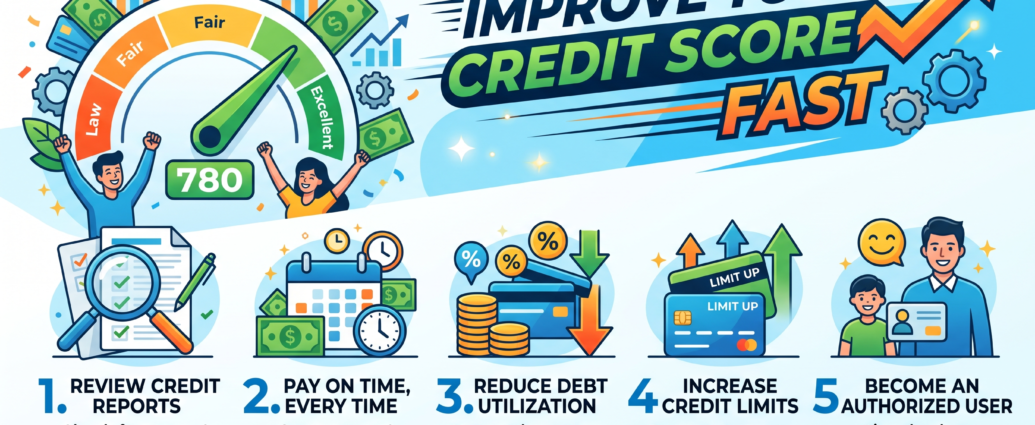
If you are trying to improve your credit score fast, it is easy to come across promises claiming that your score can jump dramatically in a few days. The reality is more straightforward: there is no legitimate shortcut that can instantly transform a credit profile.
However, some actions can produce results faster than others.
If your credit score is being held back by high credit card balances, inaccurate information, or recent missed payments, addressing those issues can potentially make a meaningful difference once the updated information reaches the credit reporting agencies.
The key is knowing which actions have the greatest impact and which common “credit repair” strategies are mostly marketing.
This guide explains how credit scores work, the fastest legitimate ways to improve them, how credit utilization affects your score, what to do about late payments and credit-report errors, and how to build stronger credit over the long term.
Important: This article focuses primarily on U.S. credit scoring and reporting. Credit scores differ by scoring model, lender, and credit bureau. There is no guaranteed number of points that any particular action will add to your score.
What Does It Mean to Improve Your Credit Score Fast?
Improving your credit score fast does not mean finding a secret formula that bypasses the credit system.
It means identifying the factors currently hurting your credit profile and addressing the ones you can realistically control.
For some people, the quickest opportunity is reducing credit card balances.
For others, it may be correcting an error on a credit report.
Someone with several recent missed payments may need more time because accurate negative information cannot simply be removed because you want a higher score.
The Consumer Financial Protection Bureau (CFPB) states that rebuilding credit takes time and that there are no shortcuts or secrets that can instantly repair a damaged credit history.
That distinction matters because legitimate credit improvement and “credit repair” scams are very different things.
How Credit Scores Work
Your credit score is calculated from information contained in your credit reports.
Different scoring models use different formulas, so there is no single universal credit-score formula.
For example, the widely used FICO Score considers five major categories:
- Payment history
- Amounts owed
- Length of credit history
- New credit
- Credit mix
FICO says these categories generally account for approximately 35%, 30%, 15%, 10%, and 10% respectively, although the importance of individual factors can vary depending on a person’s credit profile.
This gives us an important practical lesson:
You don’t need to improve every part of your credit profile at the same time.
Start with the factors that are currently causing the greatest damage.
1. Pay Every Bill on Time
If you want to improve your credit score fast, your first priority should be avoiding additional late payments.
Payment history is the largest category in the standard FICO scoring framework, accounting for about 35% of the score.
A single late payment can potentially hurt your score, particularly if it is recent or severe.
More importantly, repeatedly missing payments can make rebuilding credit substantially harder.
Set up automatic payments
One of the simplest ways to prevent accidental late payments is to use autopay.
You can set autopay to cover:
- The minimum payment
- The full statement balance
- Another amount allowed by the lender
If your cash flow is reliable, paying the full statement balance can help you avoid credit-card interest while maintaining a consistent payment history.
The CFPB recommends automatic payments or electronic reminders as practical ways to help ensure payments are made on time.
Important distinction
Paying a credit card in full is not required to “build credit.”
What matters most is making payments on time and managing your balances responsibly.
2. Lower Your Credit Utilization
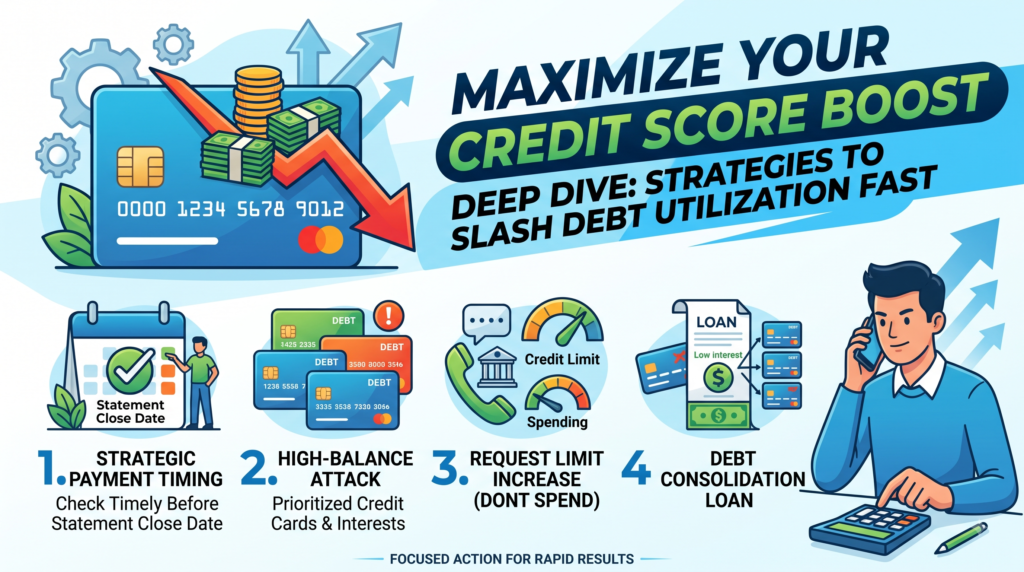
If you need to improve your credit score relatively quickly, credit utilization deserves close attention.
Credit utilization is the percentage of your available revolving credit that you are currently using.
Example
Suppose you have:
Credit limit: $10,000
Balance: $5,000
Your utilization is:
50%
If you reduce the balance to:
$2,000
your utilization becomes:
20%
Lower utilization is generally better for credit scoring.
The CFPB advises consumers not to get close to their credit limits and notes that experts often recommend keeping credit use at no more than 30% of total available credit.
FICO also identifies amounts owed as approximately 30% of a FICO Score and specifically considers revolving credit utilization.
Why Paying Down a Credit Card Can Help Quickly
Credit card issuers generally report account information to credit reporting companies periodically.
That means your score can potentially respond after a lower balance is reported.
For example:
Before paying down the card
- Credit limit: $10,000
- Reported balance: $7,000
- Utilization: 70%
After paying down the card
- Credit limit: $10,000
- Reported balance: $2,000
- Utilization: 20%
If the lower balance is subsequently reported, the scoring model may see a significantly lower utilization ratio.
However, there is no guaranteed number of points you will gain.
The CFPB notes that credit scores can be calculated at different times, so a high balance reported on one date can affect a score even if you pay the card off shortly afterward.
3. Pay Down Your Highest-Utilization Cards First
If you have several credit cards, don’t look only at your total utilization.
Individual card utilization can also matter.
Consider this example:
| Card | Credit Limit | Balance | Utilization |
|---|---|---|---|
| Card A | $10,000 | $2,000 | 20% |
| Card B | $2,000 | $1,800 | 90% |
| Card C | $8,000 | $1,000 | 12.5% |
Your total utilization is:
$4,800 ÷ $20,000 = 24%
That looks reasonable overall.
But Card B is almost maxed out.
Paying down the card with the highest utilization may be a useful strategy, particularly if you can reduce a nearly maxed-out balance.
FICO states that its scoring models consider utilization on individual revolving accounts as well as overall revolving credit usage.
4. Don’t Close Old Credit Cards Without a Reason
Closing a credit card may seem like a smart financial move, especially if you no longer use it.
But closing an account can sometimes hurt your score indirectly.
Why?
Suppose you have:
- Card A limit: $10,000
- Card B limit: $10,000
Your total available credit is:
$20,000
If you close Card B, your available credit could fall to:
$10,000
If you still owe $5,000 on Card A, your utilization changes from:
25% → 50%
That increase could negatively affect your score.
The CFPB warns that closing accounts can hurt a score when it causes a higher percentage of available credit to be used.
Before closing an account, ask:
- Does it have an annual fee?
- Is it my oldest account?
- Will closing it significantly reduce available credit?
- Can I keep it open without using it?
- Would keeping it open create financial temptation?
There is no universal rule that everyone should keep every credit card open.
The right decision depends on your circumstances.
5. Check Your Credit Reports for Errors
One of the fastest legitimate ways to potentially improve a credit score is to identify and dispute inaccurate information.
Your credit report could contain:
- An account you never opened
- Incorrect payment history
- Wrong balance
- Incorrect credit limit
- Duplicate debt
- Incorrect account status
- Identity information belonging to someone else
The CFPB specifically recommends checking credit reports for errors and explains that inaccurate information can affect your ability to obtain credit and the terms you receive.
The CFPB also lists common errors such as accounts belonging to another person, incorrect late-payment information, closed accounts reported as open, duplicate debts, and incorrect balances or credit limits.
How to Dispute a Credit Report Error
If you find inaccurate information, don’t simply ignore it.
Generally, you should contact:
- The credit reporting company showing the incorrect information.
- The company that supplied the information to the credit reporting company.
Provide an explanation of what is wrong and supporting documentation when available.
The CFPB recommends disputing inaccurate information with both the reporting company and the information provider.
Keep copies
Save:
- Dispute letters
- Screenshots
- Statements
- Receipts
- Confirmation numbers
- Supporting documents
A clear paper trail can be useful if you need to follow up later.
6. Become Current on Past-Due Accounts
If you have missed payments, getting current is important.
Continuing to miss payments creates additional negative information.
The CFPB recommends getting current and staying current when rebuilding credit.
However, getting current does not necessarily erase previous late-payment history.
Accurate negative information generally remains on a credit report for a period of time.
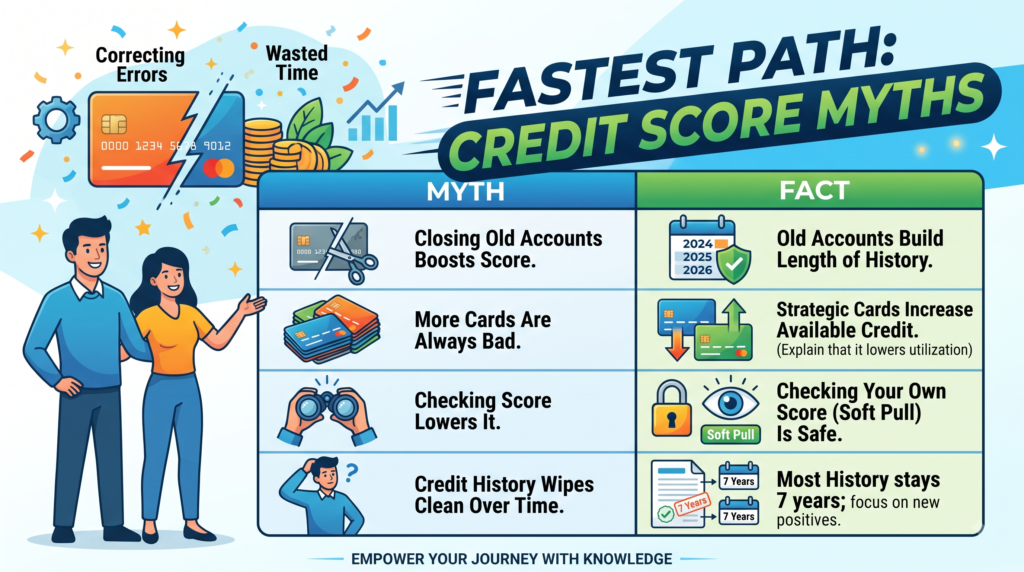
The CFPB explains that negative information can remain for years depending on the type—for example, a late payment generally may remain for seven years.
The encouraging part is that older negative information generally becomes less influential over time.
Your goal should therefore be:
Stop the damage → get current → stay current → build positive history.
7. Don’t Apply for Several New Credit Cards at Once
When trying to improve your credit, opening multiple new accounts may seem attractive.
For example:
- Apply for a rewards card
- Apply for a store card
- Apply for a balance-transfer card
- Apply for another card with a sign-up bonus
But multiple applications in a short period can create hard inquiries and may signal increased credit-seeking behavior.
The CFPB recommends applying only for credit you need and warns that applying for a lot of credit over a short period can negatively affect your score.
FICO also identifies new credit as one of the five major categories used in calculating FICO Scores.
Better approach
If you need a new credit account, choose carefully.
Don’t apply for five cards simply because each issuer offers a promotional reward.
8. Keep Older Accounts Open When Appropriate
Length of credit history is another factor considered by FICO.
FICO identifies length of credit history as approximately 15% of a typical FICO Score.
Older accounts can contribute to a longer credit history.
However, that doesn’t mean you should keep an expensive credit card forever.
If an old card charges a large annual fee and provides no meaningful benefit, you may reasonably decide to close it.
Before doing so, consider how closing the account could affect:
- Available credit
- Utilization
- Account age
- Overall credit profile
The objective is not to preserve every account indefinitely.
It’s to manage your credit accounts intentionally.
9. Don’t Carry a Credit Card Balance Just to Build Credit
This is one of the most persistent credit myths.
You do not need to pay interest to build a credit score.
Carrying a balance from month to month simply because you believe it will improve your score can cost you money.
The CFPB specifically recommends paying credit card balances in full each month when possible and explains that carrying a balance is not required to build good credit.
Better strategy
Use the card responsibly.
Then:
Pay the statement balance in full by the due date.
That can help you maintain a positive payment history while avoiding unnecessary interest charges.
10. Ask for a Higher Credit Limit Carefully
A higher credit limit can reduce your utilization ratio if your spending remains unchanged.
Example
Current limit:
$5,000
Current balance:
$2,000
Utilization:
40%
If your issuer increases your limit to:
$10,000
and you still owe $2,000:
$2,000 ÷ $10,000 = 20%
Your utilization has fallen.
However, requesting a higher limit may involve a credit inquiry depending on the issuer.
More importantly, a higher limit is only beneficial if it doesn’t encourage you to spend more.
Never increase your spending simply because your credit limit increased.
11. Consider Becoming an Authorized User
In some situations, becoming an authorized user on another person’s credit card may help establish or strengthen a credit profile.
This can be useful when the primary account holder has:
- A long credit history
- Consistent on-time payments
- Low utilization
- A well-managed account
However, the strategy can also backfire.
If the primary cardholder:
- Misses payments
- Carries high balances
- Has a poor credit history
the account could potentially be unhelpful.
Only consider this arrangement with someone you trust and after confirming whether the issuer reports authorized-user activity to the relevant credit bureaus.
12. Use a Secured Credit Card if You Have Limited Credit
If you have little or damaged credit and cannot qualify for a conventional credit card, a secured credit card can be an option.
With many secured cards, you provide a refundable security deposit that generally determines your credit limit.
For example:
Security deposit: $500
Credit limit: $500
You then use the card and make payments according to the account terms.
The CFPB identifies secured cards as one possible tool for establishing or rebuilding credit, while warning consumers to consider fees and interest rates.
What matters most
A secured card only helps your credit-building strategy if the issuer reports your account activity to the major credit reporting companies.
Check that before applying.
13. Don’t Take Out a Loan Just to Increase Your Credit Score
You may hear advice suggesting that you should take out a personal loan simply to improve your credit mix.
That is usually unnecessary.
FICO considers credit mix, but it represents a relatively small portion of a typical FICO Score compared with payment history and amounts owed.
Taking on unnecessary debt means:
- Interest costs
- New account inquiries
- Additional monthly payments
- Potential financial risk
A credit score is a tool, not a game.
Don’t borrow money you don’t need simply to manufacture a particular credit profile.
14. Create a Payment System So You Never Miss a Due Date
Improving your credit is much easier when you make good behavior automatic.
Consider using:
Autopay
Set at least the minimum payment to be paid automatically.
Calendar reminders
Create reminders several days before due dates.
Low-balance alerts
Set alerts so you know when your checking account balance falls below a certain amount.
Credit-card alerts
Receive notifications when:
- A purchase is made
- Your balance reaches a threshold
- A payment is due
- A payment is posted
These systems reduce the chance that a busy schedule causes an avoidable late payment.
15. Build an Emergency Fund
An emergency fund may not directly increase your credit score.
But it can indirectly protect your credit.
Consider what happens when an unexpected $1,500 expense appears and you have no savings.
You might:
- Max out a credit card
- Miss a payment
- Take expensive short-term debt
- Use several cards simultaneously
Those actions could create future credit problems.
A cash emergency fund gives you another option.
Even a small reserve can reduce the pressure to use credit for every unexpected expense.
How Fast Can You Improve Your Credit Score?
There is no universal timeline.
Your score may change after updated information reaches a credit reporting company and a scoring model recalculates your profile.
Potentially faster changes
These may produce relatively quick changes when updated:
- Lowering high credit-card balances
- Correcting an inaccurate account
- Reducing utilization
- Becoming current on overdue accounts
Longer-term improvements
These generally require more time:
- Building a longer payment history
- Recovering from serious delinquencies
- Rebuilding after bankruptcy
- Establishing a strong credit mix
- Maintaining consistently low utilization
The CFPB emphasizes that rebuilding credit takes time and consistent positive behavior.
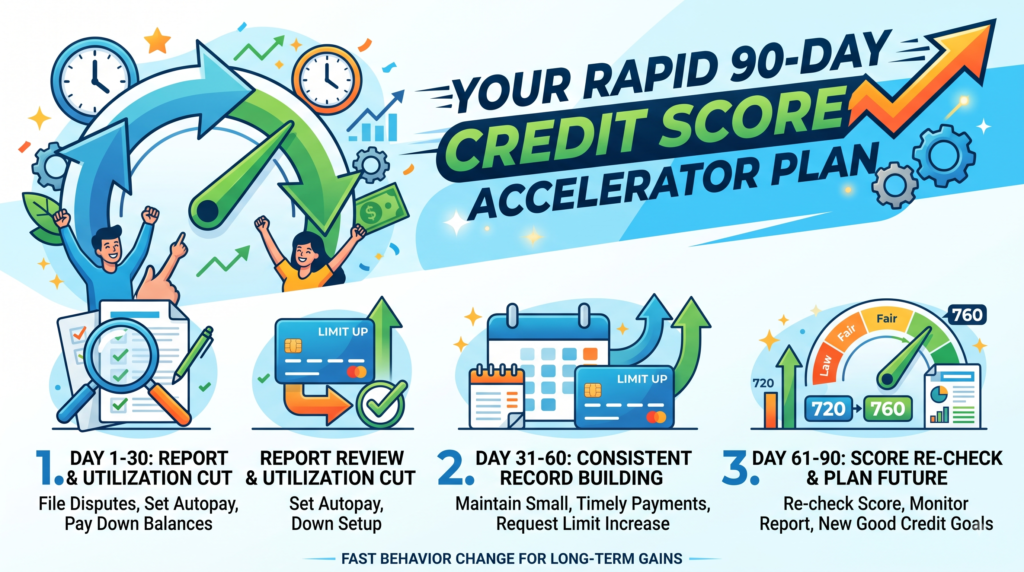
A 30-Day Plan to Improve Your Credit Score
If you want a practical starting point, use this four-week plan.
Week 1: Check Your Credit
- Obtain your credit reports.
- Review every account.
- Look for accounts you don’t recognize.
- Check payment history.
- Check balances and credit limits.
- Identify errors.
Week 2: Reduce Credit Card Balances
Focus on cards with the highest utilization.
Avoid adding new purchases while you are trying to reduce balances.
Week 3: Automate Payments
Set up autopay for at least the minimum payment on every account.
Create additional reminders for statement due dates.
Week 4: Stop Unnecessary Applications
Avoid applying for new cards or loans unless you genuinely need them.
Then continue the process every month.
How to Get Your Credit Reports for Free
Your credit report and your credit score are not the same thing.
A credit report contains information about your credit accounts and payment history.
A credit score is calculated using information from your credit report.
The CFPB recommends reviewing your credit reports regularly for inaccuracies. It also identifies AnnualCreditReport.com as the official site for obtaining free credit reports from the nationwide credit reporting companies.
AnnualCreditReport.com — Official Free Credit Reports
When reviewing your reports, check:
- Personal information
- Credit accounts
- Account ownership
- Payment history
- Balances
- Credit limits
- Collections
- Public records
- Recent inquiries
Don’t assume that information appearing on your report is automatically correct.
Credit Score vs. Credit Report: Why the Difference Matters
A credit report is the underlying record.
A credit score is a numerical assessment generated from information in that record using a particular scoring model.
You can therefore have:
Credit report: information about your accounts and payment history
Credit score: a number generated from some of that information
Different scoring models can produce different scores from the same underlying report.
That’s why it is normal to see different credit scores from different sources.
The CFPB explains that credit scores can vary and that lenders may use different scoring models depending on the type of credit being evaluated.
Credit Repair Companies: What You Need to Know
Be careful with companies promising an immediate dramatic increase in your credit score.
A legitimate company cannot simply erase accurate negative information because you paid it a fee.
The CFPB explicitly warns that no company can legally remove accurate, negative information from your credit report.
Be cautious if a company:
- Guarantees a specific score increase
- Promises to remove all negative information
- Tells you to dispute accurate information
- Requests large upfront fees
- Tells you to create a new identity
- Claims it has a secret relationship with credit bureaus
You can dispute inaccurate information yourself.
If you need help with debt or budgeting, consider a reputable nonprofit credit counseling organization rather than paying a company for unrealistic promises.
What Does Not Improve Your Credit Score?
Some financial activities are useful but don’t necessarily build credit.
The CFPB notes that the following generally do not establish a credit history by themselves:
- Paying with cash
- Using a debit card
- Using a prepaid card
That doesn’t make these payment methods bad.
It simply means you should not expect them to build your traditional credit history.
Common Credit Score Myths
Myth 1: Carrying a balance improves your score
Reality: You don’t need to pay credit-card interest to build credit.
Myth 2: Checking your own credit report hurts your score
Reality: Checking your own credit report does not hurt your credit score.
Myth 3: Closing every credit card is good
Reality: Closing accounts can sometimes increase utilization and hurt your score.
Myth 4: You need every type of loan
Reality: You don’t need a mortgage, auto loan, and personal loan simply to create a credit mix.
Myth 5: A credit repair company can erase anything
Reality: Accurate negative information cannot simply be legally removed because you paid a company.
Myth 6: A perfect score is necessary
Reality: You don’t need a perfect credit score to qualify for many financial products.
How to Maintain a Good Credit Score After Improving It
Improving your credit score is only half the job.
Maintaining it requires consistent habits.
Keep paying on time
Payment history remains fundamental.
Keep balances manageable
Avoid allowing credit cards to become heavily utilized.
Apply selectively
Only open accounts when they serve a genuine purpose.
Monitor your reports
Review your credit reports regularly for unexpected changes or errors.
Keep debt affordable
Don’t take on payments that strain your monthly budget.
Maintain financial reserves
Savings can help prevent emergencies from becoming credit problems.
Reliable Sources for Credit Score Information
Credit scoring is a financial topic where misinformation can be expensive.
For authoritative consumer guidance, the Consumer Financial Protection Bureau (CFPB) provides resources explaining credit reports, credit scores, disputes, rebuilding credit, and credit-repair scams.
CFPB — Credit Reports and Scores
For information about the FICO scoring model, myFICO — How FICO Scores Are Calculated provides an explanation of the major scoring categories and their general weighting.
These sources are particularly useful because credit scoring is not a single universal formula. A strategy that affects one scoring model may not produce the exact same result under another.
Final Thoughts: How to Improve Your Credit Score Fast
If you want to improve your credit score fast, focus on the actions that are both legitimate and financially sensible.
Start by checking your credit reports.
Then identify the biggest problems.
If your utilization is high, work on reducing your credit-card balances.
If you have missed payments, get current and make every future payment on time.
If your report contains inaccurate information, dispute it with the appropriate parties.
Avoid unnecessary new credit applications, and don’t close accounts simply because you no longer use them without considering the effect on your overall credit profile.
Most importantly, don’t fall for promises of instant credit repair.
There is no legitimate secret that can erase accurate negative information overnight.
The fastest sustainable credit improvement usually comes from fixing the biggest problems first and then consistently demonstrating responsible credit behavior.
A higher credit score can make it easier to qualify for credit and potentially help you receive better borrowing terms, but the real goal should be broader: building a financial profile that allows you to borrow responsibly when you actually need to.
Frequently Asked Questions About Improving Your Credit Score
1. How can I improve my credit score fast?
Start by paying every bill on time, reducing high credit-card balances, checking your credit reports for errors, and avoiding unnecessary new credit applications.
2. Can I raise my credit score in 30 days?
Possibly, but there is no guaranteed increase. Paying down high credit-card balances or correcting inaccurate information may produce changes after updated information is reported.
3. Does paying off a credit card improve your credit score?
It can help by reducing your credit utilization, although the exact effect depends on your complete credit profile and the scoring model used.
4. What is the fastest way to lower credit utilization?
Pay down revolving credit balances and avoid adding new charges. You can also ask whether a credit-limit increase is available, although the issuer may conduct a credit inquiry.
5. Is 30% credit utilization a good target?
Keeping utilization below 30% is a commonly cited guideline, but lower utilization can generally be better for scoring. There is no universal percentage that guarantees a particular score.
6. Does carrying a credit card balance improve credit?
No. You do not need to carry a balance or pay interest to build good credit. Paying the balance in full each month can help you manage utilization and avoid interest charges.
7. Does paying bills on time improve credit?
Yes. Consistent on-time payments are one of the most important factors in credit scoring.
8. Can a late payment lower my credit score?
Yes. A reported late payment can negatively affect your credit score, particularly depending on how recent, severe, and frequent the late payment is.
9. How long does a late payment stay on a credit report?
A late payment can generally remain on a credit report for up to seven years, although its impact on scoring can decrease as it becomes older.
10. Should I close an old credit card?
Not necessarily. Closing an account can reduce your available credit and potentially increase your utilization. Consider the account’s fees and its effect on your overall credit profile before closing it.
11. Does checking my own credit report hurt my score?
No. Requesting and reviewing your own credit report does not hurt your credit score.
12. Where can I get my credit reports for free?
You can obtain your official free credit reports through AnnualCreditReport.com.
13. How often should I check my credit report?
You should review your credit reports regularly. The CFPB recommends checking them at least once a year for errors, and consumers may have access to more frequent report availability depending on current programs.
14. Can disputing a credit report error increase my score?
It can if the dispute results in inaccurate negative information being corrected or removed. However, there is no guaranteed score increase from filing a dispute.
15. Does opening a new credit card improve your credit score?
A new credit card can affect your credit profile in several ways. It may increase available credit, but the application can create a hard inquiry and the new account can affect account age. Don’t open an account solely for a score increase.
16. Can becoming an authorized user improve credit?
It can in some situations, particularly when the primary account has a long, positive history and low utilization and the issuer reports the account to the credit bureaus. Results vary by scoring model and individual profile.
17. Does a secured credit card help build credit?
It can. Secured cards are designed to help some consumers establish or rebuild credit, provided the issuer reports account activity to the credit reporting companies.
18. Should I take out a loan to improve my credit mix?
Generally, you should not borrow money you don’t need simply to improve your credit mix. Credit mix is only one component of a FICO Score and is less influential than payment history and amounts owed.
19. Can a credit repair company quickly fix my credit?
Be skeptical of companies promising rapid guaranteed results. Accurate negative information generally cannot legally be removed simply because you pay a credit-repair company.
20. How long does it take to rebuild bad credit?
It depends on the cause and severity of the credit problems. Reducing high utilization may affect your score relatively quickly after reporting, while recovering from serious negative events requires consistent positive payment history over time.
21. Does paying a collection account improve your credit score?
The effect depends on the scoring model, the account, and how the collection is reported. Paying a collection does not necessarily produce an immediate or specific score increase.
22. Does income affect my credit score?
Income itself is generally not part of a traditional credit score calculation. However, lenders may consider income separately when deciding whether to approve you for credit.
23. What credit score should I aim for?
There is no single score that everyone needs. A stronger score can generally improve access to credit and borrowing terms, but lender requirements vary by product and applicant.
24. Can I improve my credit without paying a credit repair company?
Yes. You can monitor your reports, dispute inaccurate information, pay bills on time, reduce revolving balances, and avoid unnecessary credit applications yourself.
25. What is the most important thing for improving credit?
Consistent on-time payments are one of the most important factors. FICO identifies payment history as the largest category in its standard scoring framework.
Editorial and E-E-A-T Note
Last Updated: August 2026
Credit scores and credit-reporting practices can change, and different lenders may use different scoring models. This article is for general educational purposes and does not guarantee a specific credit-score increase.
The guidance above is based primarily on consumer information from the Consumer Financial Protection Bureau (CFPB) and FICO. Readers should use official sources and their own credit reports when making financial decisions.