Buying a vehicle is one of the largest financial decisions many people make, and for most buyers, financing plays a significant role in the purchase. While shoppers often focus on the monthly payment or the vehicle’s price, one of the most important factors affecting the total cost of ownership is the auto loan interest rate.
A seemingly small difference in interest rates can translate into hundreds or even thousands of dollars over the life of a loan. Understanding how lenders calculate interest rates, what influences the rate you receive, and how to improve your eligibility can help you make a smarter borrowing decision.
This guide explains auto loan interest rates in simple terms, explores the factors that affect them, and shares practical strategies to help you secure the most competitive financing available.
What Is an Auto Loan Interest Rate?
An auto loan interest rate is the percentage a lender charges for borrowing money to purchase a vehicle. It represents the cost of financing and is added to the amount you repay over the loan term.
When you borrow money for a car, you repay:
- The original loan amount (principal)
- Interest charged by the lender
The interest rate directly affects your monthly payment and the total amount you’ll pay over the life of the loan.
How Auto Loan Interest Rates Work
Interest is calculated based on the remaining balance of your loan. Each monthly payment typically includes two parts:
- Principal repayment
- Interest payment
During the early months of the loan, a larger portion of your payment usually goes toward interest. As your balance decreases, more of each payment goes toward reducing the principal.
Understanding this repayment structure helps explain why making extra payments early in the loan term can reduce the total interest paid.
Fixed vs Variable Interest Rates
Before choosing a car loan, it’s important to understand the two primary types of interest rates.
Fixed Interest Rates
A fixed interest rate remains the same throughout the loan term.
Advantages
- Predictable monthly payments
- Easier budgeting
- Protection from rising market interest rates
Because the payment doesn’t change, fixed-rate loans are the most common choice for vehicle financing.
Variable Interest Rates
Variable interest rates may increase or decrease over time based on market conditions or a financial benchmark.
Advantages
- Lower starting rates in some cases
- Potential savings if market rates decline
Disadvantages
- Monthly payments may increase
- Greater uncertainty for long-term budgeting
Borrowers who value payment stability often prefer fixed-rate loans.
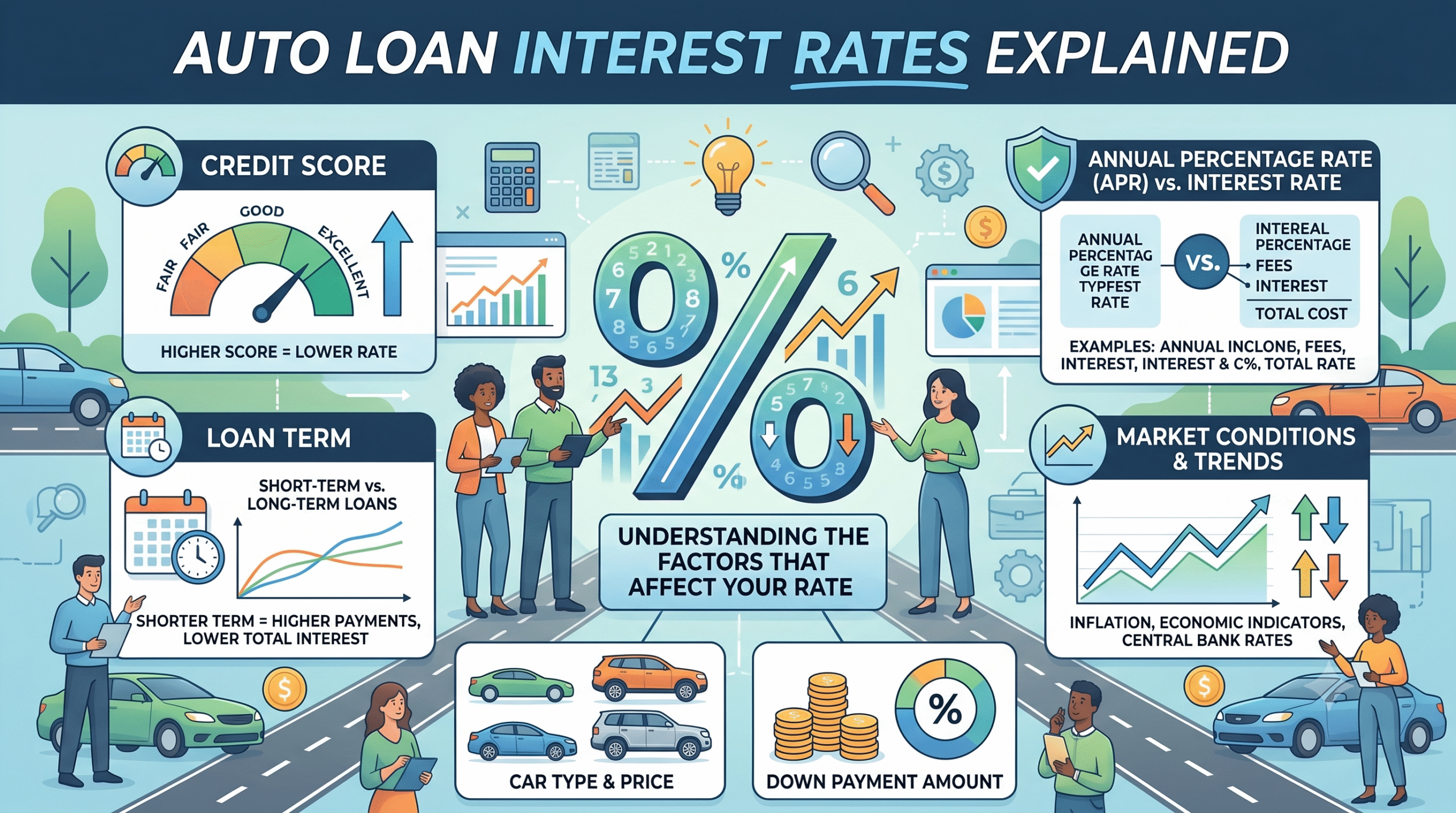
Factors That Affect Auto Loan Interest Rates
Lenders evaluate multiple factors before determining the interest rate you’ll receive.
Credit Score
Your credit score is one of the most influential factors.
Borrowers with stronger credit profiles often qualify for:
- Lower interest rates
- Better loan terms
- Higher approval chances
A history of on-time payments and responsible credit use can improve your borrowing profile.
Loan Term
The length of your loan affects the interest rate and total borrowing cost.
Common loan terms include:
- 36 months
- 48 months
- 60 months
- 72 months
- 84 months
Longer loan terms usually reduce monthly payments but may result in paying more total interest over time.
Down Payment
A larger down payment reduces the amount you need to borrow.
Lower loan amounts generally reduce lender risk and may improve financing terms.
Additionally, a substantial down payment may help prevent negative equity, where the loan balance exceeds the vehicle’s value.
New vs Used Vehicle
Interest rates often differ depending on whether you’re purchasing a new or used vehicle.
New vehicles sometimes qualify for lower financing rates because they generally retain value better and present lower lending risk.
Used vehicle financing may involve slightly higher rates due to depreciation and vehicle age.
Income and Employment
Lenders assess your ability to repay the loan by reviewing:
- Income stability
- Employment history
- Debt obligations
Stable income improves confidence in your ability to make consistent monthly payments.
Debt-to-Income Ratio
Your debt-to-income (DTI) ratio compares your monthly debt payments with your gross monthly income.
Lower DTI ratios generally indicate greater financial capacity to handle additional debt.
Why Interest Rates Matter
Many buyers focus only on monthly payments.
However, interest rates have a significant effect on the total cost of financing.
For example:
- Lower rates reduce total borrowing costs.
- Higher rates increase the amount paid over the loan’s lifetime.
Even a modest reduction in the interest rate can produce meaningful long-term savings.
Annual Percentage Rate (APR) vs Interest Rate
Many borrowers confuse APR with the interest rate.
Although they’re related, they are not identical.
Interest Rate
Represents the cost of borrowing money.
Annual Percentage Rate (APR)
Includes the interest rate plus certain lender fees and financing costs, providing a broader picture of the loan’s overall cost.
Comparing APRs often provides a more accurate way to evaluate loan offers than comparing interest rates alone.
How to Qualify for Lower Auto Loan Interest Rates
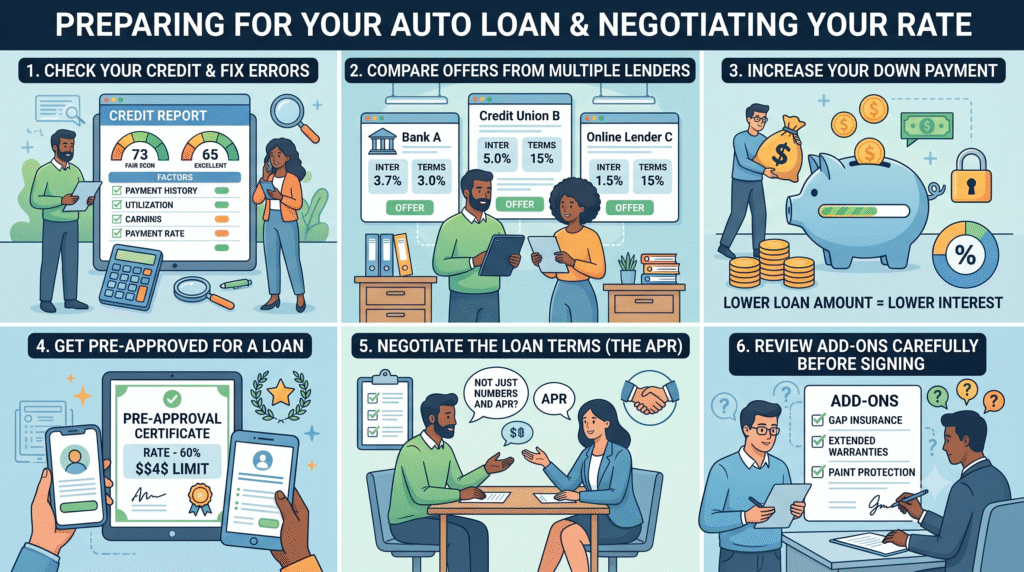
Improving your financial profile before applying can increase your chances of receiving better financing.
Improve Your Credit Score
Responsible credit habits include:
- Paying bills on time
- Reducing outstanding debt
- Keeping credit utilization low
- Correcting errors on your credit report
Even modest improvements may help qualify for better loan terms.
Save for a Larger Down Payment
The more you pay upfront, the less you need to finance.
A lower loan balance often improves lender confidence and reduces interest costs.
Compare Multiple Lenders
Interest rates vary between:
- Banks
- Credit unions
- Online lenders
- Vehicle dealerships
Comparing multiple offers can help you identify the most competitive financing.
Get Pre-Approved
Loan pre-approval provides several benefits:
- Better budgeting
- Stronger negotiating position
- Clear understanding of borrowing capacity
Pre-approval also allows you to compare financing options before visiting a dealership.
Common Mistakes When Financing a Vehicle
Avoiding these mistakes can save significant money.
Shopping Based Only on Monthly Payments
Lower monthly payments may simply result from extending the loan term.
Always consider the total cost of financing.
Ignoring the APR
Some promotional offers advertise attractive interest rates while including higher fees.
Comparing APR provides a more complete picture.
Skipping Loan Comparisons
Accepting the first financing offer may result in paying more than necessary.
Financing for Too Long
Long loan terms increase total interest costs and may leave borrowers owing more than the vehicle’s value.
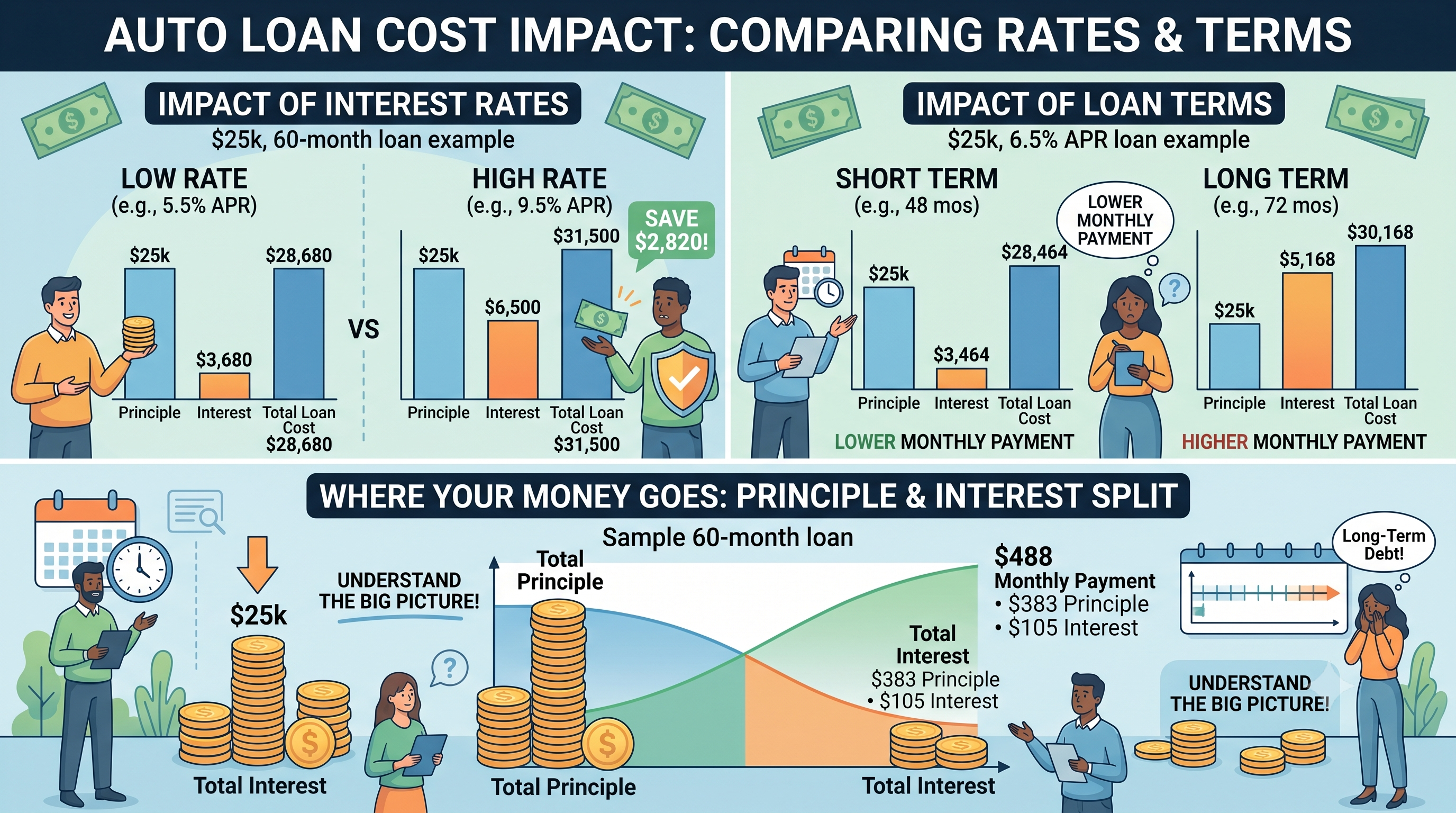
Fixed-Term Loan Example
Consider two borrowers financing identical vehicles.
One chooses a shorter loan with higher monthly payments but lower total interest.
The other selects a longer repayment period with smaller monthly payments but significantly higher total borrowing costs.
This example illustrates why choosing the longest available term isn’t always the most economical option.
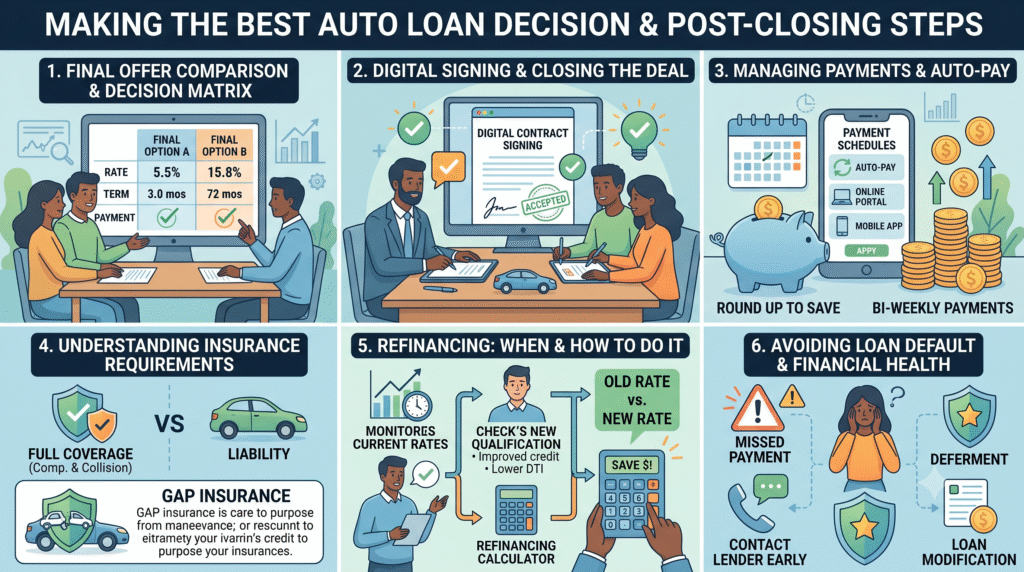
Should You Refinance an Auto Loan?
Refinancing may be worth considering if:
- Your credit score has improved.
- Market interest rates have declined.
- You qualify for a lower APR.
- You want to reduce monthly payments.
However, refinancing isn’t always beneficial. Compare total costs, fees, and remaining loan balance before making a decision.
Expert Tips for Getting the Best Auto Loan
After reviewing auto financing practices across banks, credit unions, and online lenders, one strategy consistently stands out: preparation saves money.
Before shopping for a vehicle, check your credit report, estimate a comfortable monthly payment, and obtain financing quotes from multiple lenders. Walking into a dealership with pre-approved financing often gives you greater negotiating power and helps you focus on the vehicle price rather than financing alone.
It’s also important to avoid borrowing more than the car is worth. Vehicles typically depreciate over time, and financing a larger amount with a longer loan term can increase the risk of owing more than the vehicle’s market value.
Finally, don’t overlook the total loan cost. While a lower monthly payment may appear attractive, the combination of loan term, APR, and financing fees determines how much you’ll actually spend.
Auto Loan Interest Rates vs Personal Loan Interest Rates
| Feature | Auto Loan | Personal Loan |
|---|---|---|
| Collateral | Vehicle serves as collateral | Usually unsecured |
| Interest Rate | Often lower | Often higher |
| Loan Purpose | Vehicle purchase | General expenses |
| Loan Amount | Based on vehicle value | Based on lender approval |
| Repayment Terms | Fixed monthly payments | Fixed or variable |
Because auto loans are typically secured by the vehicle, lenders often offer lower interest rates than unsecured personal loans.
Is an Auto Loan Right for You?
An auto loan can make vehicle ownership more affordable by allowing you to spread payments over several years. However, borrowing should fit comfortably within your budget.
Before signing any loan agreement, compare lenders, review the APR, understand all fees, and ensure the monthly payment aligns with your financial goals.
Responsible borrowing not only reduces financing costs but also helps maintain a healthy credit profile for future borrowing opportunities.
For more information about vehicle financing and consumer borrowing, visit the Consumer Financial Protection Bureau at https://www.consumerfinance.gov/ or read the Wikipedia article on auto finance at https://en.wikipedia.org/wiki/Vehicle_financing. These trusted resources provide additional guidance on loan terminology, consumer rights, and financing options.
Frequently Asked Questions (FAQ)
What is an auto loan interest rate?
Short answer: It’s the cost of borrowing money to purchase a vehicle.
The lender charges interest as a percentage of the loan amount, which is added to your repayment over time.
What affects my auto loan interest rate?
Short answer: Several factors.
Lenders commonly evaluate your credit score, income, loan term, down payment, debt-to-income ratio, and whether you’re buying a new or used vehicle.
Is a lower interest rate always better?
Short answer: Generally, yes.
Lower interest rates reduce the total amount paid over the life of the loan, provided other loan terms remain similar.
What is the difference between APR and interest rate?
Short answer: APR includes additional financing costs.
While the interest rate reflects borrowing costs, APR also incorporates certain lender fees, making it a better comparison tool.
Can I refinance my auto loan later?
Short answer: Yes.
Many borrowers refinance if they qualify for a lower interest rate or improved loan terms.
Does a larger down payment reduce interest costs?
Short answer: Usually.
A larger down payment reduces the amount borrowed and may help you qualify for more favorable financing.
Should I choose the longest loan term?
Short answer: Not necessarily.
Longer terms reduce monthly payments but often increase the total interest paid over the life of the loan.
How can I get the best auto loan interest rate?
Short answer: Prepare before applying.
Improve your credit score, compare multiple lenders, save for a larger down payment, and consider getting pre-approved.
Final Thoughts
Understanding auto loan interest rates explained is essential before financing a vehicle. Interest rates influence far more than your monthly payment—they determine the total cost of ownership over the life of the loan.
By improving your credit profile, comparing lenders, choosing a reasonable loan term, and focusing on APR rather than monthly payments alone, you can make informed borrowing decisions that save money and support your long-term financial well-being.