Managing your money starts with choosing the right bank account. While both checking and savings accounts are essential financial tools, they serve different purposes. Understanding the differences can help you make smarter financial decisions, avoid unnecessary fees, and maximize your savings.
If you’ve ever wondered whether you need a checking account, a savings account, or both, this guide explains everything you need to know. We’ll compare their features, advantages, drawbacks, and ideal use cases so you can confidently choose the right account for your financial needs.
What Is a Checking Account?
A checking account is designed for everyday financial transactions. It provides easy access to your money whenever you need it.
Most checking accounts include:
- Debit card
- Online and mobile banking
- Direct deposit
- Bill payment services
- ATM access
- Check-writing capability
Because checking accounts are built for frequent use, they generally pay little or no interest.
Benefits of a Checking Account
A checking account offers convenience for managing daily finances.
Easy Access to Money
Withdraw cash, make purchases, transfer funds, or pay bills anytime.
Direct Deposit
Employers can deposit your salary directly into your account, eliminating paper checks.
Digital Banking
Most banks provide mobile apps for transfers, bill payments, budgeting, and account monitoring.
Unlimited Transactions
Unlike savings accounts, checking accounts usually allow unlimited withdrawals and purchases.
What Is a Savings Account?
A savings account helps you store money securely while earning interest over time.
Unlike checking accounts, savings accounts are intended for money you don’t need every day.
Typical uses include:
- Emergency funds
- Vacation savings
- Home down payment
- Education expenses
- Future investments
Savings accounts encourage disciplined saving while keeping your money accessible when needed.

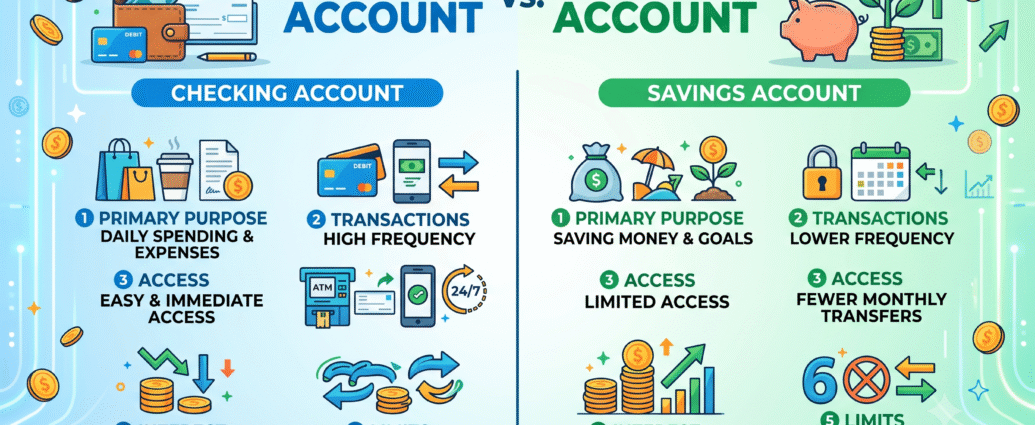
Checking Account vs Savings Account: Key Differences
| Feature | Checking Account | Savings Account |
|---|---|---|
| Primary Purpose | Daily spending | Saving money |
| Debit Card | Yes | Usually available but limited |
| Check Writing | Yes | Rarely |
| Interest Earnings | Low or none | Higher interest |
| Withdrawals | Unlimited | May be limited depending on bank |
| Bill Payments | Yes | Limited |
| Direct Deposit | Yes | Sometimes |
| Best For | Monthly expenses | Long-term savings |
When Should You Choose a Checking Account?
A checking account is ideal if you:
- Receive a monthly salary
- Pay bills regularly
- Shop frequently
- Need ATM withdrawals
- Use online payments often
For daily money management, a checking account offers maximum flexibility.
When Should You Choose a Savings Account?
A savings account is better if your goal is to:
- Build an emergency fund
- Save for future purchases
- Earn interest on unused money
- Separate spending money from savings
Keeping savings in a separate account also reduces unnecessary spending.
Can You Have Both Accounts?
Absolutely.
Financial experts often recommend using both accounts together.
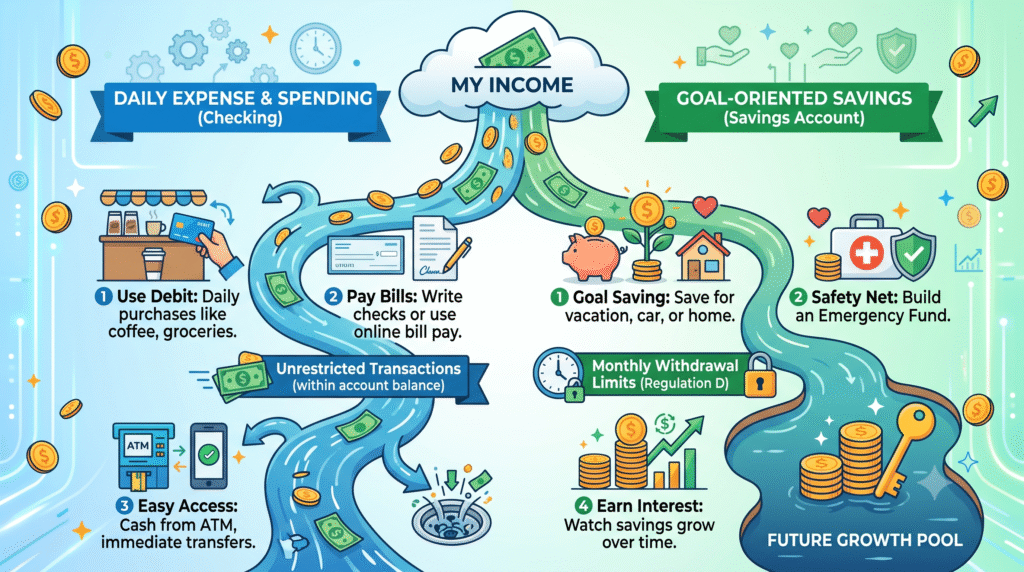
A practical approach is:
- Deposit your salary into your checking account.
- Pay monthly bills and everyday expenses from checking.
- Automatically transfer a portion of your income into savings every month.
This strategy creates a healthy balance between spending and saving.
Interest Rates: Which Account Earns More?
Savings accounts generally offer significantly higher interest than checking accounts.
Some online banks provide competitive high-yield savings accounts that help your money grow faster than traditional accounts.
Checking accounts prioritize accessibility rather than investment returns.
Fees to Watch For
Before opening either account, review the fee structure carefully.
Common fees include:
Monthly Maintenance Fees
Some banks charge monthly service fees unless certain requirements are met.
ATM Fees
Using out-of-network ATMs may result in additional charges.
Overdraft Fees
Checking accounts may charge fees if you spend more than your available balance.
Minimum Balance Requirements
Some accounts require maintaining a minimum balance to avoid monthly charges.
Choosing accounts with low or no fees can improve your overall financial health.
Security Features
Both checking and savings accounts typically provide strong security features such as:
- FDIC or NCUA insurance (where applicable)
- Fraud monitoring
- Multi-factor authentication
- Mobile alerts
- Debit card controls
- Secure online banking
These protections help safeguard your money against unauthorized access.
Advantages of a Checking Account
- Convenient for daily spending
- Unlimited transactions
- Easy online payments
- Direct deposit support
- Widely accepted debit cards
- Fast money transfers
Potential Drawbacks
- Lower interest earnings
- Possible overdraft fees
- Monthly maintenance charges at some banks
Advantages of a Savings Account
- Earns interest
- Encourages disciplined saving
- Ideal for emergency funds
- Safe place for long-term goals
- Lower spending temptation
Potential Drawbacks
- Not designed for everyday spending
- Withdrawal limitations may apply
- Limited payment features
How to Decide Which Account Is Right for You
Ask yourself these questions:
Do you spend money every day?
Choose a checking account.
Are you building an emergency fund?
Choose a savings account.
Want the best financial setup?
Use both.
Separating spending and savings helps improve budgeting while allowing your savings to grow consistently.
Common Mistakes to Avoid
Many people make avoidable banking mistakes.
Keeping All Money in Checking
This makes it easier to overspend.
Ignoring Interest Rates
A higher-yield savings account can significantly increase your earnings over time.
Not Comparing Banks
Different banks offer varying fees, features, and interest rates.
Forgetting Automatic Savings
Automatic monthly transfers help build savings without extra effort.
Expert Tips
- Keep one to three months of expenses in an accessible emergency savings account.
- Review account fees annually.
- Enable account alerts to monitor activity.
- Set up automatic transfers on payday.
- Compare online banks before opening a new account.
These habits help strengthen your financial foundation while reducing unnecessary banking costs.
Final Thoughts
Understanding the difference between a checking account vs savings account is one of the most important steps toward effective money management.
A checking account provides convenience for daily transactions, while a savings account helps you build financial security by earning interest and encouraging long-term saving.
For most people, the best strategy isn’t choosing one over the other—it’s using both together. This approach simplifies budgeting, improves cash flow, and helps you achieve both short-term and long-term financial goals.
For more detailed information about banking products and consumer protections, visit the Consumer Financial Protection Bureau and learn more about bank accounts on Wikipedia:
Frequently Asked Questions
Is a checking account better than a savings account?
Short answer: No, they serve different purposes.
A checking account is best for daily transactions, while a savings account is designed to store money and earn interest.
Can I use a savings account like a checking account?
Short answer: Not effectively.
Savings accounts are intended for saving rather than frequent spending and may have transaction limitations depending on the bank.
Which account earns more interest?
Short answer: A savings account.
Savings accounts generally offer higher interest rates than checking accounts.
Should I have both checking and savings accounts?
Short answer: Yes.
Using both accounts helps separate spending from saving and improves financial organization.
Is my money safe in both accounts?
Short answer: Yes.
Deposits are typically protected by government-backed insurance (where applicable) up to eligible limits, and banks use multiple security measures to protect customer accounts.